Rubbing a Tibetan singing bowl creates sound and a spray of droplets inside the container. But the reverse works, too! Instead of rubbing the bowl, one can project sound at it to make the droplets dance. In the video above, the speaker plays a sinusoidal wave at a frequency that resonates with the bowl. It activates the most basic vibrations in the bowl, making it bulge slightly front-to-back and then side-to-side. This is called the fundamental vibrational mode. The bowl doesn’t change shape enough to see by eye, but you can tell where the bowl is flexing the most – at the four points where the droplets are ejected! The larger vibrations there are what create the spray of droplets. (Video credit: D. Terwagne)
Tag: vibration

Growing Droplets on a Trampoline

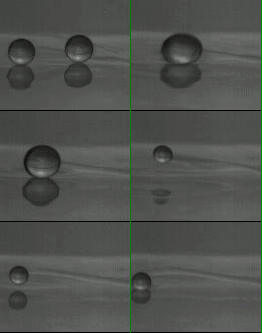
Droplets on a liquid surface will typically coalesce, thanks to gravity and the low viscosity of the air layer between them and the pool. In certain cases, droplets will partially coalesce, producing smaller and smaller droplets until they finally coalesce completely. Vibrating the liquid surface can help prevent this coalescence but only when droplets are small.
In fact, if the pool is more viscous than the droplets, bouncing can be used to produce droplets of a desired size, as shown above. Because the droplets are less viscous, they deform more than the pool does – behaving somewhat like a bouncy ball hitting a rigid wall. In this system, large droplets are unstable and will undergo partial coalescence until they are small enough to bounce stably. The size of stable drops is determined by the frequency and acceleration of the bouncing bath; by tuning these parameters, researchers can select what size droplets they want to end up with. (Research credit: T. Gilet et al.; images and submission by N. Vandewalle)

Avoiding Coalescence
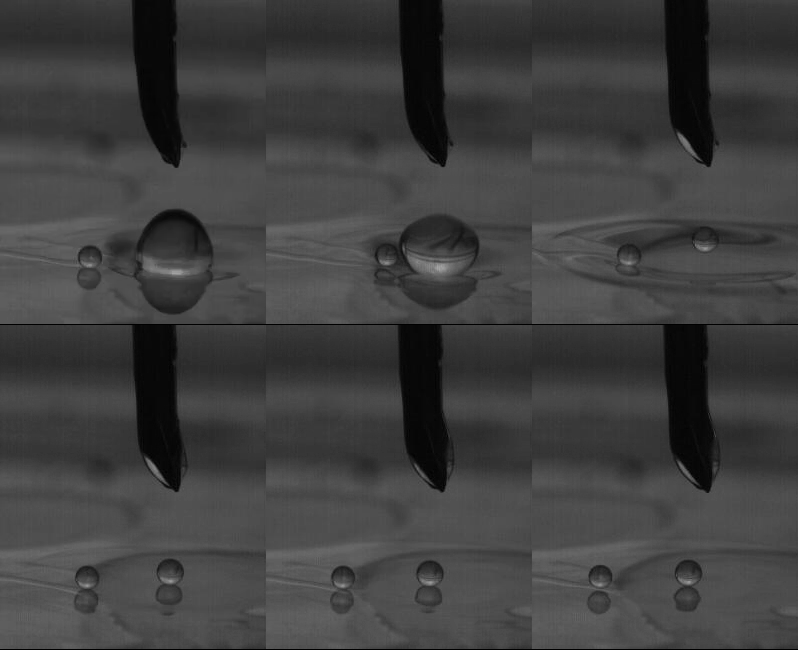
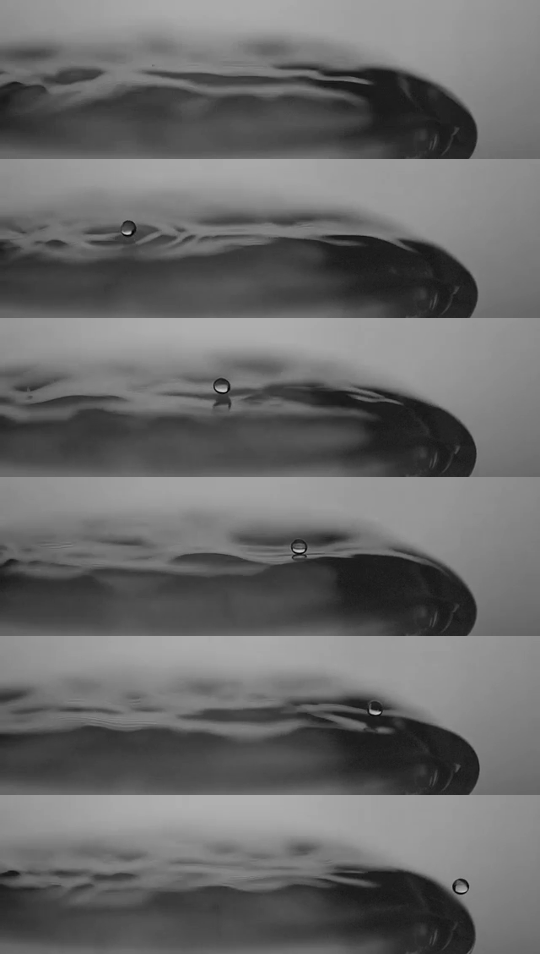
Droplets hitting a liquid surface don’t always coalesce. Above you can see a tiny droplet bounce and skate along the surface of a larger, vibrating drop. The smaller droplet doesn’t coalesce because a tiny layer of air sits between it and the vibrating drop. To actually contact and coalesce, the droplet has to sit still long enough for that air layer to get squeezed out. Instead, the vibration of the larger drop bounces it upwards, refreshing the air layer and scooting the droplet along until it falls off the vibrating drop. (Image credit: C. Kalelkar and S. Phansalkar, source)

Inside Singing
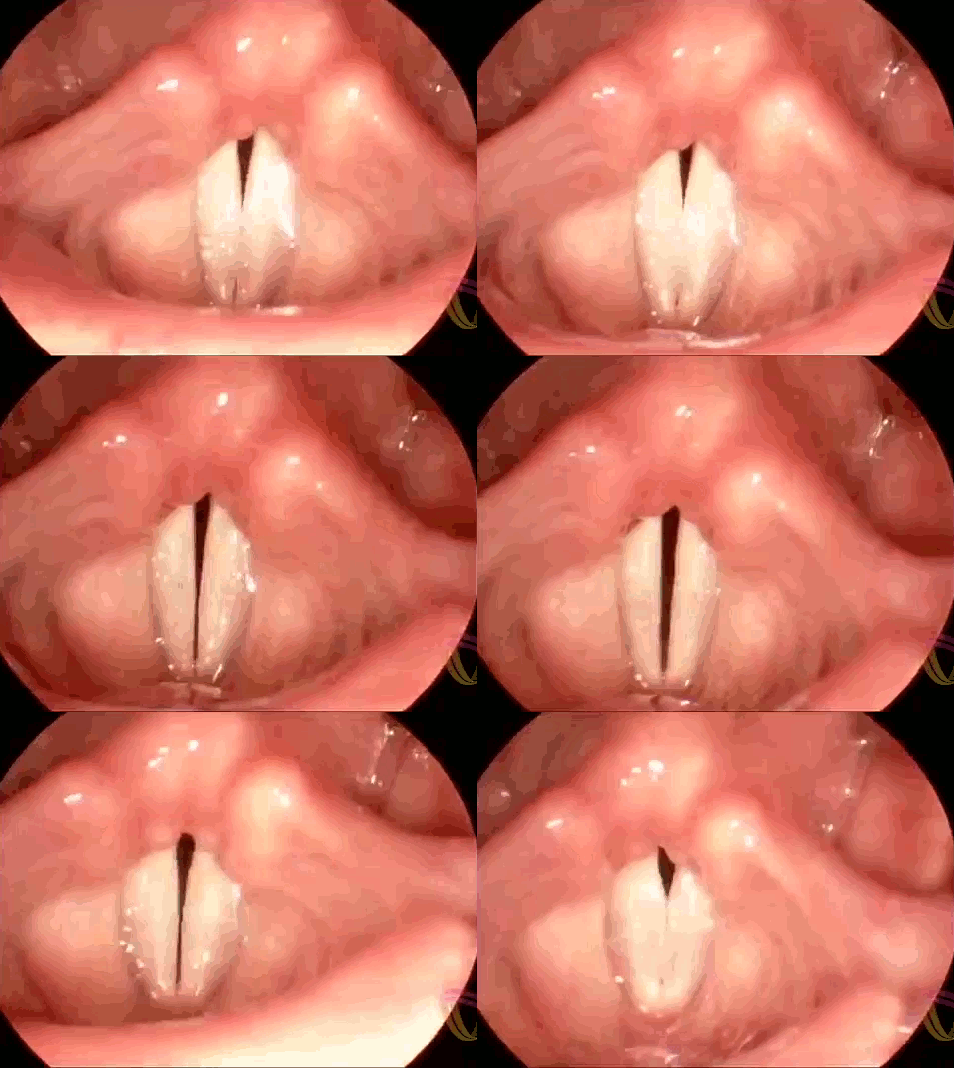
These are the vocal folds of a woman singing. Human speech (and song) results from interactions between elastic muscles and aerodynamics. As we exhale, the vocal folds are initially pushed apart, then the flow of air moving past creates low pressure (via the Bernoulli effect) that helps pull the folds together. As the folds close, high pressure again forms to force them open. This sets a cycle of oscillation or vibration that produces sound. To change the pitch of the sounds we create, we can lengthen or shorten the vocal folds or change their tension. In this respect, they behave somewhat similarly to the strings of a musical instrument. If you’d like to admire more vocal folds in action, check out this endoscopic video for four singers performing together. (Image credit: LinguaHealth, source)

Vibrated to Bits
Sound and vibration can be powerful tools for controlling liquids. In this animation, a water/glycerin drop violently bursts into a cloud of droplets when it is vibrated vertically 1000 times per second by a piezoelectric actuator. This vibration shakes the drop with accelerations of 150 g. Initially, the amplitude is small enough to simply create ripples around the drop’s circumference. As it increases, the drop deforms more at the edges and starts to eject droplets there. When the vibration hits a critical amplitude, the entire drop explodes into droplets. The technique is called vibration-induced droplet bursting, and its near-instantaneous ability to atomize drops makes it a candidate for applications like spray cooling microprocessors or spray coating a solid surface. (Video credit: B. Vukasinovic, source)

Crowns On Impact


Dropping a partially-filled test tube of water against a table makes the meniscus at the air-water interface invert into a jet of liquid. In some cases, the impact is strong enough to generate splashing crowns of water around the base of the jet. These crowns come in two forms – one with many splashes layered upon one another and the other with only a few splashes and a faster jet.
The many-layered splash crowns come from the pressure wave that reflects back and forth from the bottom of the tube to the surface and back. This pressure wave moves at the speed of sound and vibrates the water surface, creating the many splashes. The same reflected pressure wave occurs in the second type of splash crown, but it gets disrupted by cavitation bubbles that form in the water (visible in the lower left image). Instead the splash crowns form from the shock waves generated when the cavitation bubbles collapse. (Image credits: A. Kiyama et al.)

Resonating with the Windows Down
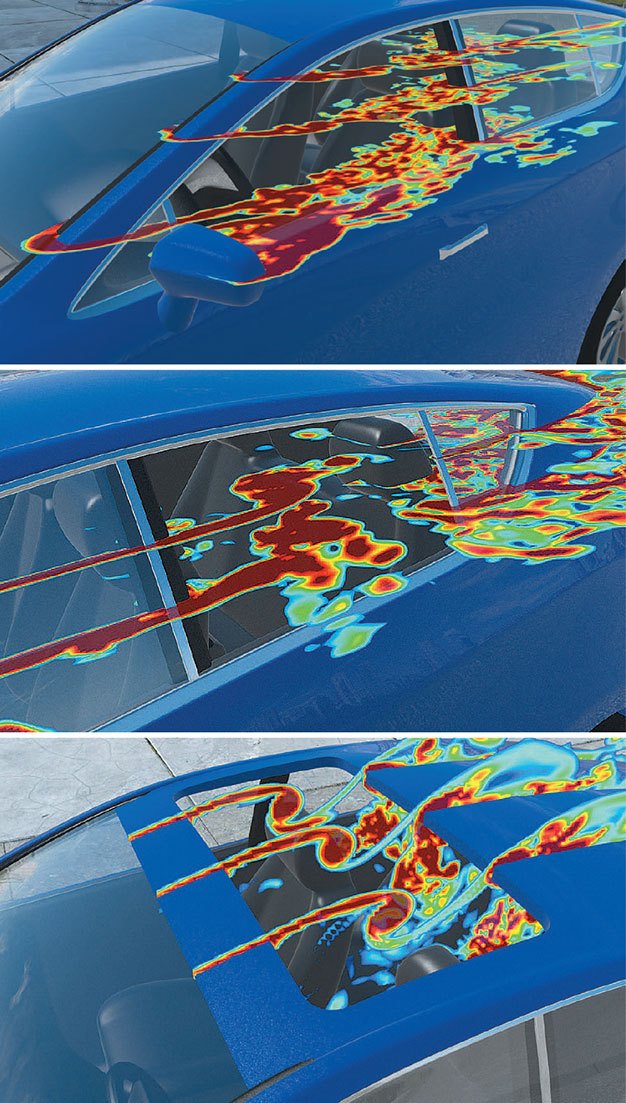
Ever roll down your window a bit while driving and immediately hear a terrible, rhythmic noise? That awful whum-whum-whum is–oddly enough–an example of the same physics that allows you to make an open bottle whistle by blowing over it. Fluid dynamicists call it Helmholtz resonance. Air flowing over the bottle neck or around the car makes the air inside the container vibrate with a frequency that depends on the bottle or car’s characteristics. That vibration generates noise that we hear as a hum or whistle for a bottle or a lower frequency whum-whum for a car window.
The images above show flow past different open windows on a car. Air flow remains relatively steady past the side-view mirror and front window of a modern car, so the noise from opening the front window is not usually too bad. But flow separation and reconnection near the rear window of a car creates very unsteady airflow there which exacerbates this resonance issue. This is why lowering the rear window usually causes more noise. Fortunately, the solution is relatively simple: open more than one window and it disrupts the resonance! (Image credit: Car and Driver; submitted by Simon H.)

Buzzing Straws
Many woodwind instruments owe their sound to the vibration caused when air moves past parts of them. As Nick Moore demonstrates in this video, you can create a simple version of this effect with a slit drinking straw. The buzzing the straw produces when air passes through is a sort of aeroelasticity – it’s a combination of aerodynamic and structural forces that drive the behavior. Low pressure created by the fast-moving flow tends to draw the straw together, but once flow is stopped, the elasticity of the straw makes it rebound open, allowing air to flow again. Even more elaborate vibrations are possible when the straw is elastic. (Video credit: N. Moore)
Bouncing Droplets
Droplets bouncing on a pool form a beautiful and fascinating system, as recently featured by Physics Girl, Veritasium, and Smarter Every Day. The Lutetium Project – a consortium of French physics, graphic design, and music students – have their own take on the subject with beautiful short videos constructed from experimental research footage. With simple text explanations and lovely original music, they combine science, art, and outreach brilliantly. Also check out their quantum walker video and be sure to subscribe to their channel (in English or French) for more! (Video credit: The Lutetium Project; submitted by @g_durey)
Avoiding Coalescence
If you watch closely as you go about your day, you may notice drops of water sometimes bounce off a pool of water instead of coalescing. Fluid dynamicists have been fascinated by this behavior since the 1800s, but it was Couder et al. who explained that these droplets can bounce indefinitely as long as the thin air layer separating the drop and pool is refreshed by vibrating the pool. In this video, Destin teams up with astronaut Don Pettit to film the phenomenon in beautiful high-speed. My favorite part of the video starts around 8:18, where Destin shows Don’s experiments with this effect in microgravity. It turns out that the cello produces just the right frequencies to create a cascade of bouncing water droplets, much like a Tibetan singing bowl turned back on itself! (Video credit: Smarter Every Day; submitted by Destin and effyeahjoebiden)