
Walking droplets – drops that bounce their way across a pool of the same liquid without coalescing – have fascinated researchers in recent years with their unusual behaviors, some of which mimic quantum phenomena. In a new experiment, researchers vibrate the pool at two frequencies simultaneously, which helps support much larger droplets, known as superwalkers. When the two driving frequencies are close to a harmonic match – like at 80 Hz and just under half that at 39.5 Hz – the droplets will walk, then come to a stop, and then begin walking again. (Image and research credit: R. Valani et al.; via APS Physics; submitted by Justin B and Kam-Yung Soh)
Tag: vibration

Guiding Particles with Chladni Patterns


During the 19th century, Ernst Chladni and Michael Faraday independently explored the patterns formed by particles of different sizes placed on a vibrating plate. Faraday found that large particles accumulated at nodes of the plate, where there was no vertical vibration, whereas smaller particles moved toward anti-nodes, where air currents caused by the large vibration amplitude lifted them up.
The situation becomes a little different if you submerge the vibrating plate in water. Then large, heavy particles gather at the anti-nodes. Drag keeps the particles on the plate, while acoustic forces and gravity conspire to move the particles horizontally toward the anti-nodes (top). Because anti-node patterns change with frequency, this actually provides a way to manipulate particle’s trajectories. The researchers demonstrated this by steering a particle through a maze (bottom) as well as by manipulating an entire swarm of beads. (Image and research credit: K. Latifi et al.; via Physics World; submitted by Kam-Yung Soh)

Granular Instabilities


Granular mixtures show surprising similarities to fluids, even though their underlying physics differ. The latest example of this is a Rayleigh-Taylor-like instability that occurs when heavy particles sit atop lighter ones. By combining vertical vibration and an upward gas flow, researchers found that the lighter particles form fingers and bubbles that seep up between the heavier grains (upper left). Visually, it looks remarkably similar to a lava lamp or other Rayleigh-Taylor-driven instability (upper right).
But the physics behind the two are distinctly different. In the fluid, buoyancy drives the instability while surface tension acts as a stabilizing force. There’s no surface tension in a granular material, though. Instead, the drag force from gas flowing upward provides the vertical impetus while friction between the grains – essentially an effective viscosity – replaces surface tension as a stabilizing influence.
The similarities don’t stop there, though. When the researchers tested a “bubble” of heavy grains suspended in lighter ones (lower left), they found that, instead of sinking, the granular bubble split in two and drifted downward on a diagonal. Eventually, those daughter bubbles also split. Again, visually, this looks a lot like what happens to a drop of ink or food coloring falling through water (lower right), but the physics aren’t the same at all.
In the fluid, the breakup happens when a falling vortex ring splits. In the granular example, gas moving upward tends to channel around the heavy grains because they’re harder to move through. Eventually, this builds up a solidified region under the bubble. When the heavy grains can’t move directly down, they split and sink through the surrounding suspended particles until they build up another jammed area and have to split again. (Image credits: granular RTI – C. McLaren et al.; RTI simulation – M. Stock; bag instability – D. Zillis; research credit: C. McLaren et al.; submitted by Kam-Yung Soh)

Vibrating in the Flow
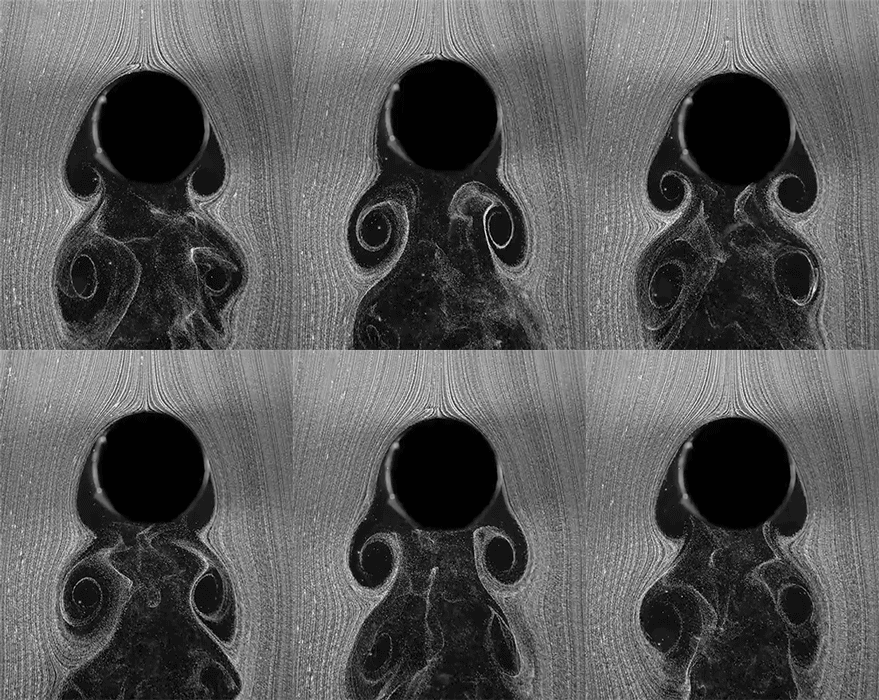

Objects can obviously affect flows, but that’s not a one-way street. Flows can also affect objects, even ones as simple a circular cylinder. If you live somewhere with traffic lights mounted to a horizontal bar, you’ve probably seen this. On a windy day, the beam holding the traffic lights will oscillate up and down. This is an example of vortex-induced vibration, a coupling between the flow structures formed by an object and the motion of the object itself. With cylinders, engineers have mostly studied a situation like the traffic light – one where the motion of the cylinder is perpendicular to the direction of the flow.
But it’s also possible to get vortex-induced vibration in the same direction as the flow. That’s what you see visualized in the images above. Notice how the oscillation of the cylinders is inline with the flow direction. As with the crossflow version of vortex-induced vibration, this inline example has several wake forms that vary based on flow conditions. (Image and research credit: T. Gurian et al.)

A Musical Splatter
High-speed video is wonderful for appreciating fluid motion in ways we can’t on our own. In this video from Warped Perception, we see what happens when a vibrating tuning fork is lowered into water. The tines of the tuning fork create a spray of tiny droplets, reminiscent of what happens in ultrasonic atomization or when blowing through an immersed straw. The ejected droplets fall slowly back onto the disturbed surface; many of them bounce rather than coalescing. This is because the surface’s vibration pushes the drops aloft again before the air layer separating the drop from the surface has the time to drain away. (Video credit: Warped Perception)

Boiling with Sound
Ultrasonic vibrations can boil nanoscale liquid layers, according to a new simulation-based study. Above you see a layer of water initially about 2 nm thick. When the surface it’s on vibrates at frequencies in the 100 GHz range – about a billion times faster than a hummingbird flaps – it superheats the thin layer of water. In this case, the film undergoes nucleate boiling, forming the same kinds of bubbles you see when boiling a pot of water. When the water layer gets too thin to support nucleate boiling, it stops boiling but evaporation continues. The transition occurs when van der Waals forces become significant. The technique only works with ultrathin layers of a liquid, but the authors envision broad application possibilities in industry as well as in micro- and nano-scale fluid systems. (Image and research credit, and submission: R. Pillai et al.)
The Mystery of Carnegie Hall’s Sound
For nearly a century, the acoustics of Carnegie Hall were touted as among the very best in the world. But after a much-needed renovation in 1986, musicians and critics felt the magic of the old sound had been lost. In this video, Gizmodo explores the mystery of what changed. Was it a hole in the ceiling? The curtains that had been removed?
Eventually, a second renovation – this time for warping of the stage floor – revealed the likely culprit. Concrete had been installed to reinforce the stage in the first renovation, and this changed the stage’s resonance. Previously, instruments like the bass had caused the wooden floor to vibrate, which amplified their sound. The concrete damped that vibration, cutting out a key ingredient in Carnegie’s acoustics. When the second renovation restored the all-wooden stage, suddenly the venerable concert hall had its sound back. (Video credit: Gizmodo)

Manipulating Droplets Remotely


Using acoustic levitation and an array of carefully-placed speakers, researchers can manipulate droplets without touching them. This lets scientists study the physics of droplet coalescence (top) without interference from solid surfaces, but it also provides opportunities for mixing two different substances in the final droplet.
On the bottom left, we see a droplet formed from the coalescence of a dyed droplet (visible as gray) and an undyed droplet. The swirling and mixing in the levitating droplet is fairly slow. By contrast, the droplet on the right is vibrated by manipulating the sound waves holding it aloft. This mixes the droplet quite efficiently, allowing it to reach a uniform state more than six times faster than the other droplet. (Image and research credit: A. Watanabe et al., source)
Psychedelic Faraday Waves


Vibrate a pool of water and above a critical frequency, a pattern of standing waves will form on the surface. These are known as Faraday waves after Michael Faraday, who studied the phenomenon in the early half of the nineteenth century. The kaleidoscopic view of them you see here comes from photographer Linden Gledhill, who used a high-speed camera and an LED ring light reflecting off the water to capture the changing motions of the waves. The wave patterns oscillate at half the frequency of the driving vibration, and, as the driving frequency changes, the wave patterns shift dramatically. Higher frequencies create more complicated patterns. (Image and video credit: L. Gledhill)
Rainbow Paint on a Speaker
Every year brings faster high-speed cameras and better quality imaging, so the Slow Mo Guys like to occasionally revisit topics they’ve done before, like paint vibrated on a speaker. The physics involved here are fantastic, so I’ll revisit the topic, too! In this version, Gav and Dan are using a pretty beefy speaker at a relatively high volume, so the paint gets a strong acceleration. As they note, the paint colors mix to brown almost immediately. In the high-speed footage, we can see why.
Watch how the individual strands of paint behave. As they fly upward, they stretch out and get thinner. That stretching has a side effect: it makes the paint spin. This is angular momentum of the paint being conserved. Just like a spinning ice skater who pulls his arms in, the paint spins faster as it gets thinner. This provides a lot of the mixing. Just look at how the different colors twist together! (Image and video credit: The Slow Mo Guys)


