Tag: vibration

  • Resonating Bowls

    Resonating Bowls

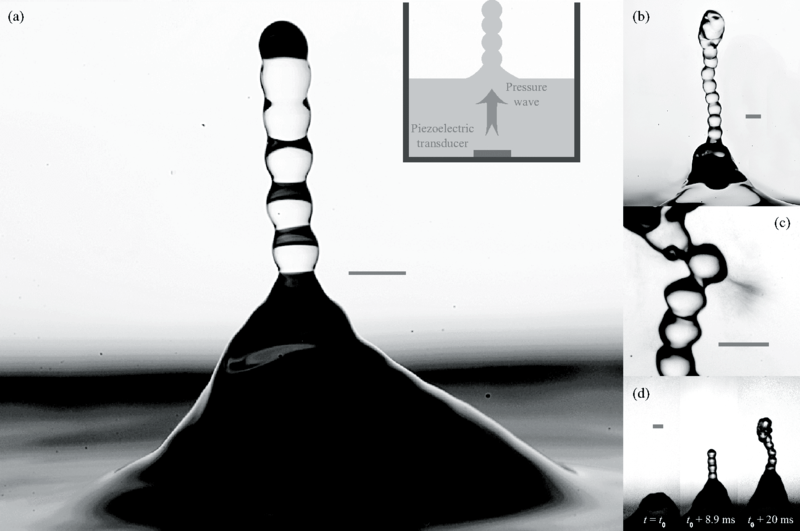
    Rub your hands on the handles of a Chinese resonance bowl and you can generate a spray of tiny droplets. The key to this, as the name suggests, is vibration. Rubbing the handles vibrates the bowl, causing small oscillations in the bowl’s shape that are too small for us to see. But those vibrations do produce noticeable ripples on the water in the bowl. When you hit the right frequency and amplitude, those vibrations disturb the water enough that the up-and-down vibration at the surface actually ejects water droplets. The vibration of the bowl affects water near the wall most strongly, which is why that part of the bowl has the strongest reaction. It takes even larger amplitude vibrations to get droplets jumping in the middle of the bowl, but you can see that happening in this video of a Tibetan singing bowl. (Image/video credit: Crazy Russian Hacker, source)

  • The Brazil Nut Effect

    The Brazil Nut Effect

    The Brazil nut effect is a common name for the phenomenon where large particles tend to rise to the top of a mixture when it’s shaken. It’s also the subject of the latest FYFD video, which you can see above.

    I’ve seen other mentions of the topic previously, but when I started researching the literature, I discovered that the Brazil nut effect was much more complicated than I’d thought! Hopefully, you’ll find the results as interesting as I did. And if you want to dig further, there are links to the papers I used over on YouTube.

    Filming was also interesting this time around. I tried out stop-motion animation for the first time. It takes so much patience! But I think the results are so cute. (Image and video credit: N. Sharp/FYFD)

  • Featured Video Play Icon

    Fluttering Feathers

    Birds do not always vocalize in order to make their songs. The male African broadbill, shown in the top video above, makes a very distinctive brreeeet in its flight displays, but as newly published research shows, the sound comes from its wings, not its voice. During the display, the broadbill spreads its primary feathers and sound is produced on the downstroke, when wingtip speeds reach about 16 m/s. By filming a broadbill wing with a high-speed camera in a wind tunnel at comparable air speeds, researchers could localize the sound production to the 6th and 7th primary feathers.

    In the second video above, you can see these feathers twisting and fluttering in the breeze. This is an example of aeroelastic flutter, a phenomenon in which aerodynamic and structural forces couple to induce oscillations. The same phenomenon famously caused the collapse of the Tacoma Narrows Bridge in 1940. In the birds, however, the flutter is non-destructive and the vibration produces audible sound which the other feathers modulate into the calls we hear. Broadbills aren’t the only birds to use this trick; some species of hummingbirds use flutter in their tail feathers during mating displays. (Video, image, and research credits: C. Clark et al.; additional videos here)

  • Featured Video Play Icon

    Singing Sand Dunes

    Reports of singing sand dunes date at least as far back as 800 C.E. Strange as it sounds, about forty sites around the world have been associated with this phenomenon, in which avalanches of sand grains on the outer surface of the dune cause a deep, booming hum for up to several minutes. As you can hear in the video above, the sound of the dune is somewhat like a propeller-driven airplane. A leading explanation for this behavior is that it results not from the size or shape of the sand grains but from the structure of the underlying dune.

    Measurements show that the booming sand dunes contain a hard packed layer of sand 1-2 meters below the surface. When sand at the surface is disturbed by the wind or sliding researchers, it creates vibrations. Those disturbances have trouble crossing into the air or into the harder layers below. Instead they resonate in the upper surface of the sand, which acts as a waveguide, reflecting and enhancing the sound, just as the body of a violin resonates to enhance the vibration of its strings. For more, check out this video from Caltech or the research paper linked below. (Video credit: N. Vriend; research credit: M. Hunt and N. Vriend, pdf)

  • Psychedelic Cymatics

    Psychedelic Cymatics

    image

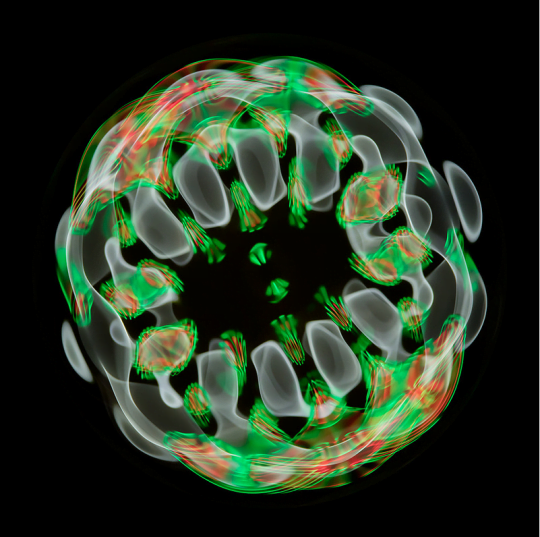
    Cymatics are the visualization of vibration and sound. Here photographer Linden Gledhill has taken a simple speaker vibrating a dish of water and turned it into some incredible art. When you vibrate liquids like water up and down, it disturbs the usually flat air-water interface and creates waves on the surface. These Faraday waves are a standing wave pattern that differs depending on which sound is being played. By combining the wave patterns with LED lighting and strobe effects, Gledhill creates some remarkable images that combine sound, light, and fluid dynamics all in one. If you watch the video (make sure to hit the HD button!), you’ll see the patterns in motion and hear the sounds used to generate them. In the last clip (around 0:19), he’s added glitter to the set-up, which highlights the circulation within the vibrating fluid. As you can see, there are strong recirculating regions in each lobe of the pattern, but other areas, like the center region are almost entirely stationary. You can see more photos from the project in his Flickr feed. Special thanks to Linden for letting me post the video of his work, too! (Video and image cred

    its and submission: L. Gledhill)

    If you enjoy FYFD, please consider becoming a patron to help make sure the Internet keeps getting its daily dose of fluid dynamics!

  • Featured Video Play Icon

    The Inverted Glass Harp

    You may be familiar with the glass harp, the instrument created by rubbing the rim of a partially-filled wine glass. But did you know that you can create the same effect by immersing an empty glass in water? In this video, Dan Quinn explains the physics behind both types of glass harps and why the pitch changes as you add or remove water. Vibration is the driving factor (as with most sound), and the key to the shifting pitches has to do with the change in mass of the material being vibrated. For more great physics, also be sure to check out Quinn’s previous video on tears of wine.  (Video credit: D. Quinn)

  • Alligators Water Dancing

    Alligators Water Dancing

    Amorous alligators call to mates with a behavior known as water dancing. Their audible bellows are accompanied by infrasonic soundvibrations below the 20 Hz limit of human hearing. These vibrations from their lungs excite Faraday waves in the water near the alligator’s back and make the surface explode in a dance of jets and atomized droplets. I’ve seen similar results in other instances of vibration, but this may be the only example of this I’ve seen in the wild. Researchers studying the phenomenon noted that the frequency of sound the alligators emit corresponds to a wavelength equal to the spacing of the raised scales, or scutes, on the alligators’ backs. They hypothesize that the shape of the scutes helps males create the display.  (Image credit: N. Marven, source; research credit: P. Moriarty and R. Holt; h/t to io9)

    ——————

    Don’t forget about our FYFD survey! I’ve teamed up with researcher Paige Brown Jarreau to create a survey of FYFD readers. By participating, you’ll be helping me improve FYFD and contributing to novel academic research on the readers of science blogs. It should only take 10-15 minutes to complete. You can find the survey here. Please take a few minutes to participate and share!

  • The Dance of the Droplets

    The Dance of the Droplets

    Milk and juice vibrating on a speaker can put on a veritable fireworks display of fluid dynamics. Vibrating a fluid can cause small standing waves, called Faraday waves, on the surface of the fluid. Add more energy and the instabilities grow nonlinearly, quickly leading to tiny ligaments and jets of liquid shooting upward. With sufficiently high energy, the jets shoot beyond the point where surface tension can hold the liquid together, resulting in a spray of droplets. (Image credit: vurt runner, source video; h/t to @jchawner)

  • Featured Video Play Icon

    Making a Bottle Resonate

    If you’ve ever blown across the top of a bottle to make it play a note, then you’ve created a Helmholtz resonator. Air flow across the top of the bottle causes air in and around the bottle neck to vibrate up and down. Like a mass on a spring, the air oscillates with a particular frequency that depends on the system’s characteristics. We hear this vibration as a a deep hum, but in the high-speed video above, you’re actually seeing the vibration as smoke pulsing in and out of the bottle. Helmholtz resonance shows up more than just in blowing across beer bottles; it’s also a factor in many resonating instruments, like the guitar. To learn more about the physics and mathematics of the effect, check out this page from the University of New South Wales. (Video credit: N. Moore)

  • Singing Toads

    Singing Toads

    Many male frog and toad species sing during warmer months to attract mates. Some, like the American toad in the photo above, can be heard for an impressive distance. Here’s a video of an American toad in action. To sing, these amphibians close their mouth and nostrils, then force air from their lungs past their larynx and into a vocal sac. As with human sound-making, forcing air past the frog’s larynx vibrates its vocal cords and generates noise. That noise resonates in the vocal sac, amplifying the sound and driving the ripples seen in the photo.  (Image credit: D. Kaneski; submitted by romannumeralfive)