Tag: vibration

  • Featured Video Play Icon

    “Cymatics”

    Nigel Stanford’s new “Cymatics” music video is full of stunning science-inspired visuals. The entire video is set up around various science demos–many of which will be familiar to readers–that translate sound or vibration into visual elements. The video uses ferrofluids, vibrates vodka on a speaker to create Faraday waves, and visualizes resonant sound waves with a Rubens’ tube. I don’t want to give away all the awesome effects, so watch it for yourself, and then check out their behind-the-scenes page where they talk about how they created each effect. (Video credit: N. Stanford; submitted by buckitdrop)

    Also, today is the final day of voting for the Vizzies, an NSF-sponsored contest for the best science and engineering visuals. Head over to their website to check out the finalists and choose your favorites!

  • Featured Video Play Icon

    “Cymatic Sun”

    “Cymatic Sun” from artist Lachlan Turczan uses vibrating fluids to generate mesmerizing and surreal visuals. At some points distinct Faraday waves are visible on the surface. At other times, there is simply a blur of motion and refracted light. Check out my “fluids as art” tag for many more great examples of fluid dynamics and art merging. (Video credit and submission: L. Turczan)

  • Featured Video Play Icon

    Bouncing with Liquids and Grains

    Bouncing a ball partially filled with a liquid can create chaotic results when the motion of the ball, fluid, and vibration plate couple. The behavior of a grain-filled ball is a bit different, though. Large grains will tend to bounce with the same frequency as the ball, even across a range of vibration conditions. A ball filled with smaller grains displays a variety of responses depending on the vibration conditions. Among these is a localized wave-like form called an oscillon which oscillates with a period different from but coupled to that of the vibration plate. All these different behaviors inside the bouncing sphere have noticeable effects on its outward motion, too. The chaotic activity of the fluid inside a bouncing ball makes it unstable, and, if not confined, it will bounce itself off the vibration platform. The grain-filled ball, on the other hand, remains bouncing on the platform even after being perturbed. This seems to be a result of the energy dissipation provided by the many inelastic collisions inside the ball as it bounces. (Video credit: F. Pacheco-Vazquez et al.)

  • Breaking Drops with Vibration

    Breaking Drops with Vibration

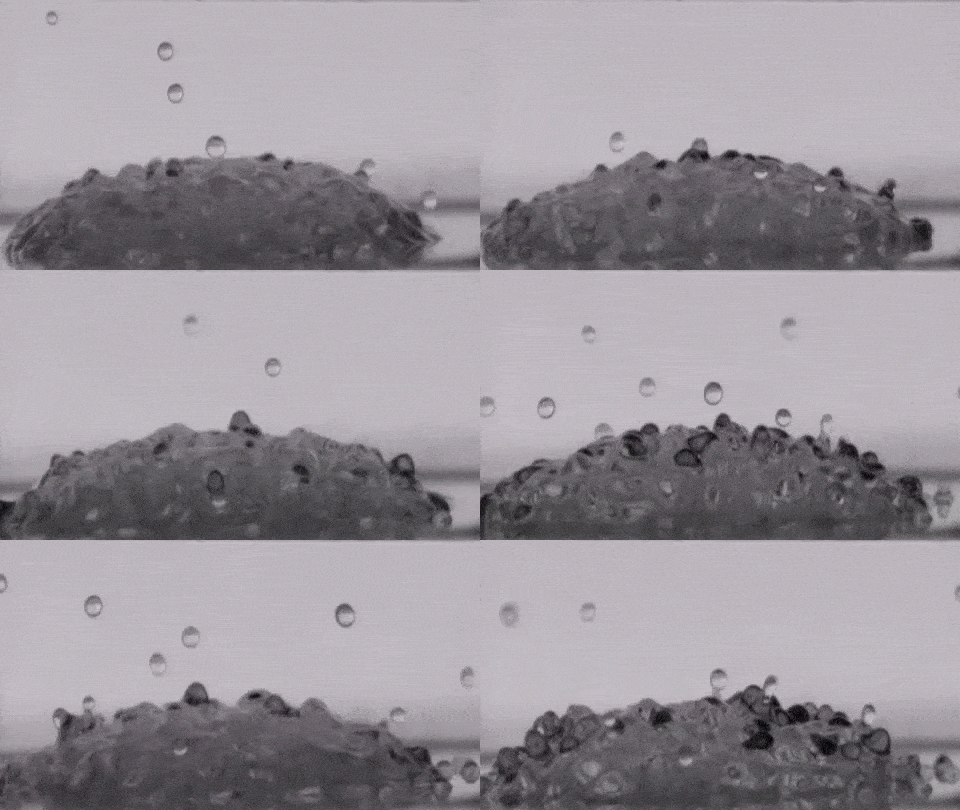
    Atomization is the process of breaking a liquid into a spray of fine droplets. There are many methods to accomplish this, including jet impingement, pressure-driven nozzles, and ultrasonic excitement. In the images above, a drop has been atomized through vibration of the surface on which it rests. Check out the full video. As the amplitude of the surface’s vibration increases, the droplet shifts from rippling capillary waves to ejecting tiny droplets. With the right vibrational forcing, the entire droplet bursts into a fine spray, as seen in the photo above. The process is extremely quick, taking less than 0.4 seconds to atomize a 0.1 ml drop of water. (Photo and video credit: B. Vukasinovic et al.; source video)

  • Stopping the Slosh

    Stopping the Slosh

    Sloshing is a problem with which anyone who has carried an overly full cup is familiar. Because of their freedom to flow and conform to any shape, fluids can shift their shape and center of mass drastically when transported. The issue can be especially pronounced in a partially-filled tank. The sloshing of water in a tank on a pick-up truck, for example, can be enough to rock the entire vehicle. One way to deal with sloshing is actively-controlled vibration damping – in other words, making small movements in response to the sloshing to keep the amplitude small. This is exactly the kind of compensation we do when carrying a mug of coffee without spilling. (Image credit: Bosch Rexroth; source)

  • Paint on Speakers

    Paint on Speakers

    Paint seems to dance and leap when vibrated on a speaker. Propelled upward, the liquid stretches into thin sheets and thicker ligaments until surface tension can no longer hold the the fluid together and droplets erupt from the fountain. Often paints are shear-thinning, non-Newtonian fluids, meaning that their ability to resist deformation decreases as they are deformed. This behavior allows them to flow freely off a brush but then remain without running after application. In the context of vibration, though, shear-thinning properties cause the paint to jump and leap more readily. For more images, see photographer Linden Gledhill’s website. (Photo credit: L. Gledhill; submitted by pinfire)

  • Vibrating on a Subwoofer

    [original media no longer available]

    Vibrating a liquid droplet produces some awesome behavior. The video above shows a water droplet vibrating on a subwoofer at real-time speeds. The behavior and shape of the droplet shifts with the frequency of vibration, which we hear as a change in pitch. To see more clearly the shapes a particular frequency induces, check out this high-speed video of vibrating water droplets. For a given driving frequency, the droplet’s shape, or mode, is distinct and consistent. For a droplet vibrating to a song, though, there is more than one frequency driving its motion. In this case, the droplet’s shape is a superposition of the individual modes, which is just a way of saying adding the shapes together. So frequency determines the droplet’s shape. The vibration amplitude, or audible volume, affects how energetic the drop’s motion is. And the fluid’s surface tension and viscosity act as dampers to the system, controlling how quickly the drop can change shape as well as how well it holds together. (Video credit: A. Read)

  • Instability

    [original media no longer available]

    Many systems can exhibit unstable behaviors when perturbed. The classic example is a ball sitting on top of a hill; if you move the ball at all, it will fall down the hill due to gravity. There is no way to perturb the ball in such a way that it will return to the top of the hill; this makes the top of the hill an unstable point. In many dynamical systems, a very small perturbation may not be as obviously unstable as the ball atop the hill, especially at first. Often a perturbation will have a very small effect initially, but it can grow exponentially with time. That is the case in this video. Here a tank of fluid is being vibrated vertically with a constant amplitude. At first, the sloshing effect on the fluid interface is very small. But the vibration frequency sits in the unstable region of the parameter space, and the perturbation, which began as a small sloshing, grows very quickly. In a real system (as opposed to a mathematical one), this kind of unstable or unbounded growth very quickly leads to destruction. (Video credit: S. Srinivas)

  • Featured Video Play Icon

    “Becoming Harmonious”

    Much as I try to keep from getting repetitious, this was just too neat to pass up. This new music video for The Glitch Mob’s “Becoming Harmonious” is built around the standing Faraday waves that form on a water-filled subwoofer. The vibration patterns, along with judicious use of strobe lighting, produce some fantastic and kaleidoscopic effects. (Video credit: The Glitch Mob/Susi Sie; submitted by @krekr)

  • Featured Video Play Icon

    “High Ball Stepper”

    The recently released music video for Jack White’s “High Ball Stepper” is a fantastic marriage of science and art. The audio is paired with visuals based around vibration effects using both granular materials and fluids. There are many examples of Faraday waves, the rippling patterns formed when a fluid interface becomes unstable under vibration. There are also cymatic patterns and even finger-like protrusions formed by when shear-thickening non-Newtonian fluids get agitated. (Video credit: J. White, B. Swank and J. Cathcart; submitted by Mike and Marius)