This numerical simulation shows the variation of salinity in the Atlantic Ocean near the mouth of the Amazon River over the course of 36 months. The turbulent mixing of the fresh river water and salty ocean shifts with the ebb and flooding of the river. Salt content causes variations in ocean water density, which can strongly affect mixing and transport properties between different depths in the ocean due to buoyancy. Understanding this kind of flow helps predict climate forecasts, rain predictions, ice melting and much more. (Video credit: Mercator Ocean)
Tag: turbulence

Helicopter Vortices
When conditions are just right, the low pressure at the center of a wingtip vortex can drop the local temperature below the dew point, causing condensation to form. Here vortices are visible extending from the tips of the propellers in addition to the wingtip. Because of the spinning of the propeller and the forward motion of the airplane, the prop vortices extend backwards in a twisted spiral that will quickly break down into turbulence. The same behavior can be observed with helicopter blades. (Photo credit: benurs)

Surf’s Up
Diffusion of ink in water + Lego minifigs = an awesome example of fluid mechanics as art. (Photo credit: Alberto Seveso; via io9; thanks to Jennifer for the link!)
Reynolds Stress
[original media no longer available]
From reader jessecaps who hung it on the office door. I expect this joke will make sense to very few but as someone who once dabbled in turbulence, I could not resist.

Flow in Urban Areas
While we typically think about boundary layers as a small region near the surface of an object–be it airplane, golf ball, or engine wall–boundary layers can be enormous, like the planetary boundary layer, the part of the atmosphere directly affected by the earth’s surface. Shown above is a flow visualization of the boundary layer in an urban area; note the models of buildings. In these atmospheric boundary layers, buildings, trees, and even mountains act like a random rough surface over which the air moves. This roughness drives the fluid to turbulent motion, clear here from the unsteadiness and intermittency of the boundary layer as well as the large variation in scale between the largest and smallest eddies and whorls. In the atmosphere, the difference in scale between the largest and smallest eddies can vary more than five orders of magnitude.

Flow Around Traffic
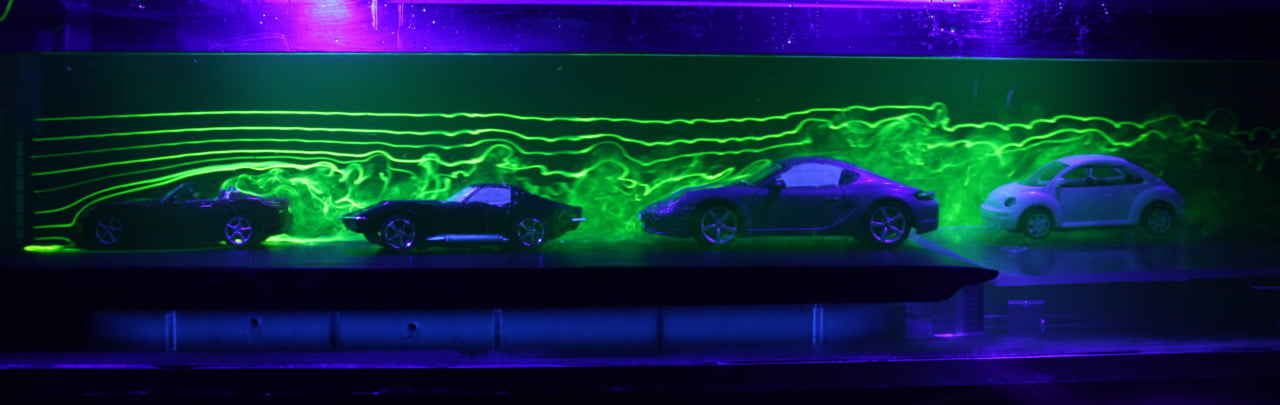
Flow visualization in a water tunnel shows what the flow around a line of traffic looks like. Note the progressively more turbulent flow around each car as it sits in the wake of the car before it. Turbulent flow is usually associated with increased drag forces, but because turbulence can actually help prevent flow separation it is sometimes desirable as a method for decreasing drag. In the case of these cars drafting on one another, it is clear that the cars further back in the line cause less effect on the fluid–and thus have less drag to overcome–than the front car. (Photo credit: Rob Bulmahn)
Smoke Flow Viz
Smoke visualization, illuminated by a laser sheet, shows a 2D slice from an axisymmetric jet as it breaks down to turbulence. The flow is laminar upon exiting the nozzle, but the high velocity at the edge of the jet and low velocity of the surrounding air causes shear that leads to the Kelvin-Helmholtz instability. This instability leads to the formation of small vortices that grow as they are advected downstream until they are large enough to interrupt the jet and it breaks down into fully turbulent flow. (Video credit: B. O. Anderson and J. H. Jensen)

Oceanic Swirls
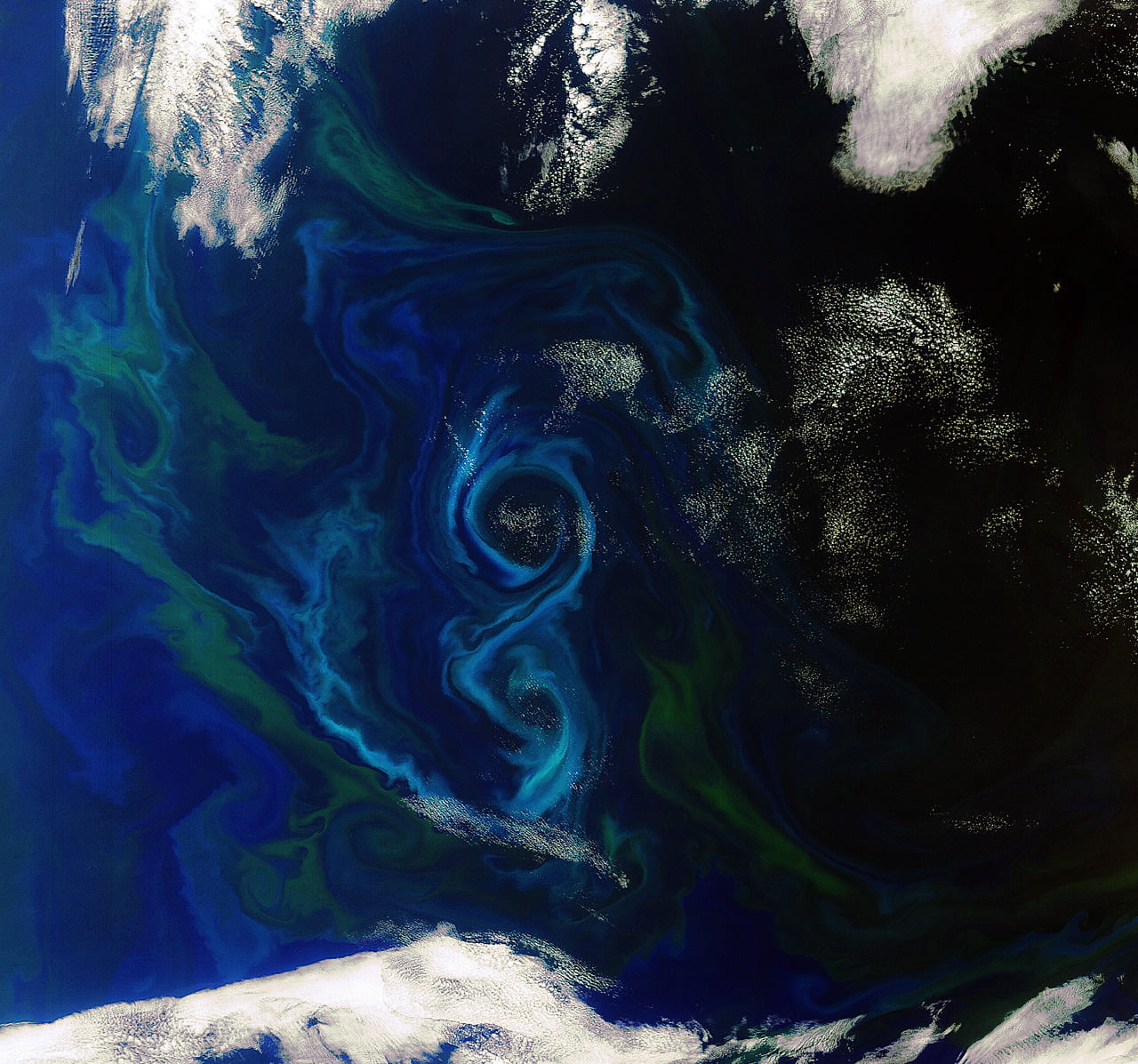
Mixing of surface waters with deeper ocean currents brings together the minerals and nutrients used by phytoplankton, resulting in gorgeous swirls of color in the ocean. These phytoplankton blooms are most common in the spring and summer, and while lovely, can be harmful to other marine life, either through the production of toxins or by depleting the waters of oxygen. Because the phytoplankton move according to the wind and waves, they can also form a sort of natural flow visualization. (Photo credit: ESA)
———-
While FYFD is not blacking out for SOPA/PIPA, we would like to take a moment to register our protest and encourage those of you who are Americans to take a moment to let Congress know that you don’t approve of these bills. Although we agree that protection of copyright holders rights is important, the measures proposed in these bills reach far beyond that line. FYFD, as a site that reposts photos and videos primarily created by others, could be taken down as a result of these bills, despite the purpose of the website as a tool for educational outreach and dissemination of science. Please support a free and uncensored Internet!
Dove in Flight
This spectacular high-speed video shows a dove in flight. Note how its wings flex through its stroke and the way the wings rotate over the course of the downstroke and reversal. There is incredible beauty and complexity in this motion. The change in wing shape and angle of attack is what allows the bird to maximize the lift it generates. Note also how the outer feathers flare during the downstroke. This promotes turbulence in the air moving near the wing, which prevents separated flow that would cause the dove to stall. (See also: how owls stay silent. Video credit: W. Hoebink and X. van der Sar, Vliegkunstenaars project)
Inside a Blender
[original media no longer available]
High-speed video visualizes the complicated flow field inside a blender. Note that the video is placed in reverse for artistic effect. This flowfield is clearly too turbulent for reversible flow. That said, it is possible to mix two fluids and then unmix them, under the right circumstances.