Tag: turbulence

  • Featured Video Play Icon

    Air Entrainment

    When a liquid jet falls into a pool, air is often entrained along with the liquid, creating a cavity and, often, bubbles. Shown above is video of a low-speed laminar jet entering a quiescent pool. The jet appears to entrain a thin film of gas, which then breaks up in a three-dimensional fashion, despite the symmetry of the incoming jet.  As the speed of the incoming jet is increased and turbulence is introduced, the resulting air entrainment becomes violent and chaotic. For additional information and videos, see Kiger and Duncan 2012 and their supplemental videos. (Video credit: K. Kiger and J. Duncan)

  • Unmanned Aerial Vehicles

    Unmanned Aerial Vehicles

    In recent years unmanned aerial vehicles (UAVs) have grown in popularity for both military and civilian application and are shifting from a remotely controlled platform to autonomous control. Since no pilot flies onboard an UAV, these craft are much smaller than other fixed-wing aircraft, with wingspans that may range from a few meters to only centimeters. At these sizes, most fixed-wing airfoil theory does not apply because no part of the wing is isolated from end effects. This complicates the prediction of lift and drag on the aircraft, particularly during maneuvering and necessitates the development of new predictive methods and control schemes. Shown above are flow visualizations of a small UAV executing a perching maneuver, intended to allow the craft to land as a bird does by scrubbing speed with a high-angle-of-attack, high-drag motion. (Photo credit: Jason Dorfman; via Hizook; requested by mindscrib)

  • Featured Video Play Icon

    Unsteady Rocket Nozzle

    This numerical simulation gives a glimpse of flow inside an unsteady rocket nozzle.  The nozzle is over-expanded, meaning that the exhaust’s pressure is lower than that of the ambient atmosphere. A slightly over-expanded nozzle causes little more than a decrease in efficiency, but if the nozzle is grossly over-expanded, the boundary layer along the nozzle wall can separate and induce major instabilities, as seen here. In the first segment of the video, turbulent structures along the nozzle wall boundary layer are shown; note how the boundary layer becomes very thick and turbulent after the primary shock wave (shown in gray). This is due to the flow separating near the wall.  The second half of the video shows the unsteadiness this can create. The primary shock wave splits into two near the wall, creating a lambda shock wave, named for the shape of the lower case Greek letter. This shock structure is indicative of strong interaction between the boundary layer and shock wave. (Video credit: B. Olson and S. Lele)

  • Rocket Exhaust

    Rocket Exhaust

    A fiery jet of exhaust remains amid plumes of smoke as a Soyuz rocket lifts off from Baikonur Cosmodrome bound for the International Space Station. The lengthscales of such turbulence range from tens of meters to only millimeters, highlighting the incredible difficulty of accurately capturing and describing the fluid motion of a practical engineering problem. (Photo credit: NASA/Carla Cioffi; via Visual Science)

  • Supercomputed Fluids

    Supercomputed Fluids

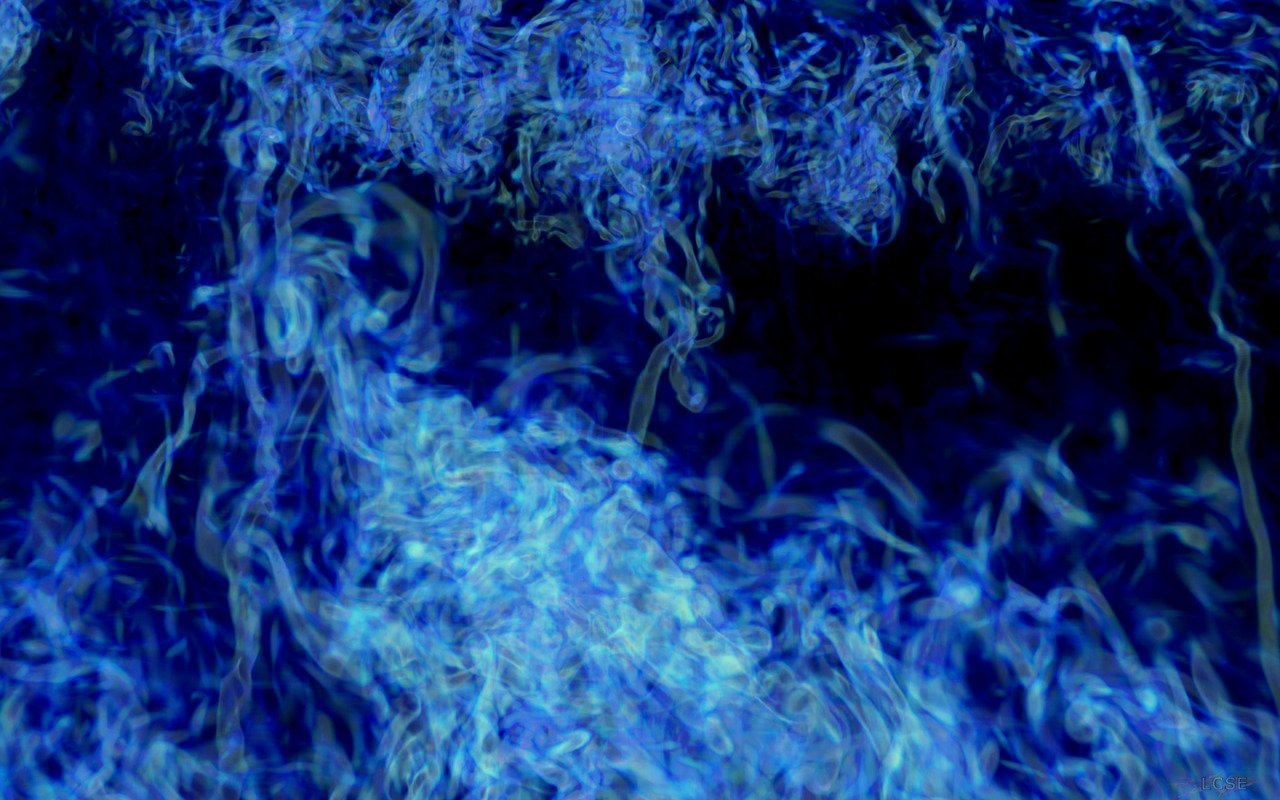
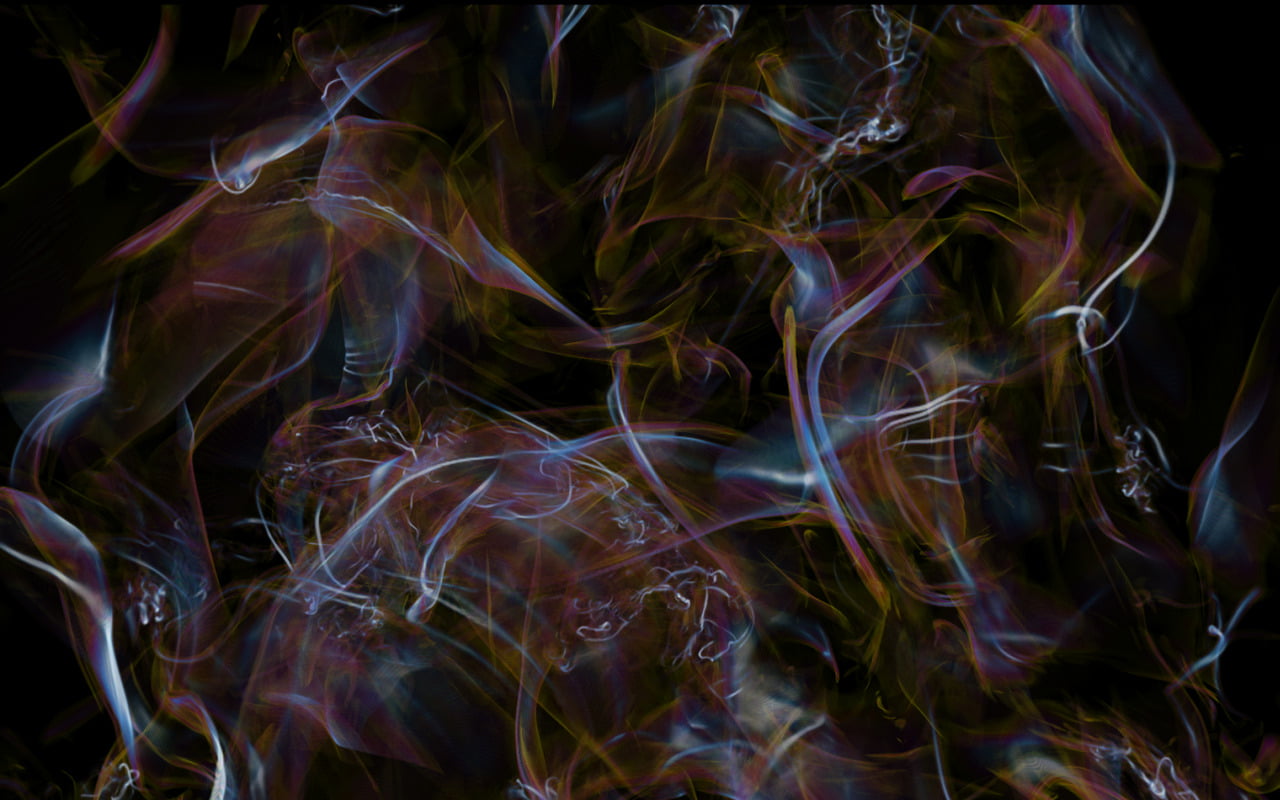
    Computational fluid dynamics and supercomputers can produce some stunning flow visualizations.  Above are examples of turbulence, the Rayleigh-Taylor instability, and the Kelvin-Helmholtz instability. Be sure to check out LCSE’s website for more; they’ve included wallpapers of some of the most spectacular ones. (Photo credits: Laboratory for Computational Science and Engineering, University of Minnesota, #)

  • Featured Video Play Icon

    The Veil Nebula

    There is no grander scale for the observation of fluid dynamics than that of the astronomical. Here Hubble astronomers discuss the formation of the Veil Nebula, a supernova remnant formed some 5,000-10,000 years ago.  Wisps of gas and plasma remain, creating stunning astronomical landscapes that are the result of shock waves, turbulence, diffusion, and other processes familiar to us here on Earth. (Video credit: ESA/Hubble)

  • Using Flow Viz for Optimization

    Using Flow Viz for Optimization

    Flow visualization is a powerful design tool for engineers. When Google was interested in determining optimal configurations for their heliostat array, they turned to NASA Ames’ water tunnel facility to test upstream barriers to deflect flow off the heliostats.   In each photo, flow is from left to right and fluorescent dye is used to mark streamlines and reveal qualitative flow detail. Upstream of the obstacles, the streamlines are coherent and laminar, but after deflection, the flow breaks down into turbulence. In this case, such turbulence is desirable because it lowers the local fluid velocity and thus the aerodynamic loads experienced by each heliostat, potentially allowing for a savings in fabrication. For more, see Google’s report on the project. (Photo credits: google.org)

  • Featured Video Play Icon

    Fireball in Slow Motion

    The high-speed video above shows an atomized spray of flammable liquid being ignited using a lighter.  It was filmed at 10,000 fps and is replayed at 30 fps. Although uncontained, this demonstration is similar to the combustion observed inside of many types of engines.  Automobiles, jet engines, and rockets all break their liquid fuel into a spray of droplets to increase the efficiency of combustion.  The turbulence of the flames dances and swirls, with small-scale motions close to the sprayed droplets and larger-scale motions around the vaporized fuel. This variation in size of the scales of motion is a hallmark feature of turbulence and can be used to characterize a flow.

  • Vortex Cross-Sections

    Vortex Cross-Sections

    The photos above show cross-sections through the leading edge vortices on a highly swept delta wing at angle of attack.  Flow in the photos is from the upper left to lower right. Notice how the vortices grow and develop waviness as they move downstream. When perturbations enter the vortex–for example, due to the shear between the vortex fluid and the freestream–some will grow and eventually cause a break down to turbulence, as in the lower picture. (Photo credits: R. Nelson and A. Pelletier)

  • London 2012: Cycling Physics

    London 2012: Cycling Physics

    In no discipline of cycling is more emphasis placed on fluid dynamics than in the individual time trial.  This event, a solo race against the clock, leaves riders no place to hide from the aerodynamic drag that makes up 70% or more of the resistance riders overcome when pedaling. Time trial bikes are designed for low drag and light weight over maneuverability, using airfoil-like shapes in the fork and frame to direct airflow around the bike and rider without separation, which creates an area of low pressure in the wake that increases drag.  Riders maintain a position stretched out over the front wheel of the bike, with their arms close together.  This position reduces the frontal area exposed to the flow, which is proportional to the drag a rider experiences.

    Special helmets, some with strangely streamlined curves, are used to direct airflow over the rider’s head and straight along his or her back. Both helmets and skinsuits are starting to feature areas of dimpling or raised texturing. These function in much the same way as a golf ball; the texture causes the boundary layer, the thin layer of air near a surface, to become turbulent.  A turbulent boundary layer is less susceptible to separating from the surface, ultimately leading to lower drag than would be observed if the boundary layer remained laminar. Wheels, skinsuits, gloves, shoe covers, and even the location of the brakes on the bike are all tweaked to reduce drag.  In an event that can be decided by hundredths of a second between riders, every gram of drag counts. (Photo credits: Stefano Rellandini, POC Sports, Reuters, Paul Starkey, Louis Garneau)

    FYFD is celebrating the Olympics by featuring the fluid dynamics of sports. Check out our previous posts on how the Olympic torch works, what makes a pool fast, the aerodynamics of archery, and the science of badminton.