Tag: swimming

  • Reader Question: Drafting in Triathlons

    Reader Question: Drafting in Triathlons

    Reader juleztalks writes:

    I’ve just entered an amateur triathlon, and there’s a whole load of rules about not “drafting” in the cycle stage (basically, not sitting in other cyclists’ slipstream). However, there are no such rules for the swim or run stage; I thought the effects would be the same from drafting other swimmers and runners. Any ideas?

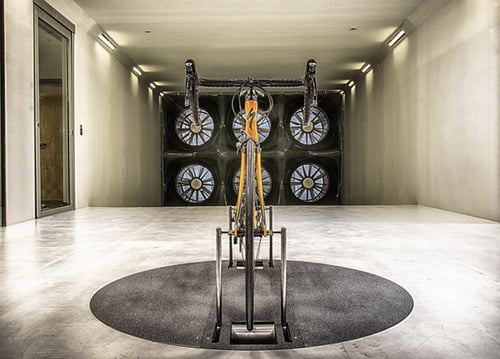
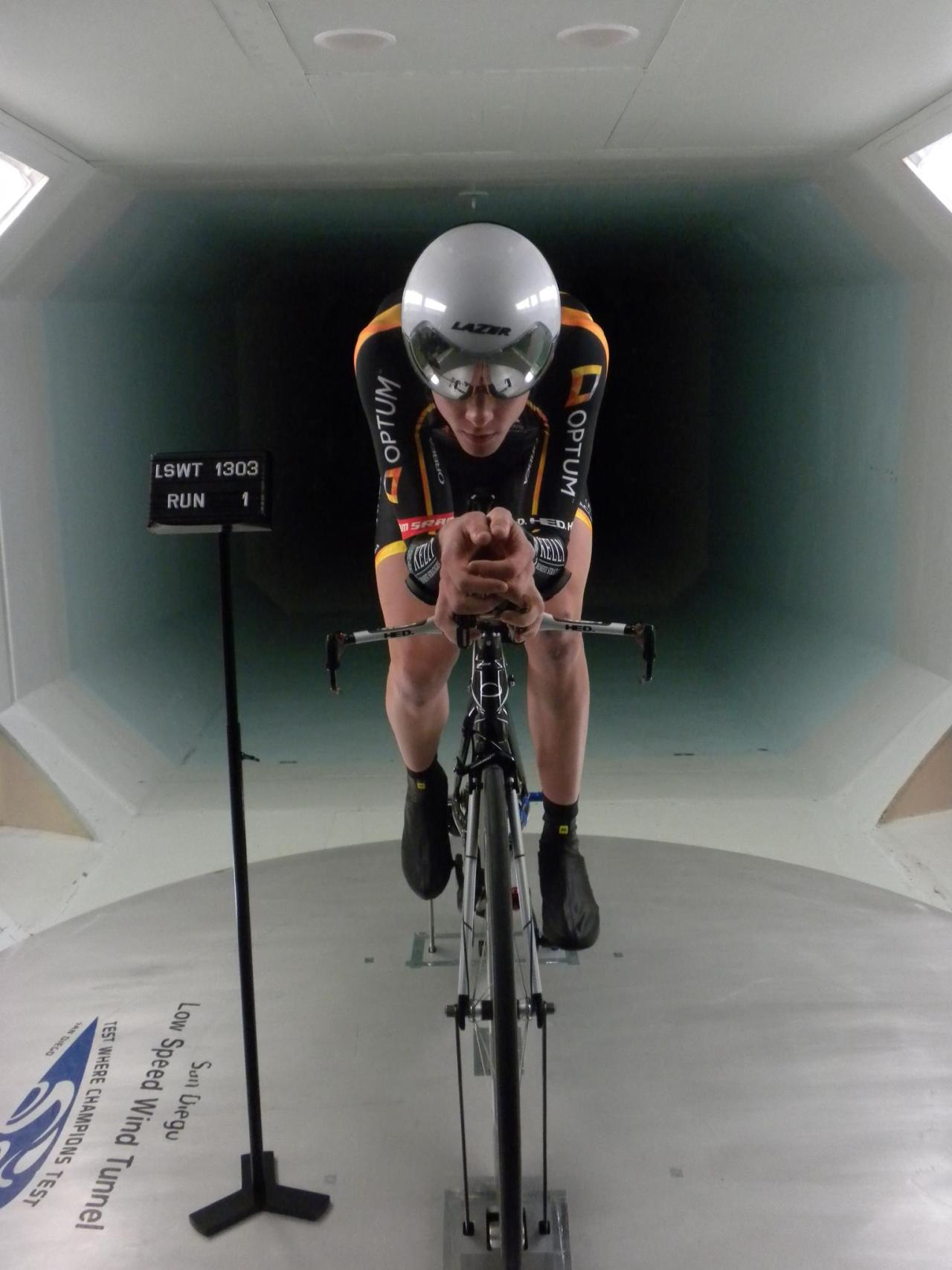
    As in many endurance sports, it’s all a question of energy savings from drag reduction. Drag on an object, like a triathlete, is roughly proportional to fluid density (air for cycling or running, water for swimming), frontal area, and the velocity squared. Because drag increases more drastically for an increase in velocity, it makes sense one would worry most about drag when one’s velocity is highest – on the bike.

    Drafting has major benefits in cycling and can reduce drag on a rider by 25-40%. Aerodynamic drag accounts for 70% or more of a cyclist’s energy expenditure, so that reduction can really add up. The energy saved by drafting during cycling can even increase a triathlete’s speed during a subsequent running leg. So it makes sense for a sport’s governing body to be concerned with it.

    That said, there’s plenty of room for drag reduction in swimming as well. Even though the velocities are much lower, water’s density is 1,000 times higher than air’s, generating plenty of drag for an athlete to overcome. For swimmers at maximum speed, drafting can reduce drag by 13-26%, depending on relative positioning. Such drafting has been found to increase stroke length and may (or may notimprove subsequent cycling performance.

    Although a similar reduction in drag is possible by drafting when running, drag on a runner only accounts for about 8% of his/her energy expenditure so such savings would matters very little next to the swimming and cycling legs. There could be some psychological benefits, though, in terms of pacing oneself. (Photo credit: Optum Pro Cycling p/b Kelly Benefit Strategies)

  • Featured Video Play Icon

    Flapping Foil Wake

    This gorgeous visualization shows the flow behind a flapping foil. Flow in the water tunnel is from right to left, with dye introduced to show streamlines. A flapping foil is a good base model for most flapping flight as well as finned swimming – anything that oscillates to create thrust. As the foil flaps, vorticity is generated and shed along the trailing edge, creating a regularly patterned wake of trailing vortices. (Video credit: R. Godoy-Diana)

  • Reader Question: Standing Waves

    Reader Question: Standing Waves

    captainandry asks:

    What would happen to a fish or swimmer in a standing wave?

    First of all, check out the video that inspired this question, which shows a standing water wave created in a wave tank. Before we tackle the standing wave, it’s helpful to know what motion exists in a typical water wave. For deep water waves, the motion of a particle as the waves pass is circular, with a decreasing radius with increasing depth. Below a certain depth the energy of the surface wave doesn’t penetrate. Here’s an animation, where the red dots represent massless particles and the blue circles show their paths:

    In shallower waters, the circular paths get compressed into ellipses. The image below shows pathlines for particles at different depths as a water wave passes. Notice how the paths are circular near the surface, where the depth is much greater than the wavelength, while close to the bottom, the pathlines are elliptical.

    So what about motion for a standing water wave? Such a wave has no apparent horizontal motion, as seen in the animation below:

    Similar to the way that decreasing the depth compresses the circular particle motion into an ellipsoid, creating a standing wave compresses the horizontal motion of any particle near the surface. What this means is that anything floating near the surface of the standing wave will simply bob up and down. Unless it’s located at one of the nodes (marked by red dots), in which case it won’t move at all! As with the other types of water waves, the amount of displacement will decrease with depth. People and fish, of course, are not massless particles, so their motion will be damped by inertia, but the same principles apply.

    (Photo credits: P. Videtich; R. L. Wiegel and J.W. Johnson; Wikipedia)

  • Surface Tension in Action

    Surface Tension in Action

    Surface tension creates a glassy, smooth layer of water over U.S. swimmer Tyler Clary the instant before he surfaces as he competes in the backstroke. Surface tension arises from intermolecular forces between water molecules. In the bulk of the liquid, any given water molecule is being pulled on in every direction by the surrounding molecules, which results in zero net force. At the surface, however, molecules only experience forces from those to the side and below them. As a result, these molecules are pulled inwards, forcing the liquid to take on a form with minimal area. (Photo credit: Getty Images; submitted by drhawkins)

  • Sharkskin’s Secrets

    Sharkskin’s Secrets

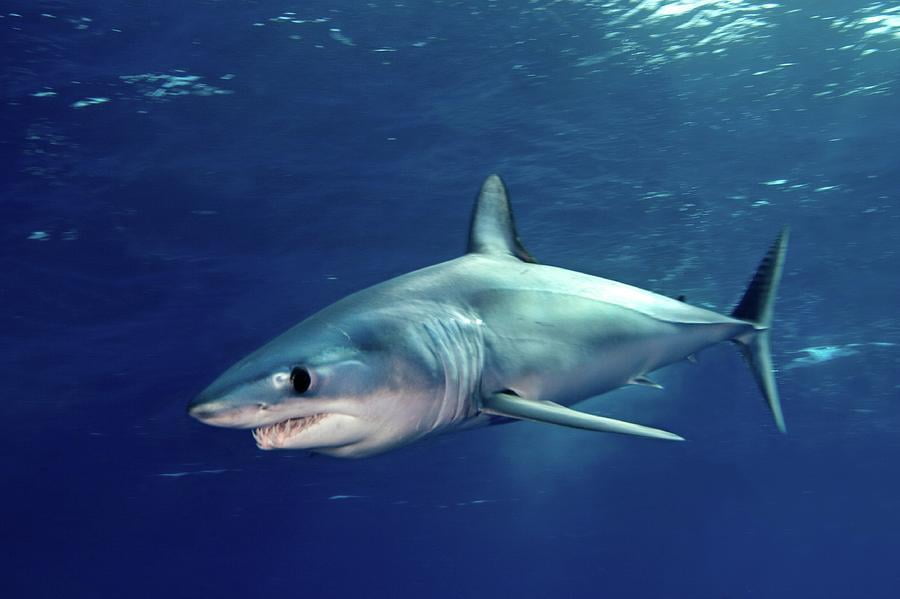
    Sharks are known as extremely fast and agile swimmers, due in part to the surface of their skin. Sharks are covered in very tiny tooth-shaped scales called denticles which are streamlined in the direction of flow over the shark. If you were to run a hand over a shark’s skin from head to tail, it would feel silky smooth, but rub against the grain and it’s like running your hand on sandpaper.  Water encounters a similar resistance, which, according to new research, provides the shark with a passive flow control mechanism, requiring no effort on the part of the shark. When water near the shark’s denticles tries to reverse direction, an early stage in flow separation, the denticles naturally bristle, slowing and trapping the reversed flow. This prevents local flow separation which would otherwise increase the shark’s drag and hinder its agility. (Photo credit: James R. D. Scott; Research by A. Lang et al.)

  • London 2012: Swimming Pool Physics

    London 2012: Swimming Pool Physics

    The era of the LZR suit may be over in swimming, but technology is still making an impact when it comes to making swimmers faster. One thing you’ll often hear from commentators is how the London Aquatic Center boasts one of the world’s fastest pools. When swimmers compete, they have to contend with all the turbulence created in the pool by eight people trying to direct as much water behind them as possible as quickly as possible. Like ripples spreading on a pond, these waves travel, reflect, and interfere, ultimately disrupting the swimmers and causing extra drag. In a fast pool, engineers have made adjustments to reduce the impact of these waves on swimmers. Firstly, the pool is 3 meters deep, meaning that vertical disruptions are mostly damped out before they reach the bottom, so any wave reflected off the bottom of the pool will be extremely weak. Along the sides and ends of the pool, a special trough captures surface waves, preventing them from reflecting back out into the pool. The lane lines are also designed to soak up wave energy so that it does not propagate as much between lanes. When waves hit the lines, their links spin, dissipating some of the wave’s energy.

    Despite these advances, the outermost lanes–those against the walls–are not used in competition. This helps to equalize the turbulence between lanes. Whether there is any fluid mechanical advantage to being in a particular lane is debatable. The outer lanes have the advantage of only one competitor’s wake to contend with, but they isolate the swimmer so he or she cannot see their competition as well. In the inner lanes, you’ll sometimes see swimmers try to swim close to the lane line if their competition is ahead of them, the idea being that they may be able to draft on their competitor’s bow wave to reduce drag. Generally speaking, the lane positions are determined by seeding going into the event, where the faster swimmers are given the innermost lanes. This is why it’s rare to see gold medals coming from the outermost lanes. For more, check out NBC’s video on designing fast pools (US only, unfortunately). (Photo credits: Associated Press, Reuters, Geoff Caddick)

  • Supercavitating Penguins

    [original media no longer available]

    Penguins, already fluid dynamicists by nature, have developed clever methods of increasing their speed to escape from the leopard seals that prey on them. In the clip above, notice from 1:55 onward as the penguins swim for the surface and leap onto the ice – they leave a trail of bubbles in their wake. The penguins are using supercavitation to decrease their drag. When the penguins first dive in to the water, they splay their feathers out in the air and then lock them closed in the water, trapping pockets of air beneath them. When the need for a burst of speed arises, the penguin shifts its feathers to release the air, coating most of its body in a layer of bubbles. Because the drag in air is much less than the drag in water, this enables the bird to achieve much higher speeds than they normally do when swimming.

  • Featured Video Play Icon

    Brine Shrimp Swimming

    For small creatures, swimming is dominated by viscosity. Here researchers use particle image velocimetry (PIV) to explore the flow field around brine shrimp. Its motion is divided into two vorticity-generating phases–the wide power stroke where the shrimp generates most of its forward motion and the recovery stroke where the shrimp returns its starting position while generating as little motion and drag as it can. (Video credit: B. Johnson, D. Garrity, L. Dasi)

  • Featured Video Play Icon

    Mackerel vs. Eel: Who Swam It Better?

    Which matters more, form or function? This simulation sets out to answer that question by comparing the swimming motion of eels and mackerels. Eels have longer, more rounded body shapes and swim in an undulatory fashion with their whole body, whereas mackerels have shorter bodies with a more elliptical cross-section and primarily move their tails when swimming. The simulation separates body type from swimming motion by creating virtual races between fishes of the same body type using the two forms of swimming. Eels swim at moderate Reynolds numbers where viscous and inertial effects are reasonably balanced.  Under those conditions, eel-like swimming was faster, even with a mackerel’s body type.  At the higher Reynolds numbers where mackerels usually swim, inertial forces domination and the racing fish moved faster if they swam like a mackerel, even with the body of an eel. The results suggest that the swimming motion matters more in each Reynolds number range than the shape of the swimmer. This is a neat way that simulation can answer questions we cannot test with an experiment! (Video credit: I. Borazjani and F. Sotiropoulos)

  • Shark Wakes

    Shark Wakes

    Volumetric imaging of swimming spiny dogfish, a type of shark, shows that their distinctively asymmetric tails produce a set of dual-linked vortex rings with every half beat of their tail. The figure above shows data from the actual shark on the right (b,d,f) and a similarly shaped robotic tail on the left (a,c,e). The second row contains lateral views (c,d) and the bottom row contains dorsal views (e,f) of the vorticity isosurfaces measured. The robotic tail does not demonstrate the same double vortex structure, leading scientists to suspect that the shark may be actively stiffening its tail mid-stroke to control its wake. The finding could help engineers design aquatic robots whose morphing fins help it swim more efficiently. For more, see Wired.