Tag: swimming

  • Swimming in Microgravity

    Swimming in Microgravity

    For years, I have wondered what a fish swimming in microgravity would look like. Finally, my curiosity has been rewarded. Here is a sphere of water in microgravity, complete with a fish. Personally, I am impressed that, despite the fish’s best efforts, the surface tension of the water is strong enough to keep it confined. This may not bode well for microgravity swimming pools at space hotels. (Video credit: IRPI LLC, source)

  • Hiding in the Sand

    Hiding in the Sand

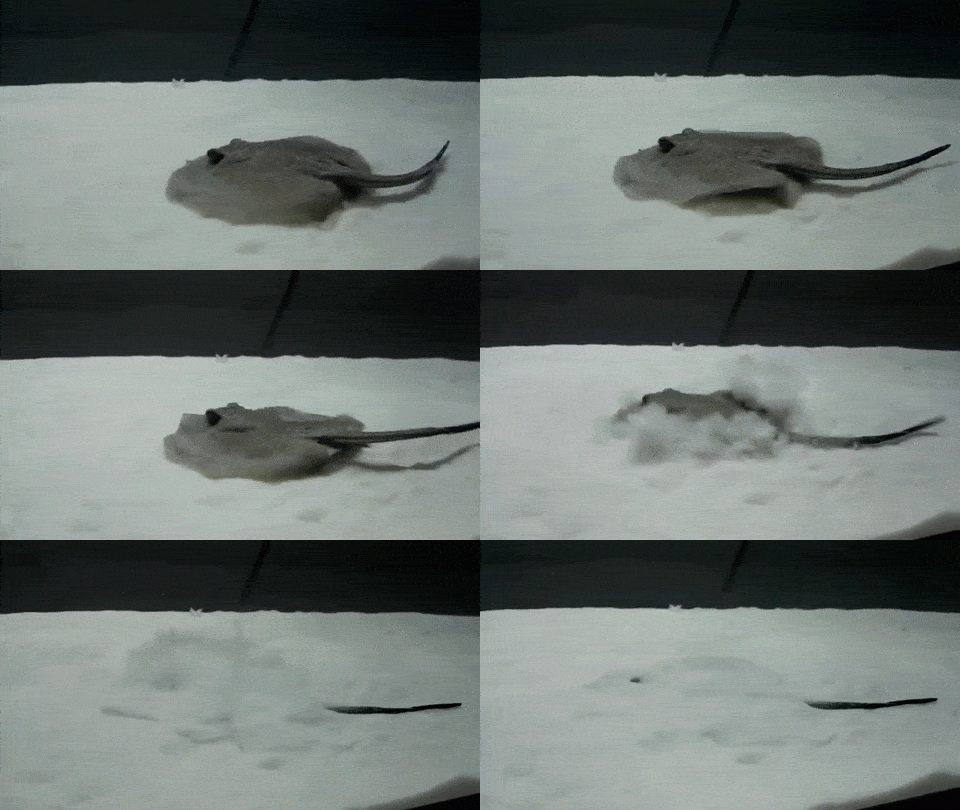
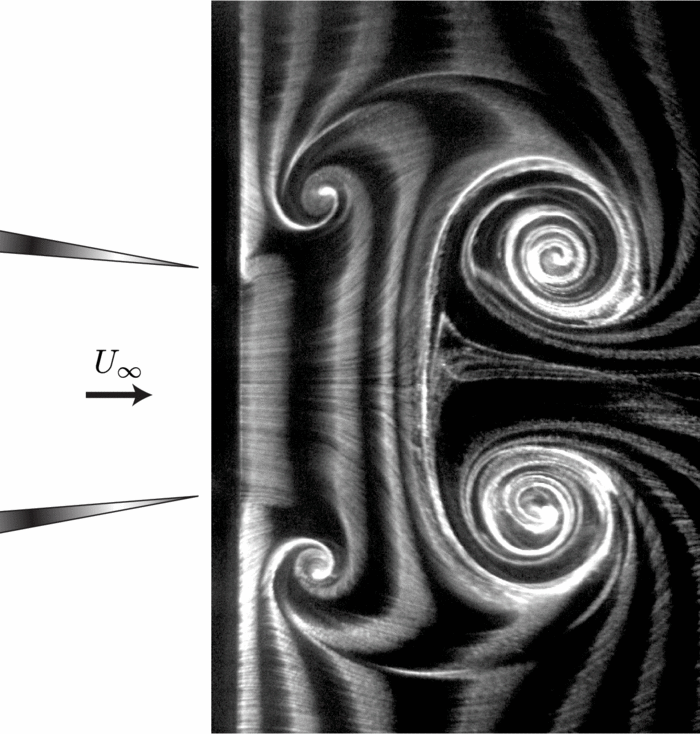
    Flounders, stingrays, and other flat, bottom-dwelling fish often hide under sand for protection. These fish move by oscillating their fins or the edge of their bodies. They use a similar mechanism to bury themselves–quickly flapping to resuspend a cloud of particles, then hitting the ground so that the sand settles down to cover them. Researchers have been investigating this process by oscillating rigid and flexible plates and observing the resulting flow. When the flapping motion exceeds a critical velocity, the vortex that forms at the plate’s edge is strong enough to pick up sand particles. Understanding and controlling how and when these vortex motions kick up particles is useful beyond the ocean floor, too. Helicopters are often unable to land safely in sandy environments because of the particles their rotors lift up, and this work could help mitigate that problem. (Image credits: TylersAquariums, source; Richmondreefer, source; A. Sauret, source; research credit: A. Sauret et al.)

  • Featured Video Play Icon

    Swimming Through Sand

    Shovel-nosed snakes and sandfish lizards both swim through granular materials like sand. Researchers at Georgia Tech used x-rays to observe their subsurface motions. Despite their different shapes, the long, slender snake and the shorter, wider lizard both move under the sand by projecting traveling waves along their bodies. The snake’s long, skinny body allows it to have more bends along its length, which increases its transport efficiency because it allows the snake to move mostly through the tunnel created by its head’s passage. In contrast, the sandfish’s motions fluidize the sand around it, enabling it to swim. Although the snake is faster, both animals have optimized their motions for fast, low-energy transit according to their body type.  (Video credit: Georgia Tech; research credit: S. Sharpe et al.; via io9)

  • Advantages of Schooling

    Advantages of Schooling

    Many fish swim in close proximity to one another in large schools, causing scientists to wonder if this behavior is motivated primarily by defense against predators or whether fish derive some hydrodynamic advantages from schooling. Examining the fluid dynamics of an entire school of fish is rather impractical, so researchers approximate two neighboring swimmers using flapping hydrofoils. The images above show flow visualizations of the wakes of these two mechanical swimmers. When the two hydrofoils flap in-phase with one another (top image), one oscillation period produces a complicated pattern of many vortices zig-zagging behind the foils. This configuration produces more efficient propulsion than a single hydrofoil, meaning that more of the energy in the wake is used to produce thrust. The cost, however, is reduced thrust overall. The bottom image shows the wake pattern for hydrofoils flapping out-of-phase. This behavior enhanced thrust without reducing propulsive efficiency. The results suggest that schooling fish might choose different swimming strategies depending on the situation.   (Image credits: P. Dewey et al.)

  • Featured Video Play Icon

    Wavy Swimmers

    Animals often move in ways engineers find counter-intuitive. Take, for example, the glass knifefish, an undulatory swimmer that controls its motion through wavelike oscillations of its fin. One might expect the knifefish to move its fin so that a single continuous wave moves from one end to the other. Instead two opposing waves move down the knifefish’s fins, one travelling from head to tail and the other travelling from the tail forward. The intersection of these waves is the nodal point, and, by shifting the nodal point fore or aft, the knifefish can hover in place, move forward or swim backward. At first glance, this seems like a wasteful system since a significant portion of each wave cancels the other, but, through mathematical modeling and experiments with a biomimetic robot, the researchers found that the dual-wave locomotion increases both the stability and maneuverability of the fish. (Video credit: N. Cowan et al.; via phys.org)

  • Featured Video Play Icon

    The Reynolds Number Illustrated

    The dimensionless Reynolds number is a key concept in fluid dynamics, allowing scientists to distinguish regimes of flow between differing geometries and even different fluids. This video gives a great primer on the subject by examining the physics of swimming for a sperm versus a sperm whale. The Reynolds number is essentially a ratio between inertial forces (driven by velocity and size) and viscous forces, and its value can indicate how important different effects are. Sperm and other microbes live at very small Reynolds numbers, meaning that viscosity dominates as the force they must overcome to move. For more on the low Reynolds number world, check out how brine shrimp swim and what happens if a microbe tries to flap its tail. (Hint: it goes nowhere, and this is why.) (Video credit: A. Bhatia/TED Ed; via Jennifer Ouellette)

  • Ig Nobel Fluids: Swimming in Syrup

    Ig Nobel Fluids: Swimming in Syrup

    Does a person swim faster in water or syrup? One expects the more viscous syrup would offer a swimmer greater resistance, but, at the same time, it could also provide more to push against. Gettelfinger and Cussler put this to a test experimentally with competitive and recreational swimmers in a pool of water and in one with a fluid measuring roughly twice the viscosity of water. Their results showed no significant change in swimming speed. When you consider that human swimming is highly turbulent, however, the result makes sense. In fluid dynamics, the dimensionless Reynolds number represents a ratio between inertial forces and viscous forces in a flow. The researchers estimate a Reynolds number of a typical human in water at 600,000, meaning that inertial effects far outweigh viscous effects. In this case, doubling the viscosity only reduces the Reynolds number by half, leaving it still well inside the turbulent range. Thus, swimming in syrup has little effect on humans. The Mythbusters also tackled this problem, with similar conclusions. This is a continuation of a series on fluids-related Ig Nobel Prizes. (Photo credit: Mythbusters/Discovery Channel; research credit: B. Gettelfinger and E. L. Cussler, winners of the 2005 Ig Nobel Prize in Chemistry)

  • Featured Video Play Icon

    Stingray Wakes

    This numerical simulation shows a swimming stingray and the vorticity generated by its motion. Stingrays are undulatory swimmers, meaning that the wavelength of their motion is much shorter than their body length. Manta rays, in contrast, move their fins through a wavelength longer than their body length, making them oscillatory swimmers. Observe the difference in this video. To swim faster, stingrays increase the frequency of their undulation, not the amplitude. This is quite common among swimmers because increasing the amplitude also increases projected frontal area, which causes additional drag. Increasing the frequency of motion does not affect the projected area, making it the more efficient locomotive choice. (Video credit: G. Weymouth; additional research credit: E. Blevins; submitted by L. Buss)

    Also, FYFD now has a Google+ page for those who prefer to follow along and share that way. – Nicole

  • Fluids Round-up – 11 August 2013

    Fluids Round-up – 11 August 2013

    Time for another fluids round-up! Here are your links:

    • Back in January 1919, a five-story-high metal tank full of molasses broke and released a wave of viscous non-Newtonian fluid through Boston’s North End. Scientific American examines the physics of the Great Molasses Flood, including how to swim in molasses. If you can imagine what it’s like to swim in molasses, you’ll know something of the struggle microbes experience to move through any fluid. They also discusses some of the strange ways tiny creatures swim.
    • In sandy desert environments, helicopter blades can light up the night with so-called helicopter halos. The effect is similar to what causes sparks from a grinding wheel. Learn more about this Kopp-Etchells effect.
    • Check out this ominous footage of a tornadic cell passing through Colorado last week.
    • If you want more of a science-y look to your drinkware, you should check out the Periodic TableWare collection over on Kickstarter.
    • Finally, wingsuits really take the idea of gliding flight to some crazy extremes. Check out this video of in-flight footage. Watch for the guy’s wingtip vortices at 3:16 (screencap above)! (submitted by Jason C)

    (Photo credit: Squirrel)

  • Fluids Round-up – 25 May 2013

    Fluids Round-up – 25 May 2013

    Sometimes I come across cool links and stories about fluid dynamics that don’t quite fit into a typical FYFD post, but I’d like to start sharing those semi-regularly with round-up posts. Here’s some fun stuff I’ve seen lately:

    And, yes, that last Specialized video chat includes an FYFD shout-out about 49 minutes in. 🙂

    (Photo credit: Specialized)