Which matters more, form or function? This simulation sets out to answer that question by comparing the swimming motion of eels and mackerels. Eels have longer, more rounded body shapes and swim in an undulatory fashion with their whole body, whereas mackerels have shorter bodies with a more elliptical cross-section and primarily move their tails when swimming. The simulation separates body type from swimming motion by creating virtual races between fishes of the same body type using the two forms of swimming. Eels swim at moderate Reynolds numbers where viscous and inertial effects are reasonably balanced. Under those conditions, eel-like swimming was faster, even with a mackerel’s body type. At the higher Reynolds numbers where mackerels usually swim, inertial forces domination and the racing fish moved faster if they swam like a mackerel, even with the body of an eel. The results suggest that the swimming motion matters more in each Reynolds number range than the shape of the swimmer. This is a neat way that simulation can answer questions we cannot test with an experiment! (Video credit: I. Borazjani and F. Sotiropoulos)
Tag: swimming

Shark Wakes
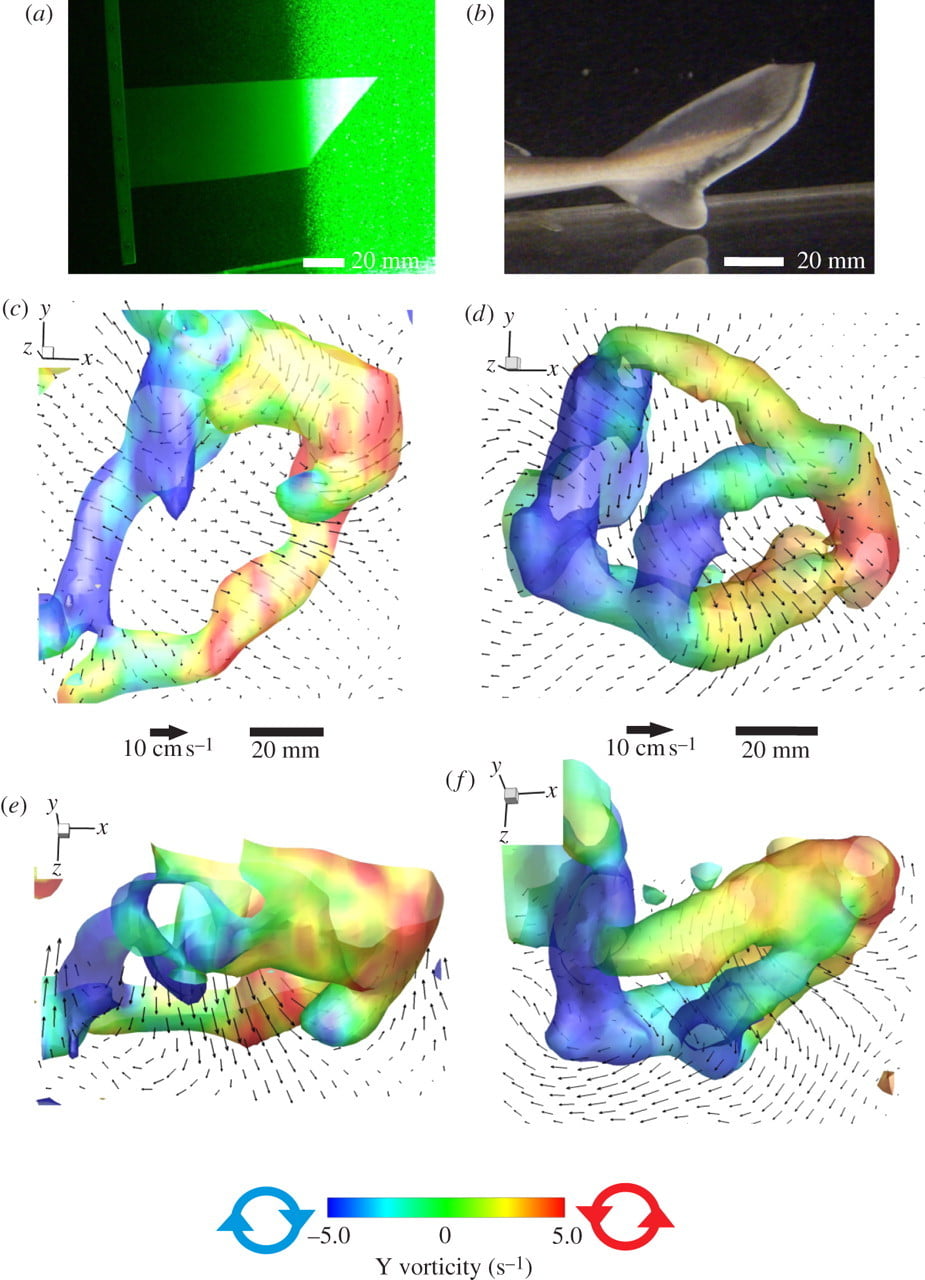
Volumetric imaging of swimming spiny dogfish, a type of shark, shows that their distinctively asymmetric tails produce a set of dual-linked vortex rings with every half beat of their tail. The figure above shows data from the actual shark on the right (b,d,f) and a similarly shaped robotic tail on the left (a,c,e). The second row contains lateral views (c,d) and the bottom row contains dorsal views (e,f) of the vorticity isosurfaces measured. The robotic tail does not demonstrate the same double vortex structure, leading scientists to suspect that the shark may be actively stiffening its tail mid-stroke to control its wake. The finding could help engineers design aquatic robots whose morphing fins help it swim more efficiently. For more, see Wired.

Visualizing Fish Wakes
This novel flow visualization technique uses dilute solutions of the tobacco mosaic virus (TMV). These rod-shaped particles align with shear and produce a birefringent interference pattern visible when viewed between crossed polarizing filters. The intensity of the light is related to the magnitude of shear. The technique is benign to the fish but enables researchers to see fluid motion around fish that other techniques cannot capture. #
Jellyfish Flow
Florescent dye reveals the flow pattern of ocean water around a swimming jellyfish. Some researchers posit that fluid drift associated with the swimming of marine animals may be as substantial a factor in ocean mixing as turbulence caused by the wind and tides. If true, modeling of climate change–past, present, and future–would need to take into account the biology of the ocean as well! #
Sharkskin-Style Swimsuits
Fans of swimming will recall the controversies of the now-banned sharkskin-style swimsuits that helped break so many records in the past few years. The suits decrease drag on a swimmer both by making them more hydrodynamic in form and by drastically reducing skin friction where the water meets the swimmer’s body. In addition to decreasing the two major sources of drag on a swimmer, the compression provided by the material can help increase blood flow to muscles. These improvements came at a high material cost, though, and, since the technology was not viable for all athletes, it has since been banned.
The Spinning Underwater Vortex
Vortex rings are a topic we’ve covered before with dolphins, whales, humans, volcanoes and even moss, but this video is particularly fun thanks to the addition of a bottle cap. By sticking the bottle cap next to the ring, these swimmers are able to demonstrate the forceful spinning of the fluid near the vortex. This spinning is what helps the vortex hold its shape over distances much larger than its diameter. As you can also see, though, sticking a bottle cap in the ring causes it to break up faster than it would otherwise! (submitted by Kris S)

Reader Question: Swimming and Buoyancy
aniiika asks:
How does buoyancy relate to swimming?
Buoyancy is the force that enables a swimmer to float in the water, even when still. Buoyant force is equal to the weight of the fluid displaced by the swimmer; in other words, the density of the fluid multiplied by the volume of the swimmer that is submerged.
Different people float at different heights in the water depending on many factors, such as body shape, amount of fat, and how much air is in their lungs. All of these things affect a person’s volume and/or density, thereby affecting the buoyant force they experience.
Because a person’s body is not fully submerged their center of buoyancy–the point where all buoyant forces on the body can be represented by a single force–does not coincide with the center of mass (sometimes referred to as center of gravity). Where those forces are relative to one another determines the stability of a person floating in the water. Everyone’s center of buoyancy is higher than their center of mass, so people always float stably in an upright orientation. Our legs, for example, don’t float as well as our torsos, so, when floating horizontally, one’s legs will tend to sink.
Swimmers can control their buoyancy to their advantage by actually pressing their upper chests further into the water. This tends to bring one’s hips closer to the surface and can reduce drag (#).
Swimming in Corn Syrup
Highly viscous laminar flows exhibit kinematic reversibility, meaning: if you move the fluid one direction and then execute the same motion in the opposite direction, every fluid particle will return to its initial, undisturbed position. Above, you see a swimming device attempting to move through corn syrup by flapping. Because of this kinematic reversibility, it cannot propel itself. For the same reason, many microscopic organisms do not utilize flapping to move.