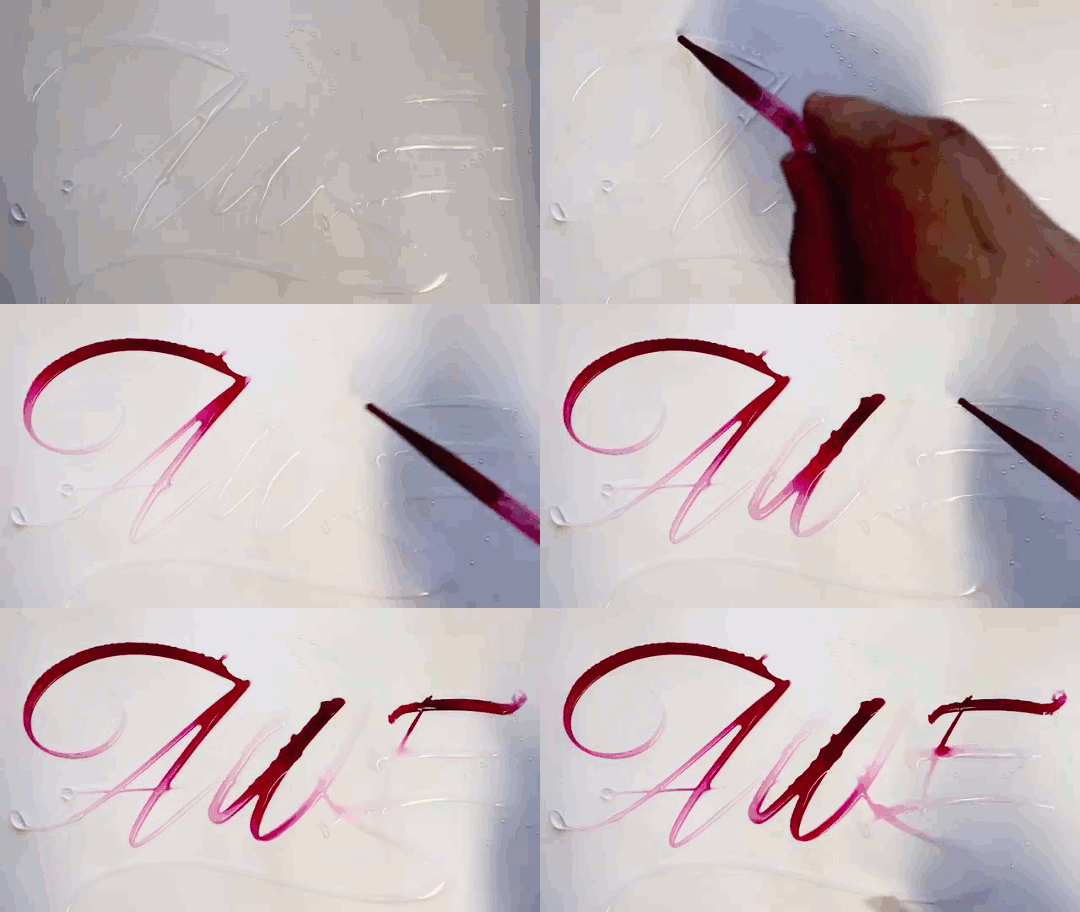
Artist Seb Lester creates calligraphy using ink and water, but not in the way you might expect. After writing in water, the artist applies ink a drop at a time, allowing fluid forces to spread it. There are a few effects at play here. Molecular diffusion – the random motion of molecules – can help two fluids mix, but it’s an extremely slow process. The fast, dramatic spread of ink seen in the video is more likely a Marangoni effect. The water and ink have different surface tensions, creating a gradient in surface tension that depends on the relative concentration of the two fluids. Gradients in surface tension create flow, which is why the ink spreads most quickly when it’s applied in an area that’s pure water. For similar physics, check out maze-solving soaps and the title sequence for “Marco Polo”. (Video and image credit: S. Lester, source; via Gizmodo)
Tag: science

The Drinking Bird
At first glance, the drinking bird is a simple desk toy, but the physics and engineering behind the device is clever enough to have challenged many great minds. In this video, Bill Hammack dissects the drinking bird, revealing the heat engine beneath the felt and feathers. The bird’s drinking is driven by thermodynamics and the relative pressures of fluids in its head and body. When the beak is wetted, fluid wicks up the felted head and slowly evaporates, thereby cooling the vapor inside the head. Some of that vapor condenses, lowering the vapor pressure in the head and allowing liquid to rise from the body. When enough fluid reaches the head, the bird tips forward. This allows vapor to rise up the liquid column into the head, equalizing the pressure between the two ends. The bird sits up with a freshly wetted head and starts the cycle over. Check out the full video for more detail, including a look at what other methods can drive the bird, including bourbon and light bulbs. (Video and image credit: B. Hammack; via J. Ouellette)


Prehistoric CFD
Computational fluid dynamics (CFD) has been a valuable tool in engineering for decades, but its use is spreading to other fields as well. The image to the left shows a reconstruction of Parvancorina, a shield-shaped marine creature that lived some 550 million years ago. Fossil evidence alone cannot tell paleontologists whether this extinct creature could move through the water, and there are no living relatives that resemble the creature that scientists could study as an analogue. Instead, researchers turned to CFD to simulate flow over and around Parvancorina. They found that Parvancorina’s shape caused fast flow over the outer portions of its body and the slowest flow near its mouth. The results suggest that, not only was the creature mobile in the water, but that it was able to adjust its orientation to drive flow to different areas of its body. Paleontologists have only been using CFD for a decade or so, but already it’s giving us valuable insight into the creatures that roamed our planet hundreds of millions of years ago. (Image credit: M. De Stefano/Muse, I. Rahman; via Physics Today)

Microfluidic Legos
Microfluidic devices are valuable tools in a lab, but they are difficult and time-consuming to manufacture. Researchers looking to simplify the building of such fluidic circuits have turned to toys. The uniformity and modularity of LEGO bricks makes them a promising platform for modifiable microfluidics. Using a micromilling machine, researchers cut narrow channels into bricks, then sealed the channel with clear adhesive and a set of tiny O-rings. Their results allow them to build and rebuild simple microfluidic devices in moments. There are limitations, though. Micromills cannot cut the smallest size channels used in today’s microfluidic devices, and the plastic of the LEGO bricks restricts the chemicals and temperatures scientists can use. Nevertheless, this could be a useful teaching tool and a new method for testing and prototyping microfluidic devices. (Image credit: MIT, source; research credit: C. Owens and A. Hart)

Scallops and Erosion


Although we often think of solids as immovable in the face of flow, the motion of air and water sculpts many parts of our world. One common pattern, seen both on surfaces that melt and those that dissolve into a flow, is called scalloping. Mathematical analysis shows that flat surfaces exposed to a flow that melts or dissolves them unavoidably develop these scallops. The surface becomes rougher as the scallops form, but the instability that drives them only works up to a specific level of roughness. Instead of the scallops becoming deeper and deeper, the flow shifts as the surface changes. Peaks in the surface erode faster than the valleys, which tends to keep the scallops relatively uniform in depth after they’ve formed. Scallops like these are often seen in soluble rocks like limestone or marble as well as in snow and ice. (Image credit: Seattle Times, G. Smith; research credit: P. Claudin et al., L. Ristroph)
“Breathe”


In black and white, the towering power of a thunderstorm looks almost apocalyptic. Photographer Mike Olbinski’s latest storm timelapse, “Breathe,” features roiling turbulence, distant downpours, and eerie mammatus clouds. Supercell thunderstorms churn and rotate over empty horizons. Billowing cumulus clouds condense from bright skies. Flashes of lightning reveal the outlines of massive thunderheads. It’s a beautiful glimpse of atmospheric fluid dynamics in action, with every texture magnified and enhanced by the stark black and white palette. (Video and image credit: M. Olbinski; via Gizmodo)

In the Eye of a Hurricane
Although eyes are common at the center of large-scale cyclones, scientists are only now beginning to understand how they form. Since real-world cyclogenesis is complicated by many competing effects, researchers look at simplified model systems first. A typical one uses a shallow, rotating cylindrical domain in which heat rises from below. The rotation provides a Coriolis force, which shapes the flow. In particular, it causes a boundary layer along the lower surface of the domain, creating a thin region where the flow moves radially inward. (Its opposite forms at the upper surface of the domain, sending flow radiating outward.) Like an ice skater spinning, the flow’s vorticity intensifies as it approaches the central axis of rotation. When the conditions are right, this intensely swirling boundary layer flow lifts up into the main flow, forming an eyewall. The eye itself, it turns out, is merely a reaction to the eyewall’s formation. (Image credit: S. Cristoforetti/ESA; research credit: L. Oruba et al.)
Jumping Larvae
Gall midge larvae, despite their lack of legs, are prodigious jumpers. These worm-like creatures use hydrostatic pressure to jump more than 30 body lengths. To do so, the larva curls itself into a loop, latching its mouth to its tail. It then shifts the fluids inside its body, flattening itself as the pressure builds. When the larva releases its tail, it flies into the air at about 1 m/s. The human equivalent of a gall midge larva’s jump would be about 60 meters, far beyond the world record long jump of less than 9 meters (with a running start). The larva’s technique is a relatively simple but highly effective one that might be useful in applications like soft robotics. (Video credit: Science; research credit: G. Farley et al.)
Withstanding Windstorms
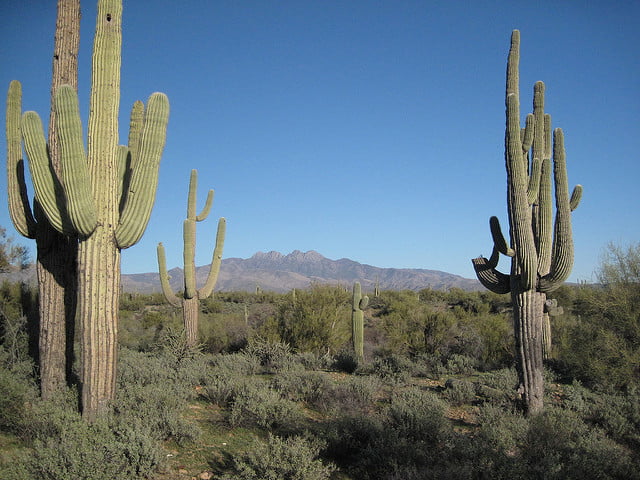
Saguaro cacti can grow 15 meters tall, and despite their shallow root systems can withstand storm winds up to 38 meters per second without being blown over. Grooves in the cacti’s surface may contribute to its resilience, by adding structural support and/or through reducing aerodynamic loads. The latter theory mirrors the concept of dimples on a golf ball; namely, grooves create turbulence in the flow near the cactus, which allows air flow to track further around the cactus before separating. The result is less drag for a given wind speed than a smooth cactus would experience.
Indeed, recent experiments on a grooved cylinder with a pneumatically-controlled shape showed exactly that; the morphable cylinder’s drag was consistently significantly lower than fixed samples. Cacti do change their shapes somewhat as their water content changes, but they don’t have the ability for up-to-the-minute alterations. Nevertheless, their adaptations can inspire engineered creations that morph to reduce wind impact. (Image credit: A. Levine; research credit: M. Guttag and P. Reis)
Water Walking, Exploding Droplets, and Colliding Vortices


Every year I look forward to the APS DFD conference in November. It brings thousands of researchers together to share the latest in fluid dynamics. So much goes on in those three days that it’s impossible to capture, but last year I teamed up with Tom Crawford and the Journal of Fluid Mechanics to attempt just that. We interviewed 50 researchers on their projects, and we’ll be bringing you their work, in their words, each month leading up to the 2018 APS DFD meeting.
This first video focuses on some of the awesome entries to the 2017 Gallery of Fluid Motion. Watch to learn about oil droplets that go flying everywhere when you’re cooking, balls that walk on water, the water music of Vanuatu and more! To see the videos we discuss and all the other entries, go to gfm.aps.org. (Video credit: N. Sharp and T. Crawford)