Vortex rings may look relatively calm, but they are concentrated regions of intensely spinning flow, as this poor jellyfish demonstrates. The rings form when a high-speed fluid gets pushed suddenly (and briefly) into a slower fluid. In the case of this bubble ring, a burst of air is pushed by a diver into relatively still water. The vorticity caused by the two areas of fluid trying to move past one another forms the ring. Like a spinning ice skater who pulls his arms inward, the narrow core of the vortex spins fast due to the conservation of angular momentum. Meanwhile, the bubble ring moves upward due to its buoyancy, pulling nearby water in as it goes. This catches the hapless jellyfish (who relies on vortex rings itself) and gives it quite a spin. But. don’t worry, the photographer confirmed that the jelly was okay after its ride. (Video credit: V. de Valles; via Ashlyn N.)
Tag: science

Castle-like Clouds
An astronaut captured this towering cloud over Andros Island from orbit aboard the ISS. This is a cumulus castellanus cloud, named for the castle-like crenelations at its top. Castellanus clouds form in areas with strong vertical updrafts, often due to cloud-level atmospheric instabilities rather than heating at the Earth’s surface. These clouds frequently proceed rain or even thunderstorms. What distinguishes castellanus from other types of cumulonimbus clouds is their shape: castellanus clouds have protrusions that are taller than they are wide – like the castles for which they are named. (Image credit: NASA / Expedition 48; via NASA Earth Observatory)

Modons
The spin of the Earth creates myriad eddies in our oceans, most of which move slowly westward at a speed dependent on their latitude. You can see many in the animation above as green and red rings slowly marching to the left. According to theory, it’s possible for two of these eddies to combine to become more than the sum of their parts; under the right conditions, the two conjoined eddies could become a modon, which, like a vortex ring, is capable of traveling far faster than its parental eddies. Despite the theory, however, no one had ever observed a modon in nature.
A new paper uses satellite imagery to identify nine modons in different locations around the world. One is shown above. Watch the eastern coast of Australia carefully, and you’ll see a modon form. It moves much faster than its surroundings, first southward toward Tasmania, then quickly eastward toward New Zealand. Thin black circles mark the two eddies that make up the modon. The strength and speed of these features makes them capable of pulling significant water mass with them. This suggests that they may play a role in ocean life, transporting water of different temperatures and nutrient content into regions it would not otherwise reach. (Image and research credit: C. Hughes and P. Miller; via Gizmodo)

Chemistry in Infrared

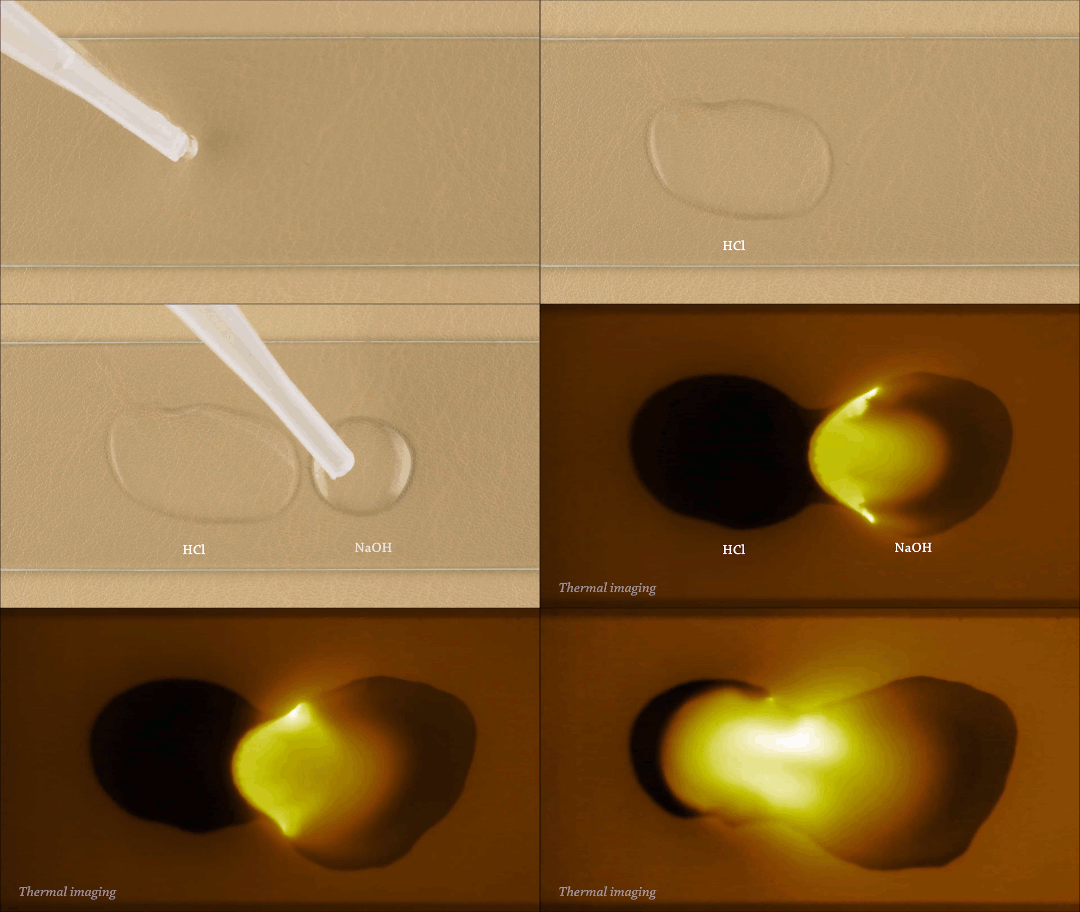

Many chemical reactions, and the flows that accompany them, are invisible to the human eye. But in infrared wavelengths those same events are vibrant and energetic. In this video from the Beauty of Science group, various chemical reactions are shown in visible and IR wavelengths, revealing very different perspectives on the same thing. Many of the reactions are exothermic, meaning that they produce heat as they occur. Because of this the thermal imaging shows where the most intense reaction is occurring at a given time. Other areas gradually darken as diffusion and flow move and dilute the heat energy released. (Video and image credit: Beauty of Science, source)

Hairy Tongues Help Bats Drink
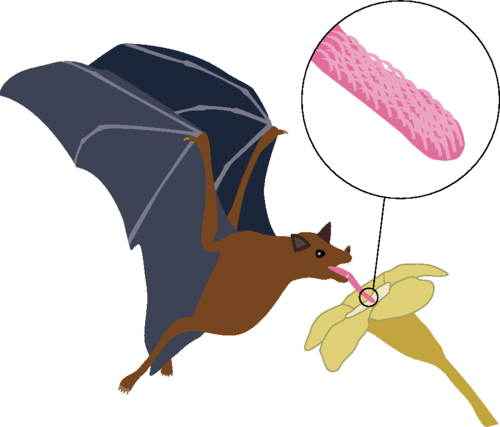
Nectar-drinking bats, honey possums, and honeybees all use hair-like protrusions on their tongues to help them drink. In bats, these papillae have blood vessels that swell when drinking, stiffening the hairs. To investigate this drinking mechanism, researchers built their own version of a bat tongue by fabricating hairy surfaces and testing how well they trapped viscous oil when dipped and withdrawn. Through a combination of experiment and mathematical modeling, the researchers found that the optimal fluid uptake depended on the density of hairs, fluid viscosity, and the withdrawal speed. When they compared their results to actual bats, honey possums, and honeybees, they found that those animals’ tongues have hair densities very close to the predicted optimal value, suggesting that their model is capturing the important physical mechanisms that have driven evolutionary advantages for these species. (Image and research credit: A. Nasto et al.; submitted by Kam-Yung Soh)
When Friction Isn’t Enough
If you try to build a pyramid of dry glass beads, you’ll have a hard time of it. The frictional forces simply aren’t enough to hold the beads together against the force of gravity. If you add a little water, though, the story is different. The intermolecular forces inside water give it a lot of cohesion, which helps it fill the narrow gaps between beads. That added capillary force gives just enough additional sticking power to hold a pyramid of beads together. (Image and video credit: amàco et al.)

Skiing, Avalanches, and Freezing Bubbles



To wrap up our look at Olympic physics, we bring you a wintry mix of interviews with researchers, courtesy of JFM and FYFD. Learn about the research that helped French biathlete Martin Fourcade leave PyeongChang with 3 gold medals, the physics of avalanches, and how bubbles freeze.
If you missed any of our previous Olympic coverage, you can find our previous entries on the themed series page, and for more great interviews with fluids researchers, check out our previous collab video. (Video credit: T. Crawford and N. Sharp; image credits: GettyImages, T. Crawford and N. Sharp)

PyeongChang 2018: Curling


Curling is a deceptively engrossing sport with some unique physics among Winter Olympic events. Athletes slide 19kg granite stones at a target 28 meters away. Along the way, teammates sweep the pebbled ice with brooms, melting it with frictional heating to help the stone slide further. The underside of the stones is concave, so they only touch the ice along a narrow ring. Researchers think roughness in the leading edge of the sliding stone cuts into the ice, leaving scratches that the trailing edge tries to follow. This is what causes the stone’s trajectory to curl. By melting the ice, sweeping also prevents curling, so competitors must know exactly when and how much to sweep. Ice conditions shift throughout a match, and the best players can read the ice to keep their stones where they want them. (Image credit: AP; W. Zhao/GettyImages)

PyeongChang 2018: Cross-Country Skiing


Cross-country skiing, also known as Nordic skiing, is a part of many longstanding disciplines in the Winter Games. Unlike downhill skiing, cross-country events typically involve mass starts, which allow athletes to interact, using one another for pacing and tactics. Drafting can be a valuable method to save energy and reduce drag. A following skier sees a 25% drag reduction while drafting; the lead skier gets about a 3% reduction in drag compared to skiing solo. Competitors usually wear tight-fitting suits to minimize drag, but unlike speedskating, for example, cross-country skiers don’t get much benefit from roughened surfaces and impermeable fabrics. Typical race speeds are 4 – 9 m/s, and most of these high-tech fabrics don’t provide tangible benefits until higher speeds. (Image credit: Reuters/S. Karpukhin, US Biathlon, GettyImages/Q. Rooney)

PyeongChang 2018: Ice-Making


When it comes to winter sports, not all ice is created equal. Every discipline has its own standards for the ideal temperature and density of ice, which makes venue construction and maintenance a special challenge. Figure skating, for example, requires softer ice to cushion athletes’ landings, whereas short-track speed skating values dense, smooth ice for racing. The Gangneung Ice Arena hosts both and can transition between them in under 3 hours. Gangneung Oval hosts long-track speed skating and makes its ice layer by layer, spraying hot, purified water onto the rink. This builds up a particularly dense and therefore smooth ice.
The toughest sport in terms of ice conditions is curling, which requires a finely pebbled ice surface for the stones to slide on. Forming those tiny crystals on the ice sheet can only be done at precise temperature and humidity conditions. This is a particular challenge for Gangneung Curling Center due to its coastal location. To keep the temperature and humidity under control at full crowd capacity, officials even went so far as to replace all the lighting at the facility with LEDs! (Image credit: Pyeongchang 2018, 1, 2, 3)