These days artificial snow-making is a standard practice for ski resorts, allowing them to jump-start the early part of the season. Snow guns continuously spray a mixture of cold water and particulates 5 or more meters in the air to generate artificial snow. The tiny droplet size helps the water freeze faster and the particles provide nucleation sites for snow crystals to form. As with natural snow, the shape and consistency of the snow depends on humidity and temperature conditions. Pyeongchang is generally cold and dry, so even the artificial snow there tends to be similar to snow in the Colorado Rockies. Recreational skiers tend to look down on artificial snow, but Olympic course designers actually prefer it. With artificial snow, they can control every aspect of an alpine course. For them, natural snowfall is a disruption that puts their design at risk. (Video credit: Reactions/American Chemical Society)
Tag: science

PyeongChang 2018: Speedskating


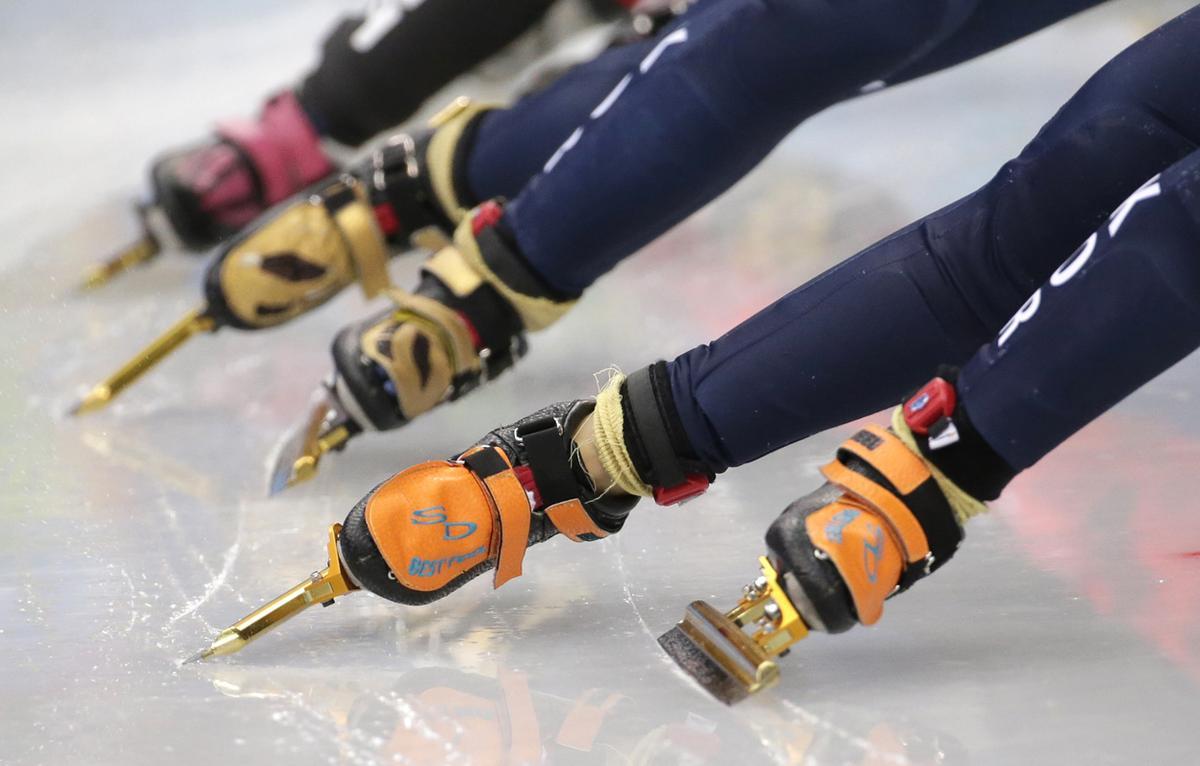
Four years ago in Sochi, Under Armour’s suits for the U.S. speedskating team took a lot of flak after the team failed to medal. The company defended the physics and engineering of their suits, and an internal audit of the speedskating program ultimately placed blame on flaws in their training regimen, unfamiliarity with the new suits, and overconfidence.
This time around Under Armour has taken a more hands-on approach with the team, helping with training regimens in addition to providing suits. Under Armour spent hundreds of hours testing the suits in Specialized’s wind tunnel, including testing many fabrics before settling on the slightly rough H1 fabric used in patches on the skater’s arms and legs. Like the previous suit’s dimpled design, the roughness of the fabric promotes turbulent flow near it. Because turbulent flow follows curved contours better than laminar flow does, air stays attached to the athlete for longer, thereby reducing their drag. The suit is also designed with asymmetric seams that help the athlete stay low and comfortable in the sport’s frequent left turns.
U.S. speedskaters have been competing in a version of the suits since last winter, ensuring that athletes are familiar with the equipment this time around. Whether the new suits and training program will pay off remains to be seen. After their disastrous experience in Sochi, both the team and the company are shy about setting expectations. (Image credits: D. Maloney/Wired; US Speedskating)

PyeongChang 2018: Skeleton


Skeleton, the sliding event in which athletes race down an ice track head first, is a fast-paced and punishing sport. Skeleton racers can reach speeds of 125 kph (~80 mph) during their descents. This is a little slower than the feet-first luge, in part because the skeleton sled runs on circular bars rather than sharp runners.
Body positioning is key in the sport. It’s the athlete’s primary method of steering, and it controls how much drag slows them down. But skeleton runs are brutally taxing; athletes pull 4 or 5g in the turns – more than astronauts experience during a launch! All that jostling means athletes cannot stand more than about 3 trips down the track in a day. To practice positioning without the bone-jarring descent, athletes can work in a wind tunnel. While the wind tunnel provides the aerodynamic equivalent of their usual speed, athletes focus on holding their bodies in the most streamlined position. Some wind tunnels are even able to provide screens that let the athletes see their drag values in real-time, letting them adjust to learn what works best for them. (Image credit: N. Pisarenko/AP, Bromley Sports)

PyeongChang 2018: Ski Jumping


No winter sport is more aerodynamically demanding than ski jumping. A jump consists of four parts: the in-run, take-off, flight, and landing. The in-run is where an athlete gains her speed, and to keep drag from slowing her down, she descends in a streamlined tuck that minimizes frontal area. The biggest aerodynamic challenge comes during flight, when the jumper wants to maximize lift while minimizing drag. The athlete spreads her skis in a V-shape and flattens her body, using her hands to adjust her flight. Flying the farthest requires careful management of forces while in the air. Wind plays a major role as well, with headwinds helping athletes fly farther. To compensate, scoring includes a wind factor calculated based on conditions for each jump. (Image credit: B. Pieper, Reuters/K. Pfaffenbach, PyeongChang 2018)

PyeongChang 2018: Moguls


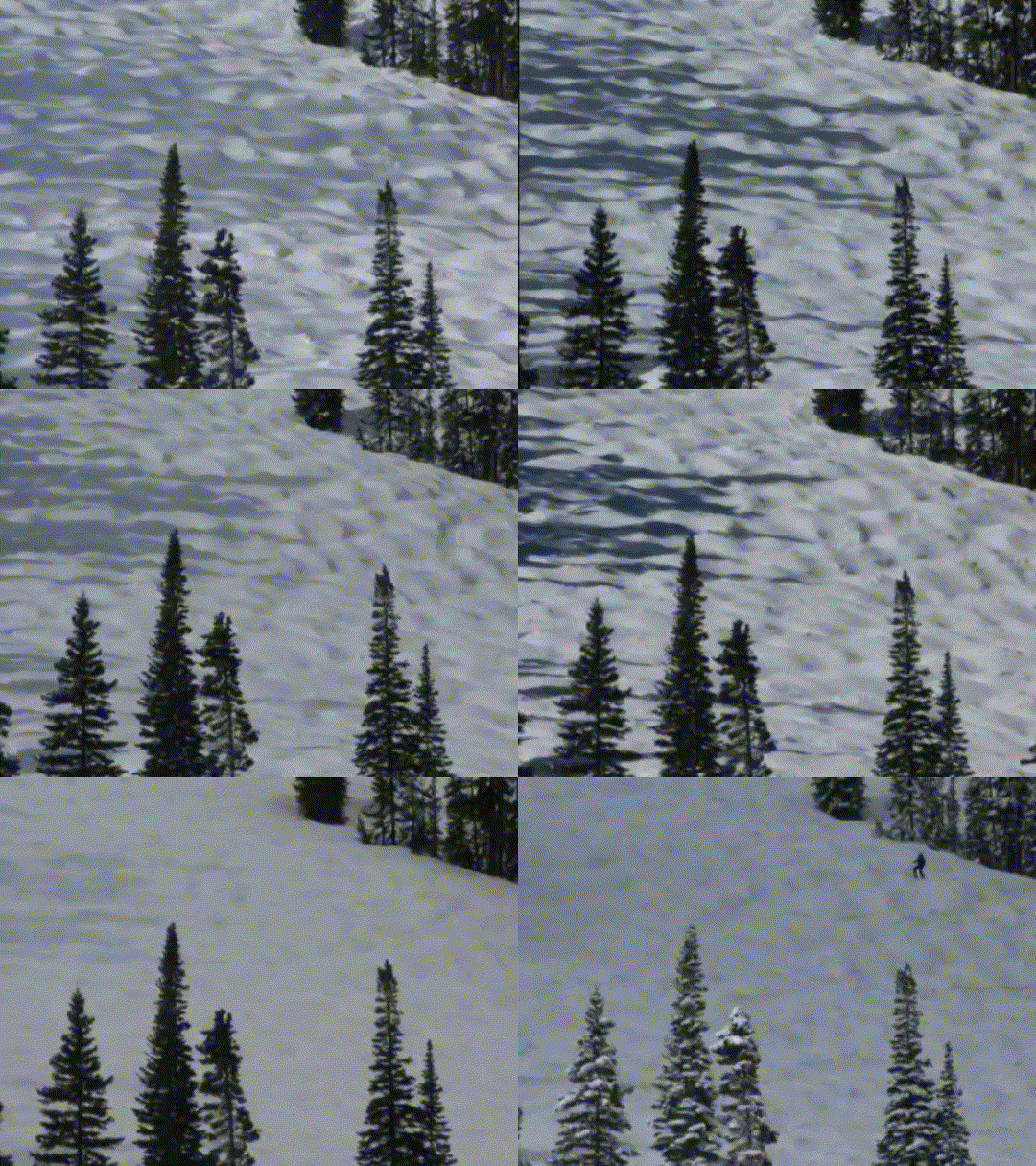
Moguls are bump-like snow mounds featured in freestyle skiing competitions and also frequently found on recreational ski courses. Although competition runs are man-made, most mogul fields form naturally on their own. As skiiers and snowboarders carve S-shaped paths down the slope, their skis and snowboards remove snow during sharp turns and deposit it further downhill. Over a surprisingly short amount of time, these random, uncoordinated actions form bumps large enough that they force skiers and snowboarders to begin turning on the downhill side of the bump. That action continues to carve out snow on the uphill side and deposit it downhill, effectively causing the downhill bumps to migrate uphill, as seen in the timelapse animation below. As more moguls form, their motion organizes them into a checkerboard-pattern that moves in lockstep. Observations show that mogul fields can move about 10 meters uphill over the course of a season. Seemingly, the only way to prevent mogul formation on steep slopes is to regularly groom them back to a flat state! (Image credits: J. Gruber/USA Today; J. Huet; D. Bahr; research credit: D. Bahr et al.)


PyeongChang 2018: Ice’s Watery Sublayer
The Olympic Charter declares that winter sports must be practiced on snow or ice. Both are frozen forms of water, which despite its ubiquity, is one of the strangest substances around. In addition to its tendency to expand as it freezes, ice is inherently slippery, and no one’s quite certain yet why.
Most people have heard the theory that ice skating is possible due to high pressure melting the ice beneath the narrow blade. But realistically, pressure melting should only work for ice down to about -3.5 degrees Celsius. By contrast, the ideal temperatures for figure skating and ice hockey are -5.5 and -9 degrees Celsius, respectively. Melting due to friction might account for slipperiness a few more degrees below freezing, but it doesn’t explain why ice can be slippery when you’re just standing on it.
When physicist Michael Faraday suggested in 1850 that ice has a thin liquid-like layer at its surface, many discounted the theory. But modern experimental techniques and computer simulations have shown that Faraday was right. Ice has a liquid-like layer some 1 to 100 nanometers thick at its surface, and this layer persists to temperatures below -30 degrees Celsius. The process is known as surface pre-melting and what causes it is an area of active research for physical chemists. Current theories include hydrogen bonding and even quantum mechanical effects. (Image credit: AP Photo/B. Armangue; research credit: R. Rosenberg; Y. Li and G. Somorjai; F. Paesani and G. Voth)
This opens FYFD’s two-week series on the physics and fluid dynamics of the Winter Olympics. Stay tuned! – Nicole

“Moving Creates Vortices and Vortices Create Movement”
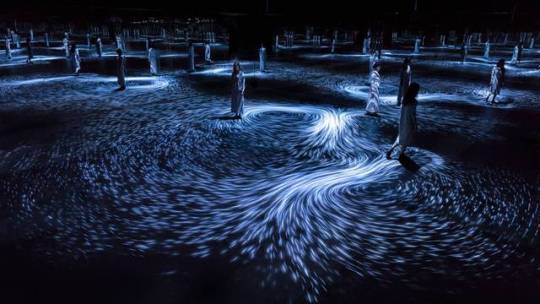
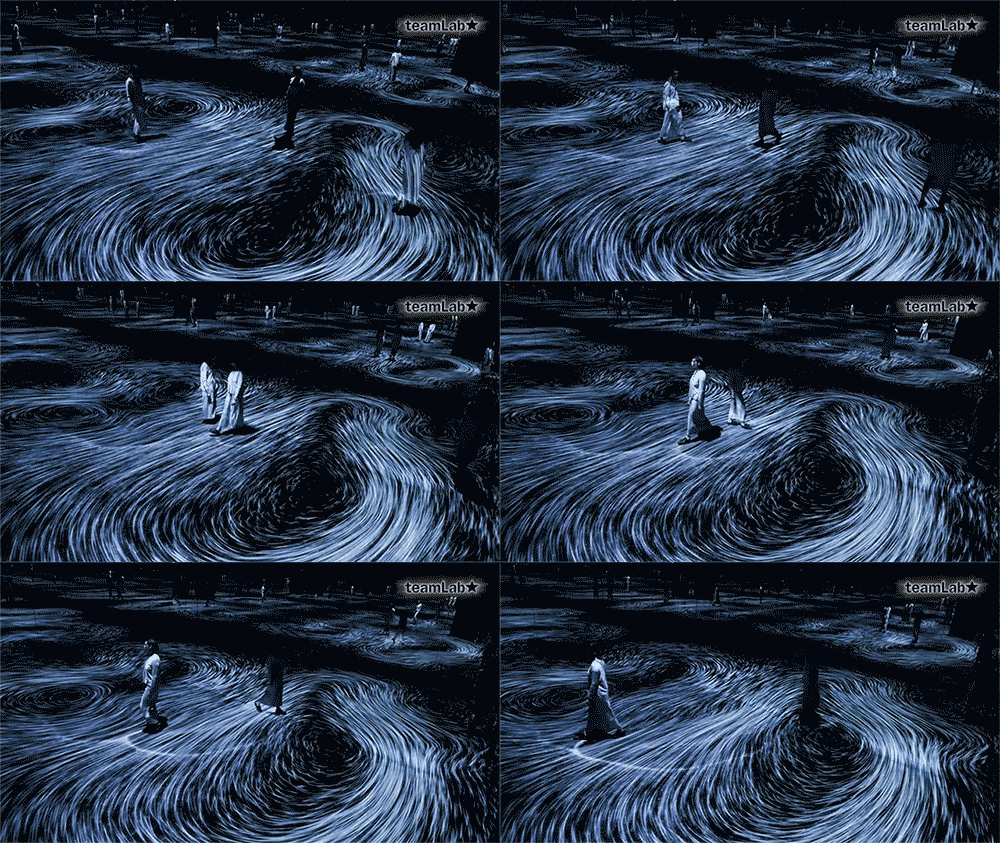

A new interactive installation by the Japanese art collective teamLab uses the movement of visitors to drive vortex motion. Entitled “Moving Creates Vortices and Vortices Create Movement,” the installation uses projectors in a mirror room to create the sensation of an infinite, indoor ocean that’s constantly churned by the paths visitors take. In the absence of motion, the room slowly fades to darkness. The installation is currently in the National Gallery of Victoria in Melbourne, Australia, and will be open until April 15th, 2018. (Image credit: teamLab; via Colossal; submitted by jshoer)
P.S. – Winter Olympic coverage will start on Monday, February 12th! – Nicole

Crevasses


Glacial ice is constantly flowing but at speeds we don’t notice by eye. That doesn’t mean there aren’t signs, though! Crevasses, narrow fractures in the ice that may be tens of meters deep, are a sign of those flows. Crevasses form in areas where the ice is under high stress. That could be a spot where the ice is flowing down a steeper incline or a place where multiple ice flows merge. Researchers can even use ice-penetrating radar to locate buried crevasses deep inside the ice. These are remnants of past flow conditions and provide hints at how the ice flows have changed over time. Crevasses are also a path for meltwater to penetrate deep into the ice, which can change slip conditions at the base of the glacier and increase both flow and melt rates. (Image credit: NASA/Digital Mapping Survey; via NASA Earth Observatory)

Flowing Through Tight Spaces
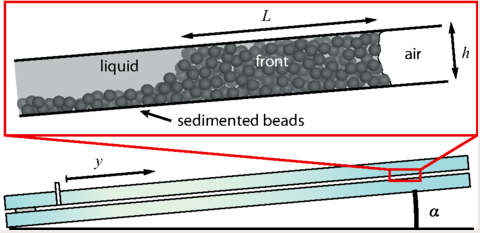
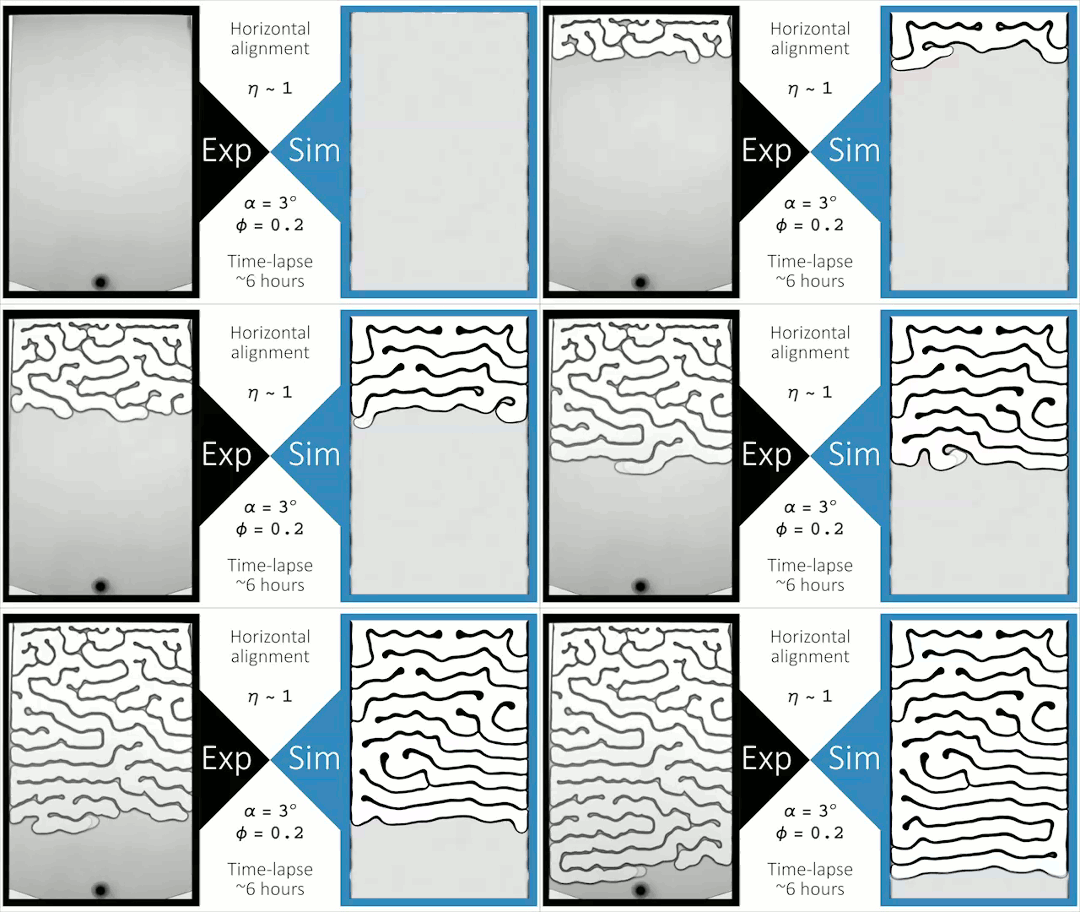
Fluid flow through porous media inside confined spaces can be tough to predict but is key to many geological and industrial processes. Here researchers examine a mixture of glass beads and water-glycerol trapped between two slightly tilted plates. As liquid is drained from the bottom of the cell, air intrudes. Loose grains pile up along the meniscus and get slowly bulldozed as the air continues forcing its way in. The result is a labyrinthine maze formed by air fingers of a characteristic width. The final pattern depends on a competition between hydrostatic pressure and the frictional forces between grains. Despite the visual similarity to phenomena like the Saffman-Taylor instability, the authors found that viscosity does not play a major role. For more, check out the video abstract here. (Image and research credit: J. Erikson et al., source)
Water Calligraphy
Artist Seb Lester creates calligraphy using ink and water, but not in the way you might expect. After writing in water, the artist applies ink a drop at a time, allowing fluid forces to spread it. There are a few effects at play here. Molecular diffusion – the random motion of molecules – can help two fluids mix, but it’s an extremely slow process. The fast, dramatic spread of ink seen in the video is more likely a Marangoni effect. The water and ink have different surface tensions, creating a gradient in surface tension that depends on the relative concentration of the two fluids. Gradients in surface tension create flow, which is why the ink spreads most quickly when it’s applied in an area that’s pure water. For similar physics, check out maze-solving soaps and the title sequence for “Marco Polo”. (Video and image credit: S. Lester, source; via Gizmodo)