Tag: Plateau-Rayleigh instability

  • Featured Video Play Icon

    Molten Copper

    In this video, the Slow Mo Guys prove that pouring molten copper in slow motion is every bit as satisfying as one would imagine. Because they pour the metal from fairly high up, they get a nice break-up from a jet into a series of droplets; that’s due to the Plateau-Rayleigh instability, in which surface tension drives the fluid to break up into drops. Upon impact, the copper splashes and splatters very nicely, forming the crown-like splash many are familiar with from famous photos like Doc Edgerton’s milk drop. The key difference between the molten copper and any other liquid’s splash comes from cooling; watch closely and you’ll see some of the copper solidifying along the edges and surface of the fluid as it cools. In this respect, watching the molten copper is more like watching lava flow than seeing water splash. (Video and image credit: The Slow Mo Guys)

  • Shot Through a Drop

    Shot Through a Drop

    Shoot a sphere through a drop with sufficient speed, and you’ll see something like the composite photo above. Going from right to left, the projectile is initially coated in liquid and stretches the fluid behind it as it continues flying. This forms a thin sheet of fluid called a lamella with a thicker, uneven rim at its far end. The lamella continues stretching until the projectile breaks through and detaches. Now the lamella starts rebounding back on itself as surface tension struggles to keep the fluid together. A new rim forms on the front, and both the front and back rims thicken as the lamella collapses. Along the rims thicker portions start forming droplets – like spikes on a crown – as the surface-tension-driven Plateau-Rayleigh instability starts breaking the structure down. The untenable sheet of fluid will break up into a cloud of smaller, satellite droplets when it can hold together no longer. (Image credit: V. Sechenyh et al., video)

  • Featured Video Play Icon

    Colors in Macro

    Milk, acrylic paints, soap, and oil – all relatively common fluids, but together they form beautiful mixtures worth leaning in to enjoy. Variations in surface tension between the liquids cause much of the motion we see. Soap, in particular, has a low surface tension, which causes nearby colors to get pulled away by areas with higher surface tension, behavior also known as the Marangoni effect. Adding oil creates some immiscibility and lets you appreciate both the coalescence and fragmentation of the fluids. And finally, there’s one of my favorite sequences, where bubbles start popping in slow motion. As the bubble film ruptures, fluid pulls away, breaking into ligaments and then a spray of droplets as the bubble disintegrates. (Video credit: Macro Room; via Gizmodo)

  • Dripping, Frozen

    Dripping, Frozen

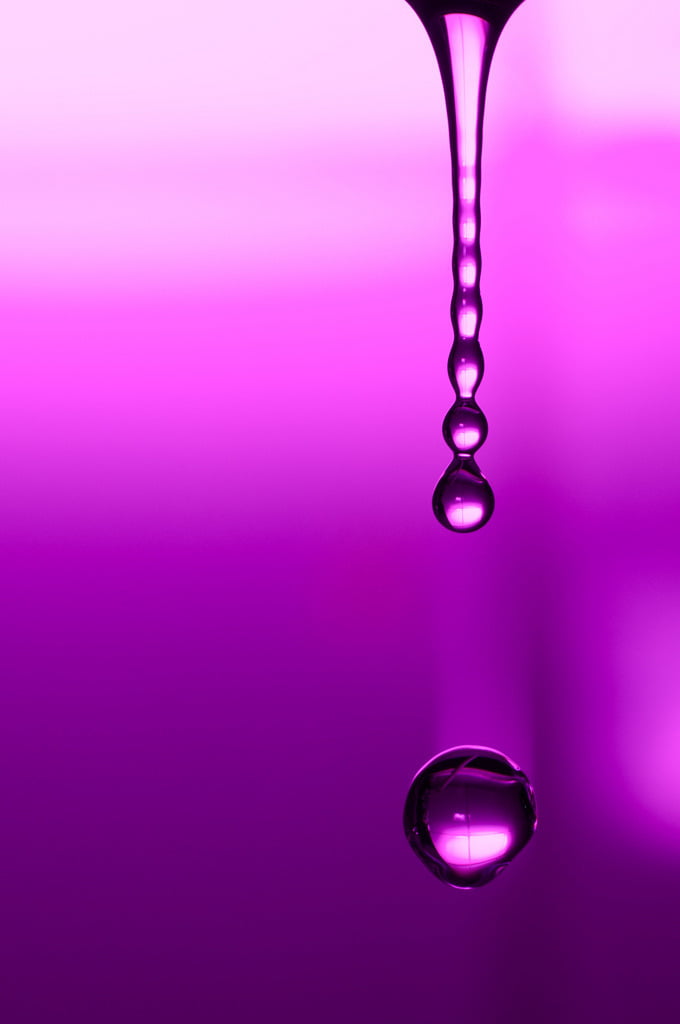
    The simple drip of a faucet is more complicated when frozen in time. Any elongated strand of water tends to break up into droplets due to surface tension and the Plateau-Rayleigh instability. Whenever the radius of the water column shrinks, surface tension tends to drive water away from the narrow region and toward a wider point. This exaggerates the profile, making narrow regions skinnier and wider regions fatter. Eventually, the neck connecting the droplets becomes so thin that it pinches off completely, leaving a string of falling droplets.  (Image credit: N. Sharp)

  • Daily Fluids, Part 1

    Daily Fluids, Part 1

    Just getting cleaned up and ready for the day involves a lot of fluid physics. Here are a few of the phenomena you may see daily without realizing:

    Plateau-Rayleigh Instability
    This behavior is responsible for the dripping of your faucet. More specifically, it’s the reason that a falling jet breaks up into droplets. It works on rain, too!

    Forced Convection
    Everyone is familiar with a winter wind making them colder or hot air from a dryer getting the moisture off their hands. These are examples of forced convection – heat transfer by driving a fluid past a solid. Another common example? The fans in your computer!

    Liquid Atomization
    This is the process of breaking a liquid into lots of tiny droplets. Aside from any aerosol can ever, this phenomenon is also key to your daily shower and internal combustion in your car.

    Archimedes Principle
    This might be one of my favorite bits of the whole video because it hearkens back to some of my own earliest fluid dynamics exposure. Archimedes Principle says that buoyancy is equal to the weight of the fluid a body displaces. My mom (a science teacher) taught me about this one in the bathtub! It’s key to everything that ever floated, including us!

    Tune in all week for more examples of fluid dynamics in daily life. (Image credit: S. Reckinger et al., source)

  • Featured Video Play Icon

    Watching a Sneeze

    What does a sneeze look like? You might imagine it as a violent burst of air and a cloud of tiny droplets. But this high-speed video shows, that’s only part of the story. The liquid leaving a sneezer’s mouth and nose is a mixture of saliva and mucus, and in the few hundred milliseconds it takes to expel this air/mucosaliva mixture, there’s not enough time for the liquid to break into droplets. Instead, liquid leaves the mouth as a fluid sheet that breaks into long ligaments.

    Because mucosaliva is viscoelastic and non-Newtonian, it does not break down into droplets as quickly as water. Instead, when stretched, the proteins inside the fluid tend to pull back, causing large droplets to form with skinny strands between them – the beads-on-a-string instability. The end result when the ligaments do finally break is more large droplets than one would expect from a fluid like water. Understanding this break-up process and the final distribution of droplet sizes is vital for better understanding the spread of diseases and pathogens.  (Video credit: Bourouiba Research Group; research paper: B. Scharfman et al., PDF)

  • Featured Video Play Icon

    Inside a Popping Bubble

    Popping a soap bubble is more complicated than what the eye can see. In high-speed video, we find that the action is very directional, with the soap bubble film pulling away from the point of rupture. As it does so, waves, like those in a flapping flag, appear along the surface and strings of fluid form along the edge of the film before breaking into droplets. This video takes matters a step further, looking at what happens to air inside a bubble when it pops. Those subtle waves and strings of fluid we see in the high-speed rupture have a distinctive effect on air inside the bubble. As the film pulls away, it leaves behind a rippled, wavy surface rather than a smooth sphere of foggy air. (Video credit: Z. Pan et al.)

  • Breaking Jets Into Drops

    Breaking Jets Into Drops

    A falling stream of water will break into droplets due to the Plateau-Rayleigh instability. Small disturbances can create a wavy perturbation in the falling jet. Under the right conditions, the pressure caused by surface tension will be larger in the narrower regions and smaller in the wider ones. This imbalance will drive flow toward the wider regions and away from the narrower ones, thereby increasing the waviness in the jet. Eventually, the wavy jet breaks into droplets, which enclose the same volume of water with less surface area than the perturbed jet did. The instability is named for Joseph Plateau and Lord Rayleigh, who studied it in the late 19th century and showed that a falling jet of a non-viscous fluid would break into droplets if the wavelength of its disturbance was larger than the jet’s circumference.  (Image credit: N. Morberg)

  • Spinning Paint

    Spinning Paint

    Fluid dynamical behaviors are often the result of competing forces. Here paint flung from a spinning rod illustrates the effects of adhesion, surface tension, and centrifugal force. In general, surface tension tries to hold a fluid together, and adhesion allows it to stay attached to a surface. Centrifugal force, on the other hand, tends to push the fluid outward. As the spinning rod accelerates, centrifugal force wins over adhesion and the paint spirals outward. For awhile, surface tension manages to hold the paint together, stretching it into spiraling ligaments of fluid. But when centrifugal force overpowers surface tension as well, the ligaments of paint snap into smaller droplets, still flying outward. Check out the full video for more great slow motion shots, and be sure to look at photographer Fabian Oefner’s “Black Hole“ series, which inspired the video. (Image credit: BBC Earth Unplugged, source video)

  • Piazza del Popolo

    Piazza del Popolo

    The lions of the fountain in Rome’s Piazza del Popolo eject a turbulent sheet of water. Random fluctuations in the water sheet cause holes to form. Driven by surface tension, these holes grow and merge, leaving behind ligaments of water which quickly break up into a spray of unevenly-sized drops. (Image credit: E. Villermaux)