
Have you ever wondered what happens inside a jet of fluid as it breaks into droplets? Such events are not commonly or readily measured. This video uses a double emulsion–in which immiscible fluids are encapsulated into a multi-layer droplet–to demonstrate interior fluid flow during the Plateau-Rayleigh instability. The innermost drops and the fluid encapsulating them have a low surface tension between them, thanks to the addition of a surfactant to the inner drops. As a result, the inner drops are easily deformed by motion in the fluid surrounding them. Flow on the left side of the jet is clearly parabolic, similar to pipe flow. Closer to the pinch-off, the inner droplets shift to vertical lines, indicating that the interior flow’s velocity is constant across the jet. After pinch-off, the inner droplets return to a spherical shape because they are no longer being deformed by fluid movement around them. The coiling of the inner drops inside the bigger one is due to the electrical charges in the surfactant used. (Video credit: L. L. A. Adams and D. A. Weitz)
Tag: Plateau-Rayleigh instability

Breaking into Droplets
A falling column of liquid, like the water from your faucet, will tend to break up into a series of droplets due to the Plateau-Rayleigh instability. This instability is driven by surface tension. Small variations in the radius of the column occur naturally. Where the radius shrinks, the pressure due to surface tension increases, causing liquid to flow away, which shrinks the column’s radius even further. Eventually the column pinches off and breaks into droplets. What’s especially neat is that the size of the final droplets can be predicted based on the column’s initial radius and the wavelength of its disturbances. (Video credit: BYU Splash Lab)

Stopping Jet Break-Up
When a stream of liquid falls, a surface tension effect called the Plateau-Rayleigh instability causes small variations in the jet’s radius to grow until the liquid breaks into droplets. For a kitchen faucet, this instability acts quickly, breaking the stream into drops within a few centimeters. But for more viscous fluids, like honey, jets can reach as many as ten meters in length before breaking up. New research shows that, while viscosity does not play a role in stretching and shaping the jet as it falls–that’s primarily gravity’s doing–it plays a key role in the way perturbations to the jet grow. Viscosity can delay or inhibit those small variations in the jet’s diameter, preventing their growth due to the Plateau-Rayleigh instability. In this respect, viscosity is a stabilizing influence on the flow. (Photo credit: Harsha K R; via Flow Visualization)

Colorful Spirals

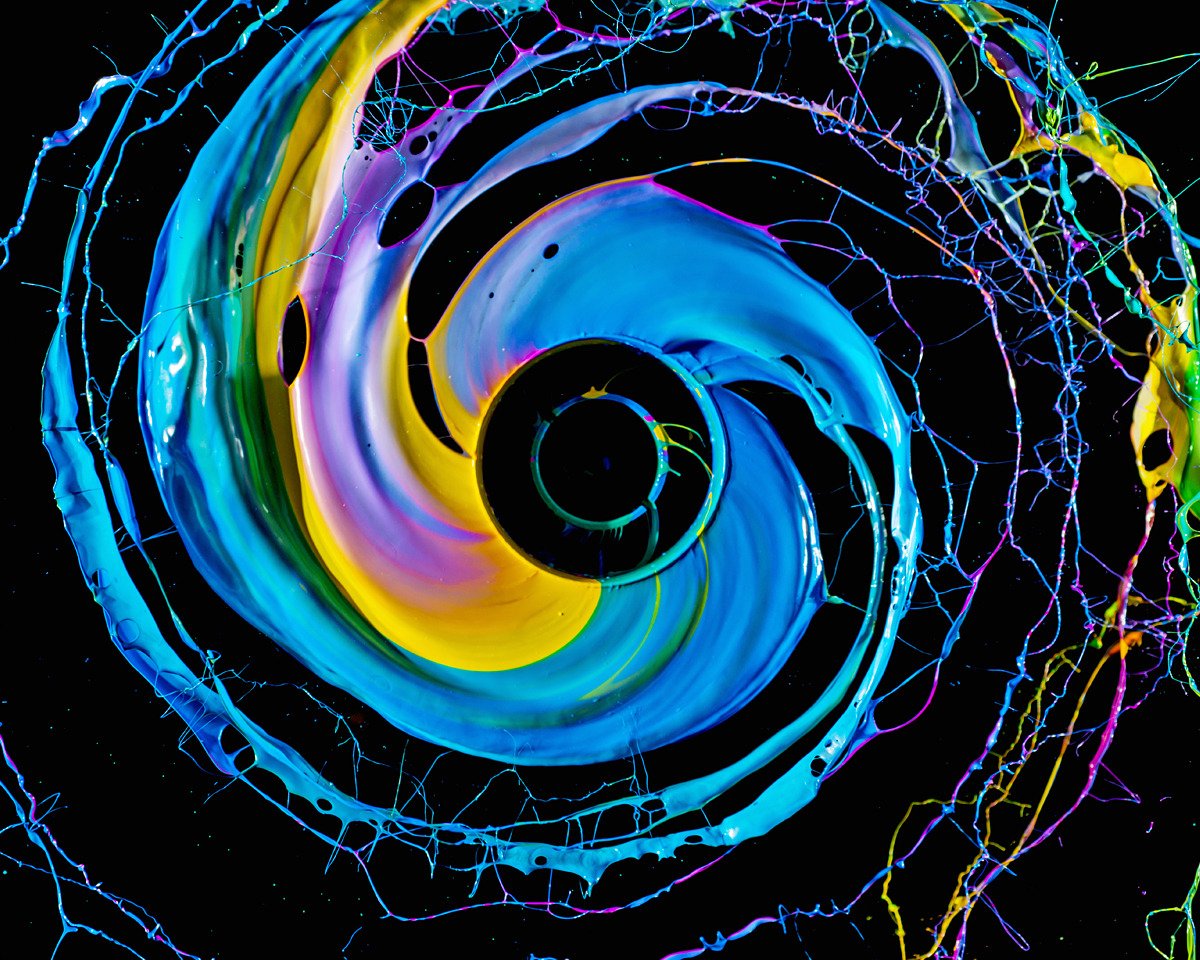
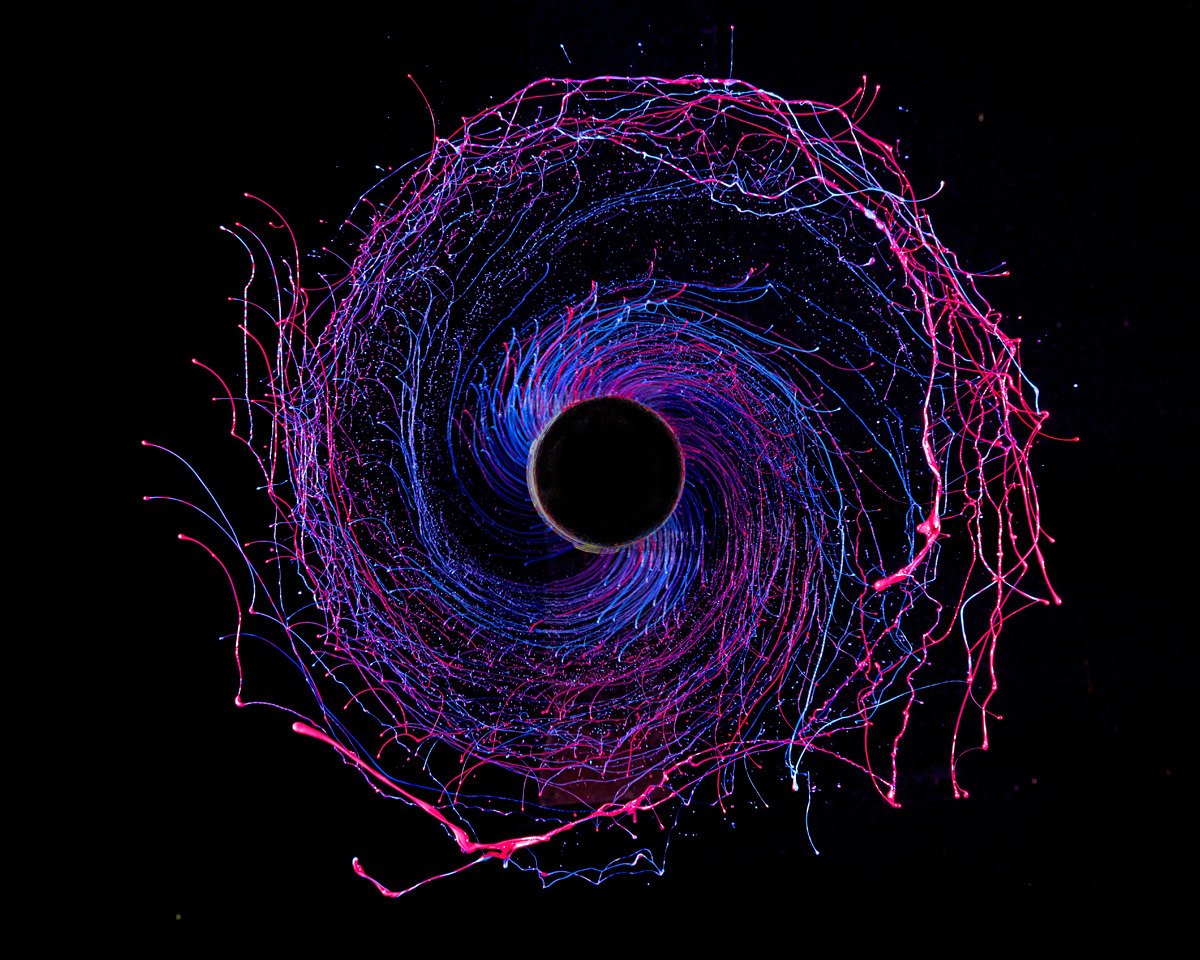
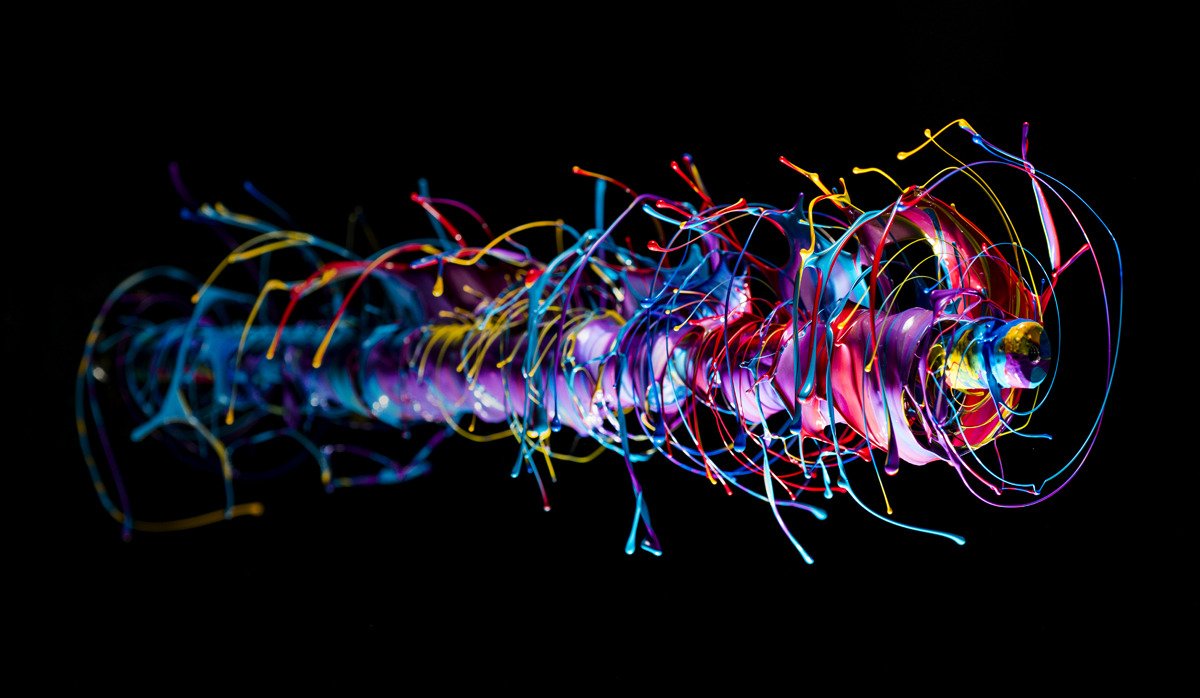
Artist Fabian Oefner captures these colorful portraits of fluid instability by dripping acrylic paints onto a metal rod, which is connected to a drill. When the drill is switched on, paint is flung away from the rod, creating these snapshots of centripetal force and surface tension. Note how droplets gather at the ends of the spiral arms like in a Plateau-Rayleigh or a rimming instability. For more, check out Oefner’s webpage, which includes a video showing how the images are made, or his previously featured work, “Millefiori”. (Photo credit: F. Oefner; submitted by Stephen D.)

The Red Crown
A drop of red dye falls into a thin layer of milk, forming a crown splash. Notice the pale edges of the droplets at the rim of the crown; this is milk that has been entrained by the original drop. The rim and satellite droplets surrounding the splash are formed due to surface tension effects, chiefly the Plateau-Rayleigh instability–the same effect responsible for breaking a falling column of liquid into droplets like in a leaking faucet. The instability will have a most unstable wavelength that determines the number of satellite droplets formed. (Photo credit: W. van Hoeve et al., University of Twente)
Spitting Droplets
Any phenomenon in fluid dynamics typically involves the interaction and competition of many different forces. Sometimes these forces are of very different magnitudes, and it can be difficult to determine their effects. This video focuses on capillary force, which is responsible for a liquid’s ability to climb up the walls of its container, creating a meniscus and allowing plants and trees to passively draw water up from their roots. Being intermolecular in nature, capillary forces can be quite slight in comparison to gravitational forces, and thus it’s beneficial to study them in the absence of gravity.
In the 1950s, drop tower experiments simulating microgravity studied the capillary-driven motion of fluids up a glass tube that was partially submerged in a pool of fluid. Without gravity acting against it, capillary action would draw the fluid up to the top of the glass tube, but no droplets would be ejected. In the current research, a nozzle has been added to the tubes, which accelerates the capillary flow. In this case, both in terrestrial labs and aboard the International Space Station, the momentum of the flow is sufficient to invert the meniscus from concave to convex, allowing a jet of fluid out of the tube. At this point, surface tension instabilities take over, breaking the fluid into droplets. (Video credit: A. Wollman et al.)

Slapping Sheets
Here fluid is ejected as two flat plates collide, creating a sheet of silicone oil. The initially smooth sheet forms a thicker ligament about the edge. Gravity causes the sheet to bend downward like a curtain, and growing instabilities along the ligament cause the development of a wavy edge. The points of the waves develop droplets that eject outward. Not long after this photograph, the entire liquid sheet will collapse into ligaments and flying droplets. (Photo credit: B. Chang, B. Slama, and S. Jung)
Laminar Fountain
In the midst of holiday travels, take a moment (particularly if you’re flying through Detroit) to enjoy the simple beauty of WET Design’s fountain in the McNamara Terminal. Laminar jets arc through the air almost like perfect crystalline columns of fluid. Watch closely and you’ll see a few wavy variations–like a Plateau-Rayleigh instability creeping in–but there will be no turbulence to distress passengers and passers-by. (Video credit: WET Design)

The Archer Fish’s Arrows

The archer fish hunts by shooting a jet of water at insects in the leaves above and knocking them into the water. How the fish achieve this feat has been a matter of contention. A study of high-speed video of the archer’s shot shows that fluid dynamics are key. The fish releases a pulsed liquid jet, imparting greater velocity to the tail of the jet than the head. As a result, the tail tends to catch up to the head and increase the jet’s mass on impact while decreasing the duration of impact. Simultaneously, the jet tends to break down into droplets via the Rayleigh-Plateau instability caused by surface tension. Surface tension’s power to hold the water in droplets combined with the inertial effects of the pulsed jet create a ball of fluid that strikes the archer’s prey with more than five times the power than vertebrate muscles alone can impart. For more on archer fish, check out this video and the original research paper by A. Vailati et a. (Photo credits: Scott Linstead and BBC; submitted by Stuart R)

Rebounding
A ping pong ball bounces off a puddle, drawing a liquid column upward behind it. This photo shows the instant after the fluid has disconnected from the ball, allowing it to rebound without further loss of momentum to the fluid. The fluid column begins to fall under gravity, the tiny undulations in its radius growing via the Rayleigh-Plateau instability and eventually causing the column to separate from the puddle. You can see the whole process in action in this high-speed video. (Photo credit: BYU Splash Lab)


