The lions of the fountain in Rome’s Piazza del Popolo eject a turbulent sheet of water. Random fluctuations in the water sheet cause holes to form. Driven by surface tension, these holes grow and merge, leaving behind ligaments of water which quickly break up into a spray of unevenly-sized drops. (Image credit: E. Villermaux)
Tag: Plateau-Rayleigh instability

Hydrophobicity and Viscous Flow
Hydrophobic surfaces are great for creating some wild behaviors with water droplets, but they make neat effects with other liquids, too. The viscous honey in the first segment of this Chemical Bouillon video is a great example. Because the honey doesn’t adhere to the hydrophobic surface, the viscoelastic fluid does not maintain the form it had when drizzled on the surface. Instead, the honey contracts, with surface tension driving Plateau-Rayleigh-like instabilities that break the contracting ligaments apart to form nearly spherical droplets of honey on the surface. (Video credit: Chemical Bouillon)

The Real Shape of Raindrops
We often think of raindrops as spherical or tear-shaped, but, in reality, a falling droplet’s shape can be much more complicated. Large drops are likely to break up into smaller droplets before reaching the ground. This process is shown in the collage above. The initially spherical drops on the left are exposed to a continuous horizontal jet of air, similar to the situation they would experience if falling at terminal velocity. The drops first flatten into a pancake, then billow into a shape called a bag. The bags consists of a thin liquid sheet with a thicker rim of fluid around the edge. Like a soap bubble, a bag’s surface sheet ruptures quickly, producing a spray of fine droplets as surface tension pulls the damaged sheet apart. The thicker rim survives slightly longer until the Plateau-Rayleigh instability breaks it into droplets as well. (Image credit: V. Kulkarni and P. Sojka)
Colliding in Microgravity
On Earth, it’s easy for the effects of surface tension and capillary action to get masked by gravity’s effects. This makes microgravity experiments, like those performed with drop towers or onboard the ISS, excellent proving grounds for exploring fluid dynamics unhindered by gravity. The video above looks at how colliding jets of liquid water behave in microgravity. At low flow rates, opposed jets form droplets that bounce off one another. Increasing the flow rate first causes the droplets to coalesce and then makes the jets themselves coalesce. Similar effects are seen in obliquely positioned jets. Perhaps the most interesting clip, though, is at the end. It shows two jets separated by a very small angle. Under Earth gravity, the jets bounce off one another before breaking up. (The jets are likely separated by a thin film of air that gets entrained along the water surface.) In microgravity, though, the jets display much greater waviness and break down much quicker. This seems to indicate a significant gravitational effect to the Plateau-Rayleigh instability that governs the jet’s breakup into droplets. (Video credit: F. Sunol and R. Gonzalez-Cinca)
When Jets Collide
When two jets of a viscous liquid collide, they can form a chain-like stream or even a fishbone pattern, depending on the flow rate. This video demonstrates the menagerie of shapes that form not only with changing flow rates but by changing how the jets collide – from a glancing impingement to direct collision. When just touching, the viscous jets generate long threads of fluid that tear off and form tiny satellite droplets. At low flow rates, continuing to bring the jets closer causes them to twist around one another, releasing a series of pinched-off droplets. At higher flow rates, bringing the jets closer to each other creates a thin webbing of fluid between the jets that ultimately becomes a full fishbone pattern when the jets fully collide. The surface-tension-driven Plateau-Rayleigh instability helps drive the pinch-off and break-up into droplets. (Video credit: B. Keshavarz and G. McKinley)
Vibrating Paint
Paint is probably the Internet’s second favorite non-Newtonian fluid to vibrate on a speaker–after oobleck, of course. And the Slow Mo Guys’ take on it does not disappoint: it’s bursting (literally?) with great fluid dynamics. It all starts at 1:53 when the less dense green paint starts dimpling due to the Faraday instability. Notice how the dimples and jets of fluid are all roughly equally spaced. When the vibration surpasses the green paint’s critical amplitude, jets sprout all over, ejecting droplets as they bounce. At 3:15, watch as a tiny yellow jet collapses into a cavity before the cavity’s collapse and the vibration combine to propel a jet much further outward. The macro shots are brilliant as well; watch for ligaments of paint breaking into droplets due to the surface-tension-driven Plateau-Rayleigh instability. (Video credit: The Slow Mo Guys)
Avoiding Splashback
Here’s a likely Ig Nobel Prize candidate from the BYU SplashLab: a study of splashing caused by a stream of fluid entering a horizontal body of water or hitting a solid vertical surface. In other words, urinal dynamics. The researchers simulated this activity using a stream of water released from a given height and angle and observed the resulting splash with high-speed video. They found a stream falls only 15-20 centimeters before the Plateau-Rayleigh instability breaks it into a series of droplets, and that this is the worst-case scenario for splash-back. The video above shows how a stream of droplets hits the pool, creating a complex cavity driven deeper with each droplet impact. Not only does each impact create a splash, the cavity’s collapse does as well. Similarly, when it comes to solid surfaces, they found that a continuous stream splashes less. They’ve also put together a helpful primer on the best ways to avoid splash-back. (Video credit: R. Hurd and T. Truscott; submitted by Ian N., bewuethr, John C. and possibly others)
For readers attending the APS DFD meeting, you can catch their talk, “Urinal Dynamics,” Sunday afternoon in Session E9 before you come to E18 for my FYFD talk.

How Fast Do Holes Grow?
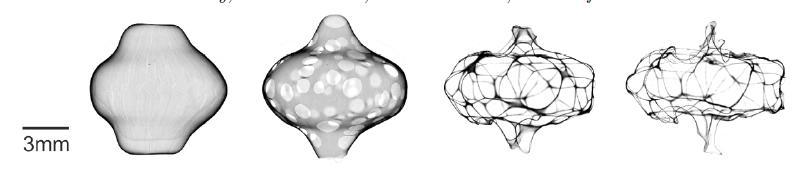
Taylor and Culick predicted a constant velocity for the rim of an opening hole in a soap film of uniform thickness. Unfortunately, it is difficult to experimentally produce a soap film of uniform thickness. It is much easier to create films of uniform thickness with liquid crystals in their smectic-A phase, in which the molecules are ordered in layers along a single direction. When smectic-A bubbles burst, however, it bears little resemblance to a soap bubble. Smectic-A bubbles burst spontaneously during oscillations, the holes in the film growing until a network of filaments is left behind. The filaments themselves will rapidly break up into droplets due to the Plateau-Rayleigh instability. (Photo credit: R. Stannarius et al.)
Liquids Pinching Off
There is a surprising variety of forms in the pinch-off of a liquid drop. This short video shows three examples, and you’ll probably find yourself replaying it a few times to catch the details of each. On the left, a drop of water pinches off in air. As the neck between the nozzle and the drop elongates, the drop end of the neck thins to a point around which the drop’s surface dimples. This is called overturning. When the drop snaps off, the neck disconnects and rebounds into a smaller satellite droplet. The middle video shows a drop of glycerol, which is about 1000 times more viscous than water. This droplet stretches to hang by a thin neck that remains nearly symmetric on the nozzle end and the drop end. There is no satellite drop when it breaks. The rightmost video shows a polymer-infused viscoelastic liquid pinching off. This liquid forms a very long, thin thread with a fat satellite drop still attached. When gravity eventually becomes too great a force for the stresses generated by the polymers in the liquid, the drops break off. (Video credit: M. Roche)

The Real Raindrop
What is the shape of a falling raindrop? Surface tension keeps only the smallest drops spherical as they fall; larger drops will tend to flatten. The very largest drops stretch and inflate with air as they fall, as shown in the image above. This shape is known as a bag and consists of a thin shell of water with a thicker rim at the bottom. As the bag grows, its shell thins until it ruptures, just like a soap bubble. The rim left behind destabilizes due to the surface-tension-driven Plateau-Rayleigh instability and eventually breaks up into smaller droplets. This bag instability limits the size of raindrops and breaks large drops into a multitude of smaller ones. The initial size of the drop in the image was 12 mm, falling with a velocity of 7.5 m/s. The interval between each image is 1 ms. (Photo credit: E. Reyssat et al.)