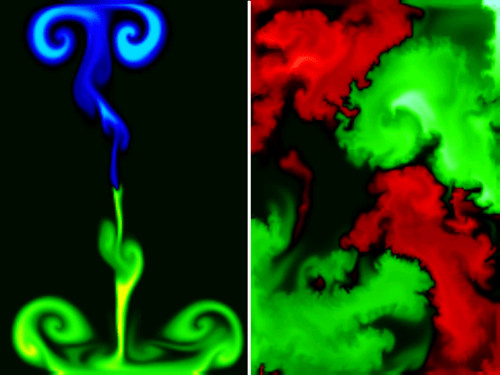
Happy 4th of July.
Tag: physics

Self-Siphoning Stream of Beads
Pull a bit of a long chain out of a container, and you’ll quickly find the beads take on a life of their own, siphoning out of the jar while leaping and looping in the air. Some of the dynamics are clear – the ever-growing free end of the chain has weight enough to pull the rest of the chain out, much like the pressure difference that drives a siphon. But a lot of the rest of the dynamics are unclear and have generated a lot of discussion. It turns out that the same behavior is observed for chain laid out on a horizontal surface (video links on the right of that page) and even the dynamics of that simpler version of the problem are complex. All part of the beauty inherent in Newton’s second law. (Video credit: Steve Mould/Earth Unplugged; Research credit: J. A. Hanna et al.; submitted by Elin R)

Dancing Jets
Vibrating a gas-liquid interface produces some exciting instability behaviors. The photo above shows air and silicone oil vibrated vertically within a prism. For the right frequencies and amplitudes, the vibrations produce liquid jets that shoot up and eject droplets as well as gas cavities and bubble transport below the interface. To see a similar experiment in action, check out this post. (Photo credit: T. J. O’Hern et al./Sandia National Laboratories)
Hydrophobia
Hydrophobic literally means water-fearing, and, once a surface is treated with a hydrophobic coating, the effect on water droplets is stark. The tendency of the non-polar hydrophobic molecules to repel the polar water molecules leads to high contact angles – which make the droplets almost spherical as they glide along the surface. The droplets dance across the surface, colliding and bouncing and coalescing. (Video and submission credit: M. Bell)

How Flames Expand
Combustion is a remarkably complicated phenomenon fluid dynamically. The schlieren images above illustrate a couple of the variables that affect flame propagation. The top image shows an idealized, essentially spherical flame expanding in a quiescent hydrogen-air mixture at atmospheric pressure. The middle flame is expanding in a high-pressure environment, similar to an internal combustion engine. The lowest image shows a flame in a highly turbulent environment, which is also typical of internal combustion engines in order to promote mixing of the air and fuel. (Photo credit: C.K. Law, S. Chaudhuri, and F. Wu)
Studying Coughs
Bioaerosols–tiny airborne fluid droplets generated by coughing or sneezing–are a major concern for the spread of contagions like influenza. It may be possible, however, to mitigate some of these effects by manipulating biological fluid properties. The video above shows an experimental model of a cough, complete with the generation of bioaerosols from some fake human lung mucus. Contrast this with a cough where the model’s mucus has been treated to increase its viscoelasticity. The treated mucus generates substantially fewer droplets during a cough. The results suggest that drugs that increase viscoselasticity of biofluids may help stem the spread of disease. (Video credit: K. Argue et al.; research credit: M. D. A. Hasan et al.)

Hanging Liquids
A horizontal filament of viscous liquid hanging between two plates stretches under gravity. The photo above is a composite showing the stretching of a single thread over several time steps. The fluid forms a catenary, the same shape as a hanging chain or cable when supported only at its ends. This behavior is confined to viscous filaments of sufficient length and diameter. Short and thin filaments instead form a U-shape with a thin horizontal filament joined to two thicker vertical threads. This difference in shape occurs due to the drainage of the liquid along the filament’s length. If the viscous thread begins to fall before surface tension drains the fluid from the center toward the ends, then a catenary of essentially uniform diameter forms. If instead the liquid drains before falling, the non-uniform U-shape is observed. (Photo credit: M. Le Merrer et al.)
Reader Question: Non-Coalescing Droplets
Reader ancientavian asks:
I’ve often noticed that, when water splashes (especially as with raindrops or other forms of spray), often it appears that small droplets of water skitter off on top of the larger surface before rejoining the main body. Is this an actual phenomenon, or an optical illusion? What causes it?
That’s a great observation, and it’s a real-world example of some of the physics we’ve talked about before. When a drop hits a pool, it rebounds in a little pillar called a Worthington jet and often ejects a smaller droplet. This droplet, thanks to its lower inertia, can bounce off the surface. If we slow things way down and look closely at that drop, we’ll see that it can even sit briefly on the surface before all the air beneath it drains away and it coalesces with the pool below. But that kind of coalescence cascade typically happens in microseconds, far too fast for the human eye.
But it is possible outside the lab to find instances where this effect lasts long enough for the eye to catch. Take a look at this video. Here Destin of Smarter Every Day captures some great footage of water droplets skittering across a pool. They last long enough to be visible to the naked eye. What’s happening here is the same as the situation we described before, except that the water surface is essentially vibrating! The impacts of all the multitude of droplets create ripples that undulate the water’s surface continuously. As a result, air gets injected beneath the droplets and they skate along above the surface for longer than they would if the water were still. (Video credit: SuperSloMoVideos)

Glinting Off Waves
Sunglint on the ocean surface can sometimes reveal different patterns in wave conditions. In the satellite photo above, we see the Canary Islands with wavering silvery wakes stretching to the southwest. The predominant wind direction over the islands is from the northeast. The rocky islands act as a wind-break, redirecting the flow and shadowing the ocean in their wake from much of it. As a result, fewer waves are stirred up in the islands’ wakes, thereby changing the local surface reflection properties and making this image possible. (Photo credit: NASA Earth Observatory)

Fluids Round-up – 23 June 2013
Time for another round-up! Here are the recent fluidsy links I’ve collected:
- A new study on Mars suggests that dry ice may be forming gullies in dunes in a fashion akin to the Leidenfrost effect. Personally, I’m reminded of Death Valley’s roaming rocks.
- A recent episode of It’s Okay to Be Smart explains what wind is.
- xkcd’s What If blog explores what would happen if you row a boat on different fluids such as mercury, bromine, and liquid helium (for you superfluid aficionados).
- Those who love microfluidics may want to follow Physics in Drops for some small-scale fluid fun.
- Not explicitly fluid dynamical, but this video of a peregrine falcon chasing a downhill mountain biker has some great examples of aerodynamics and the in-flight agility of birds.
- For the Android users among you, be sure to check out Fleya, a multi-touch, real-time fluids simulator. (via Jeremy M/Flow Visualization)
(Photo credit: Fixed Point Code)