Tag: physics

  • The Great Smog of London

    The Great Smog of London

    Our atmosphere is active and ever-changing – except when it isn’t. Some areas, including many cities, are prone to what’s known as a temperature inversion, where a layer of cooler air gets trapped underneath a warmer one. Because this means that a dense layer is caught under a less dense one, the situation is stable and – absent other changes in circumstances – will stick around. There are several ways this can happen, including overnight when areas near the ground cool faster than the atmosphere higher up.

    When temperature inversions persist, they can trap pollutants and create health hazards. One of the worst of these recorded occurred in December 1952 in London. An anticyclone created a temperature inversion over the city that trapped smoke from coal burned to warm homes and reduced visibility – sometimes even indoors – to only a meter or two. Thousands of people died from the respiratory effects of the five-day smog, and it prompted major efforts to improve emissions and air quality. Temperature inversions cannot be avoided, but the Great Smog of London taught us the necessity of reducing their danger.  (Image credit: Getty Images)

  • Featured Video Play Icon

    Underwater Snakes, Gusty Flying, and Microswimmers

    If you like your fluid dynamics with a healthy dose of biology, this video’s for you! Learn about the hydrodynamics of snake strikes, how birds fly in gusty crosswinds, and the mathematical underpinnings of a microswimmer’s journey. This is the final video in our FYFD/JFM collaboration featuring research from the 2017 APS DFD meeting. If you missed any of the previous videos, you can see them all here. Which one is your favorite? Would you like to see the series continue? Let me know in the comments or on Twitter! (Image and video credit: N. Sharp and T. Crawford)

  • Rattling Feathers for Attention

    Rattling Feathers for Attention

    Peacocks are known for their colorful mating displays, but it turns out there’s more to them than meets the eye. To help them gain a penhen’s attention, peacocks will sometimes rattle their train-feathers. The sound this makes is mostly below the range of human hearing, but the rustle creates subtle vortices in the air that cause the feathers atop a peahen’s head to vibrate. Playing back the sound at peahens from typical train-rattling distances also gets the females’ attention. Researchers found the playback makes peahens’ crests vibrate at a resonant frequency, suggesting that these feathers are for more than display; they’re used for communication as well! (Image and research credit: S. A. Kane et al.; video credit: Science)

  • “Ice Formations”

    “Ice Formations”

    As perfect as ice can appear, it always starts with a defect. Without a speck of dust or soot to act as a seed, supercooled water simply will not freeze. But these imperfections can lead to beauty. In “Ice Formations,” photographer Ryota Kajita captures some of the oddities of ice in Alaska’s interior swamps and ponds. In Kajita’s images bubbles are frozen in suspension, plates of ice form strange shapes, and star-shaped cracks peek through the snow. Whether the ice formed too quickly or too slowly, there are interesting signatures left behind. See the full set of images, spanning the last eight years, here. (Image credit: R. Kajita; via Colossal)

  • Featured Video Play Icon

    The Clever Cat’s Tongue

    Cats spend almost a quarter of their waking hours grooming, and their tongues are wonderfully specialized for this task, allowing them to clean, cool, and untangle themselves with ease. Anyone who’s ever been licked by a cat knows their tongues feel sandpaper-y. This is due to rear-facing hook-like structures called papillae that have a stiffness comparable to human fingernails.

    The papillae are hollow, and their U-shaped tip helps them wick up saliva, which the cat deposits deep into its undercoat when it licks. Although the papillae only hold about 5% of the volume of saliva on the cat’s tongue, this wicking action is key because most of the tongue surface can’t reach the inner coat; only the papillae do. The saliva that reaches these dense inner hairs is important not only for cleaning the fur, but for helping the cat cool off. As the saliva evaporates, it carries heat away with it, just like sweating does for us.

    The papillae are key to untangling fur, but their shape also makes it easy to remove hairs caught on the tongue. Researchers built a 3D-printed cat-inspired hair brush to show how efficient and easy to clean a cat’s tongue can be! (Video credit: Science; research credit: A. Noel and D. Hu)

  • What Drives Droplets

    What Drives Droplets

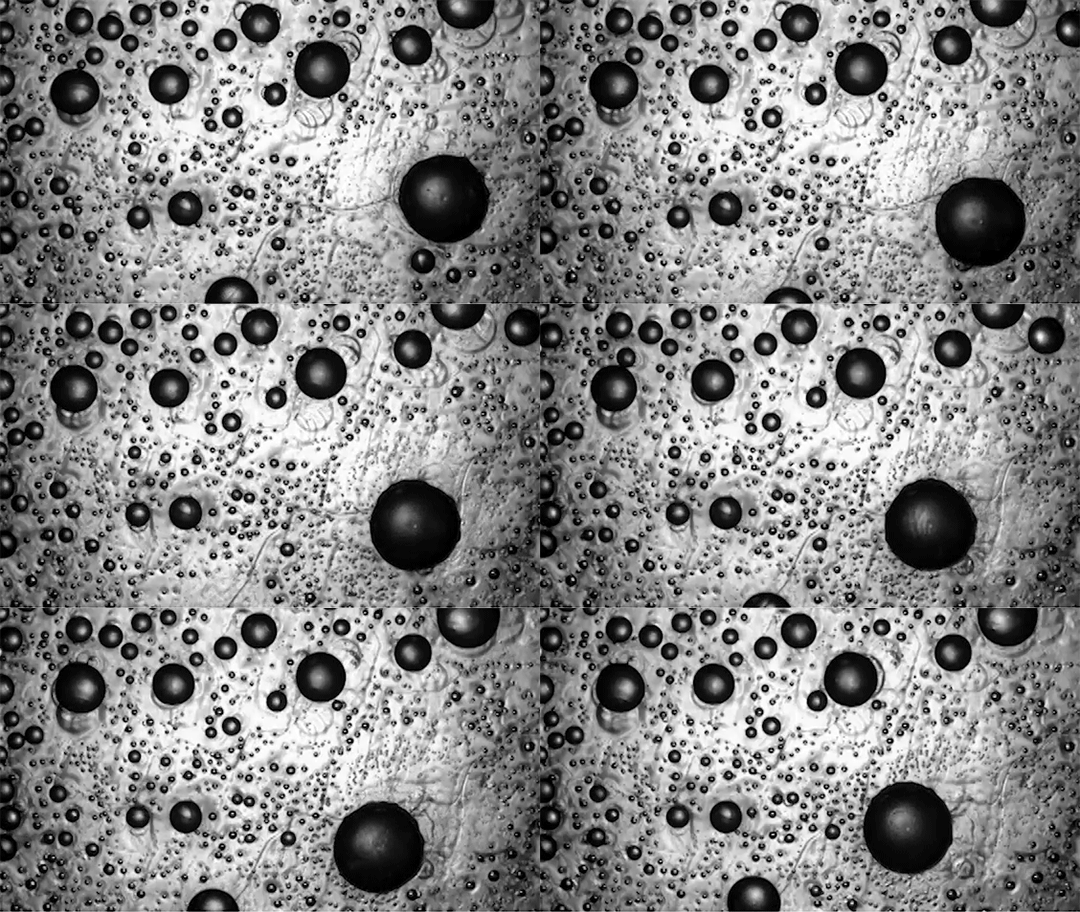
    There’s been a lot of interest recently in what goes on inside droplets made up of more than one fluid as they evaporate. This can be entertaining with liquids like whiskey or ouzo, but it has practical applications in ink-jet printing and manufacturing as well. And a new experiment suggests that we’ve been fundamentally wrong about what drives the flow inside these drops.

    As these drops evaporate, a donut-shaped recirculating vortex forms inside them, as seem in the cutaway views above. Conventional wisdom says that vortex is driven by surface tension. Evaporation of components like alcohol is more efficient at the edges of the drop, and as the alcohol evaporates, it creates a higher surface tension at the drop’s edge than at its peak. Marangoni forces then pull fluid down toward the edges, creating the vortex. That explanation is  consistent with observations of a sessile drop sitting on top of a surface (left side of images).

    But those observations are also consistent with another explanation: evaporating ethanol makes the local density higher, so alcohol-rich parts of the drop rise toward the peak while alcohol-poor regions sink. This difference in density would also create a flow pattern consistent with observations. So which is the real driver, surface tension or gravity?

    To find out, researchers flipped the drop upside-down (right side of images). When hanging, the preferred flow direction due to surface tension doesn’t change; flow should still go from the deepest point on the drop toward the edge. But gravity is swapped; alcohol-rich areas should be found near the edge and attachment points of the drop because buoyancy drives them there. And that is exactly what’s observed. The flow direction inside the hanging droplet is consistent with the direction prescribed by buoyancy-driven flow, thereby upending conventional wisdom. It turns out that gravity, not surface tension, is the major driver of internal flow in these multi-component droplets! (Image and research credit: A. Edwards et al.; via APS Physics; submitted by Kam-Yung Soh)

  • Featured Video Play Icon

    “If I Say”

    The new Mumford & Sons single “If I Say” features a fluid-dynamical music video. It’s full of dendritic fingers and flowing colors – likely from combinations of inks, paints, and other fluids. Although the fingers are reminiscent of the viscosity-dependent Saffman-Taylor instability, these appear to be driven by variations in surface tension between the different fluids. That’s a major feature throughout the video; although some of the flow is caused by the syringes depositing fluids, much of it seems to be a Marangoni effect, where flow moves away from areas of low surface tension to ones with higher surface tension. (Video credit: Mumford & Sons; filmed by P. Hofstede; via Katie M.)

  • Vortex Dome

    Vortex Dome

    Are you staring into the eye of a hurricane or watching the spin of a simple desk toy? Part of the beauty of fluid dynamics is recognizing how similar they both are. This is high-speed footage of a toy known as a “Vortex Dome,” which contains a fluid filled with tiny mica particles that react to local forces and allow users to “see” the flow. Before the video begins, the toy has been spinning for long enough that the fluid inside rotates as if it were a solid body. Then an unseen hand sets the disk spinning in the opposite direction and we observe what happens.

    Fluid at the outer edge of the toy has to immediately change direction due to friction with the wall. That change in momentum slowly passes from the wall inward as viscosity between one layer of fluid to the next passes that signal. This creates the rolls we see in the first animation. Initially, those rolls are smooth, but they quickly roughen as disturbances in them grow into full-blown turbulence. Meanwhile, viscosity continues to pass the change in rotation inward, ultimately swallowing the entire interior of the toy. Left spinning indefinitely, the disturbances will eventually quiet out and the entire fluid will spin as one. (Image and video credit: D. van Gils)

  • Ricequakes

    Ricequakes

    Rockfill dams, sinkholes, ice shelves, and other geological features often consist of brittle, porous materials that are partially submerged. Over time, pressure and chemical reactions with the fluid around them can cause these structures to collapse, but it can take many, many years. 

    To study the physics behind this, researchers have turned to a new model: puffed rice cereal. Like their counterparts in nature, puffed rice grains contain micropores that slowly soften and get crushed after being wetted. Researchers filled their test container with puffed rice and put it under pressure to give the whole stack a constant stress. Then they injected milk in the bottom section of the container. After an immediate collapse in the wet material (lower left), the remaining grains collapsed slowly in a series of “ricequakes”. 

    As the micropores compacted, the cereal let out audible cracks that corresponded with the motion of a crushing wavefront (lower right). The time between ricequakes increased linearly and depended on pore size. The relationship was so consistent, researchers found, that they could predict how long the puffed rice stack had been wet simply by listening to the time between crackles! Experiments like these offer scientists an exciting chance to understand geological physics that would otherwise take up to millions of years to observe. (Image and research credit: I. Einav and F. Guillard; via Physics World; submitted by Kam-Yung Soh)

  • Namibia From Above

    Namibia From Above

    From above, we see an all-new perspective on the flows of air and water that shape our world. Although they look like abstract art, these aerial photographs of Namibia by Leah Kennedy show rippling dunes and spreading fingers of water. Linear dunes like these grow when the prevailing winds are always from the same direction. Over time, rivers meander, always seeking new drainage paths. Patterns like these are probably driven by periodic flooding. (Image credit: L. Kennedy; via Colossal)