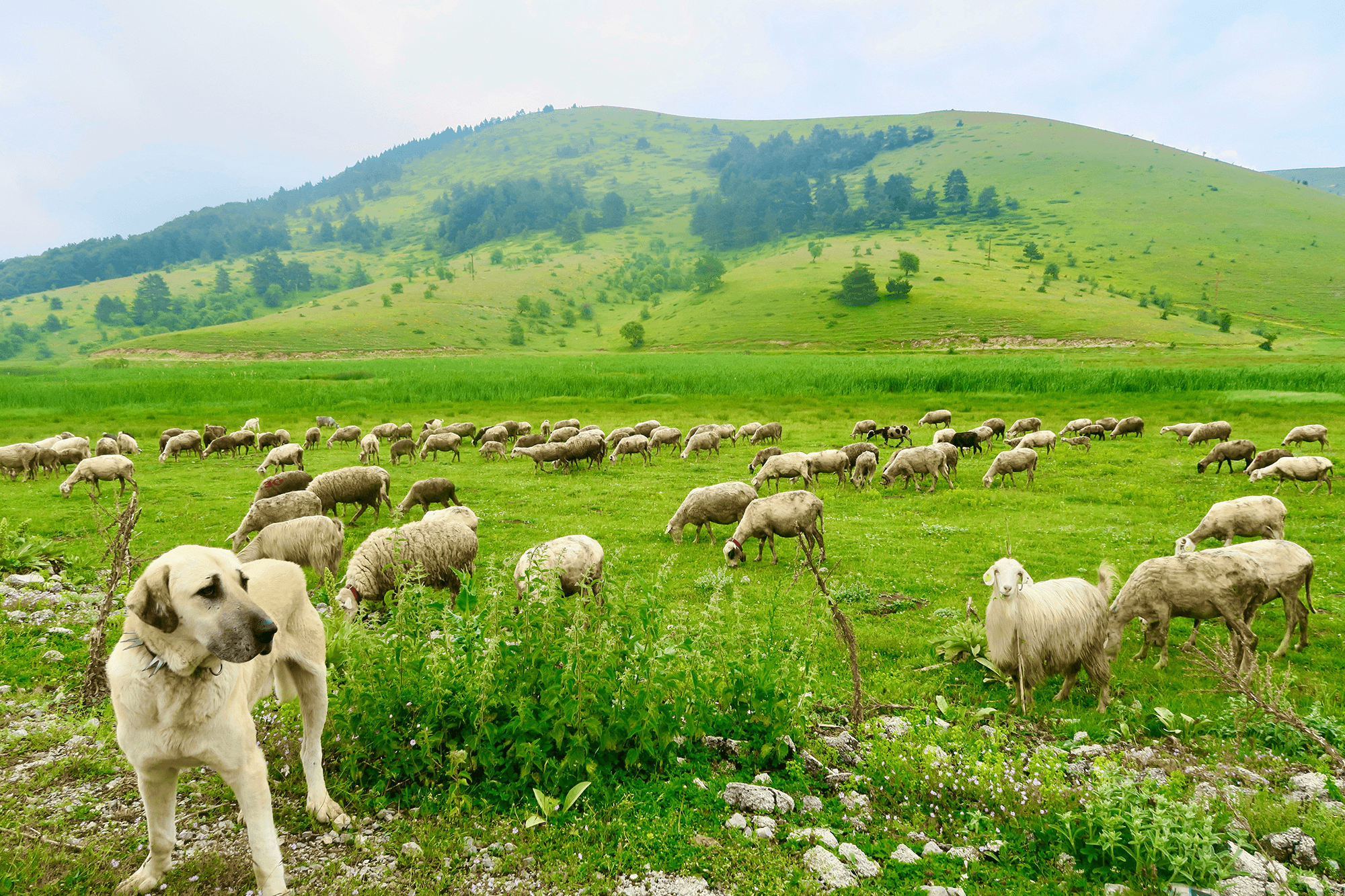
Flocks of birds, schools of fish, and herds of sheep all resemble fluids at times, and physicists have been trying to recreate their collective motion for decades. Many of these models simplify the animals into particles that follow simple rules based on the direction and speed of their neighbors. Over time, the models have grown more complex; for example, some might differentiate a “sheepdog” particle from “sheep” particles. And some models even tweak the “sheep” to account for the personality traits that real sheep show, like how skittish they behave toward a sheepdog. Physics World has a neat overview of several studies in this vein. (Image credit: E. Osmanoglu; via Physics World)
Tag: sheep

The Best of FYFD 2021




A year ago I observed what a strange year 2020 had been, and in many ways, I could say the same of 2021. Before the pandemic, I spent quite a lot of time traveling. In 2021, the only nights I slept outside my own bed came on a long weekend up to the mountains with my family. But 2021 also saw a bit of a return to normalcy – I was giving keynote addresses and workshops again, albeit virtually. What will 2022 hold? Who knows?!
As per tradition, here are the top FYFD posts of 2021:
- A superior mirage leaves a ship floating in mid-air
- Drone videos of sheep herding are mesmerizing
- Permeable pavement allows water to drain
- The slow and dreamy fluid landscape of “Le Temps et l’Espace”
- What do you do when you’re an insect researcher with a high-speed camera?
- Satellite images… or paint?
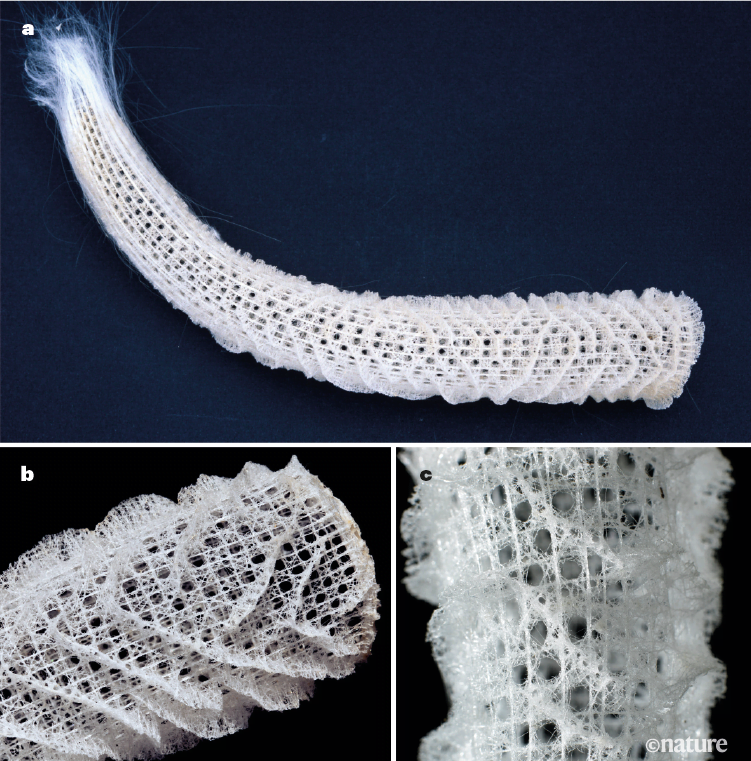
- The intricate lacework of the Venus’s flower basket sea sponge
- Building a Bluetooth speaker with ferrofluid music visualization
- Finding the acoustics of Stonehenge
- Making butter by traditional French methods
It’s an eclectic mix of topics this year: bizarre phenomena, stunning art, archaeological exploration, and a touch of biophysics!
If you enjoy FYFD, please remember that it’s primarily reader-supported. You can help support the site by becoming a patron, making a one-time donation, buying some merch, or simply by sharing on social media. And if you find yourself struggling to remember to check the website, remember you can get FYFD in your inbox every two weeks with our newsletter. Happy New Year!
(Image credits: mirage – D. Morris, sheep – L. Patel, pavement – Practical Engineering, Le Temps – T. Blanchard, insects – Ant Lab, Satellike – R. De Giuli, sea sponge – G. Falcucci et al., speaker – DAKD Jung, Stonehenge – T. Cox et al., butter – Art Insider)

Aerial Sheep Flow


I may never get tired of drone videos of sheep herding. They are mesmerizing to watch and full of so many characteristics of flow. Like a compressible fluid, the herd squeezes together as it passes through a gate, then spreads and decreases density as it reaches the pasture. The sequence of sheep moving down the road reminds me of pipe flow, with a boundary layer of sheep along the edge who choose to graze rather than move with the herd. There are even sheep vortices in this video, folks. Vortices of sheep! How could you resist watching?! (Video credit: L. Patel; via Colossal; submitted by Florian T. and Matevz D.)

Hydrodynamics of Sheep


As we’ve discussed previously, not all fluid-like behavior occurs within a literal fluid. Many groups of organisms — humans included — behave like a fluid en masse. Herds of sheep are a fantastic example of this, and now researchers have actually analyzed footage of sheep as a fluid!
The authors find strong evidence for emergent collective behavior among the sheep, as well as a tendency for the flock to minimize its perimeter. In other words, even though the sheep do not physically exert an attractive force on one another, they behave as though the flock has surface tension! For a herd animal, this behavior makes sense since it minimizes the exposure of individuals to predators. (Image credit: top image – S. Carter, drone footage – M. Bircham; research credit: M. de Marcken and R. Sarfati; submitted by Kam-Yung Soh)
ETA: Thanks to commenter gib for finding the original author of the drone footage!
Sheep as a Compressible Flow
Not everything that flows is a fluid. And when viewed from above traffic, crowds, and even herds of sheep flow in patterns like those of a fluid. In particular, these conglomerations move like compressible fluids – ones that allow substantial changes in density as they flow. From above, each sheep is just a few pixels of white, but you can see which areas of the herd have the highest density by how white an area looks. The highest density regions also tend to be the slowest moving – not surprising in a crowd.
Now watch the gates. They act like choke points in the flow and, to some extent, like a nozzle in supersonic flow. As the sheep approach the gate, they’re in a dense, slow moving clump, but as they pass through it, the sheep speed up and spread out. This is exactly what happens in a supersonic nozzle. On the upstream end, flow in the nozzle is subsonic and dense. But once the flow hits the speed of sound at the narrowest point in the nozzle, the opening on the downstream side allows the flow to spread out and speed up past Mach 1. (Video credit: MuzMuzTV*; submitted by Trent D.)
*Editor’s Note: I do my best to credit the original producers of any media featured on FYFD, but this is especially difficult with viral videos as there can be many copies, all of which are uncredited. I’ve made my best guess on this one, but if this is your video, please let me know so that I can credit you properly. Thanks!
Sheep as a Fluid
Not all fluids are, well, fluid. Traffic, flocks of birds, ants, and even sheep can behave like fluids. This video shows an aerial perspective on sheep being herded, and despite the four-legged nature of these particles, they have a lot of fluid-like characteristics. You can watch ripples and waves travel through the herd and see how disturbances propagate. The herd is actually a brilliant example of compressible flow; notice how the sheep slow down and bunch up as they near the gate then speed up and spread out once they pass the constriction. This is exactly how supersonic fluids behave! (Video credit: T. Whittaker; submitted by Simon H and John B)
If you’re in the DC area, I’ll be speaking at the Annals of Improbable Research Show at the AAAS meeting Saturday evening. Our session is open to the public, but it’s likely to be crowded, so you may want to arrive early!


