Tag: physics

  • Understanding Jupiter

    Understanding Jupiter

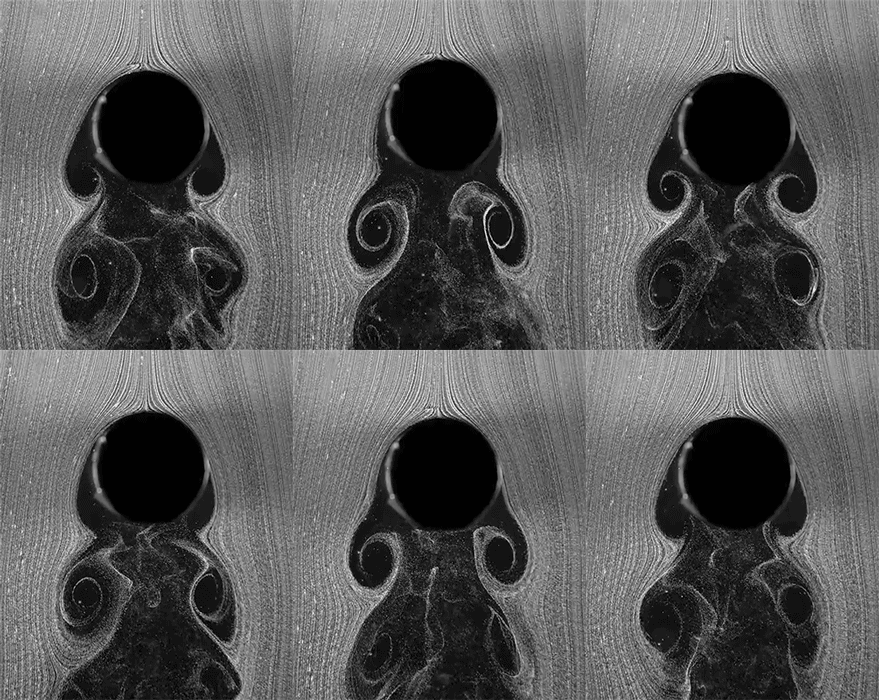
    The swirling clouds of Jupiter hide a complicated and mysterious interior. For decades, scientists have worked to puzzle out the inner dynamics of Jupiter’s atmosphere and what could be going on inside it to generate the flows we see visibly. Near Jupiter’s equator, we see strong jets that flow either east or west, depending on their latitude; this creates the stunning cloud bands we’re used to seeing on the planet. Toward the poles, though, things look more like what we see above – swirling but unbanded.

    Through theory, experiments, and simulations, scientists have tried to work out exactly what ingredients are necessary to make Jupiter look this way, but it’s pretty tough to recreate the conditions simply because Jupiter is so extreme. You need a lot of rotation, a lot of turbulence, and a way to stretch that turbulence if you want to imitate Jupiter. There’s been progress recently, though, and it suggests that the jets we see on Jupiter are far more than skin-deep. Instead, they likely stretch deep into the Jovian atmosphere at the equator and ride somewhat shallower toward the poles. (Image credit: NASA JPL; research credit: S. Cabanes et al.)

  • A Groovy Hovercraft

    A Groovy Hovercraft

    Not long ago, researchers discovered that droplets hovering over a hot grooved surface would self-propel. The extension to this was to investigate a hovercraft on a grooved, porous surface (top half of animation)–think an air hockey table with grooves. In that case, air inside the grooves flows from the point toward the edges, and it drags the hovercraft with it, thanks to viscosity. So the hovercraft travels in the direction opposite the points. This raised an obvious question: what happens if the hovercraft is grooved instead of the surface?

    That’s the situation we see in the bottom half of the animation. Air flows from the table and interacts with the grooves on the bottom of the hovercraft. And this time, the hovercraft propels in the direction of the points. That means there’s a completely different mechanism driving this levitation. When the grooves are onboard the hovercraft, pressure dominates over viscous effects. The air still gets directed down the grooves, but now, like a rocket, the exhaust pushes the hovercraft in the other direction – toward the points. For more on this work, check out the mathematical model of the problem and our interview with one of the researchers in the video below. (Research credit: H. de Maleprade et al.; image and video credit: N. Sharp and T. Crawford)

  • Inside a Heart

    Inside a Heart

    You may not give it much thought, but there is important fluid dynamics happening inside you every moment of every day, especially inside your heart. Of the four chambers of the heart, the left ventricle has the thickest walls, reflecting its important task: pumping oxygenated blood throughout the body. In a healthy heart (top of poster; click here for the full-size version), a vortex ring and trailing jet fill the ventricle when the mitral valve opens. Then the ventricle contracts and pumps blood out the aortic valve and into the rest of the body.

    But for individuals with a leaking aortic valve (bottom of poster), things look different. Blood leaks back through the aortic valve at the same time that the mitral valve opens to allow freshly oxygenated blood back in. The two inflows disrupt mixing in the chamber, and, instead of pumping fully-oxygenated blood into the body, the left ventricle has to struggle to pump a less-oxygenated mixture into the body. (Image credit: G. Di Labbio et al.)

    ETA: (Research paper: G. Di Labbio et al., arXiv)

  • Featured Video Play Icon

    A Musical Splatter

    High-speed video is wonderful for appreciating fluid motion in ways we can’t on our own. In this video from Warped Perception, we see what happens when a vibrating tuning fork is lowered into water. The tines of the tuning fork create a spray of tiny droplets, reminiscent of what happens in ultrasonic atomization or when blowing through an immersed straw. The ejected droplets fall slowly back onto the disturbed surface; many of them bounce rather than coalescing. This is because the surface’s vibration pushes the drops aloft again before the air layer separating the drop from the surface has the time to drain away. (Video credit: Warped Perception)

  • Fighting a Viscous World

    Fighting a Viscous World

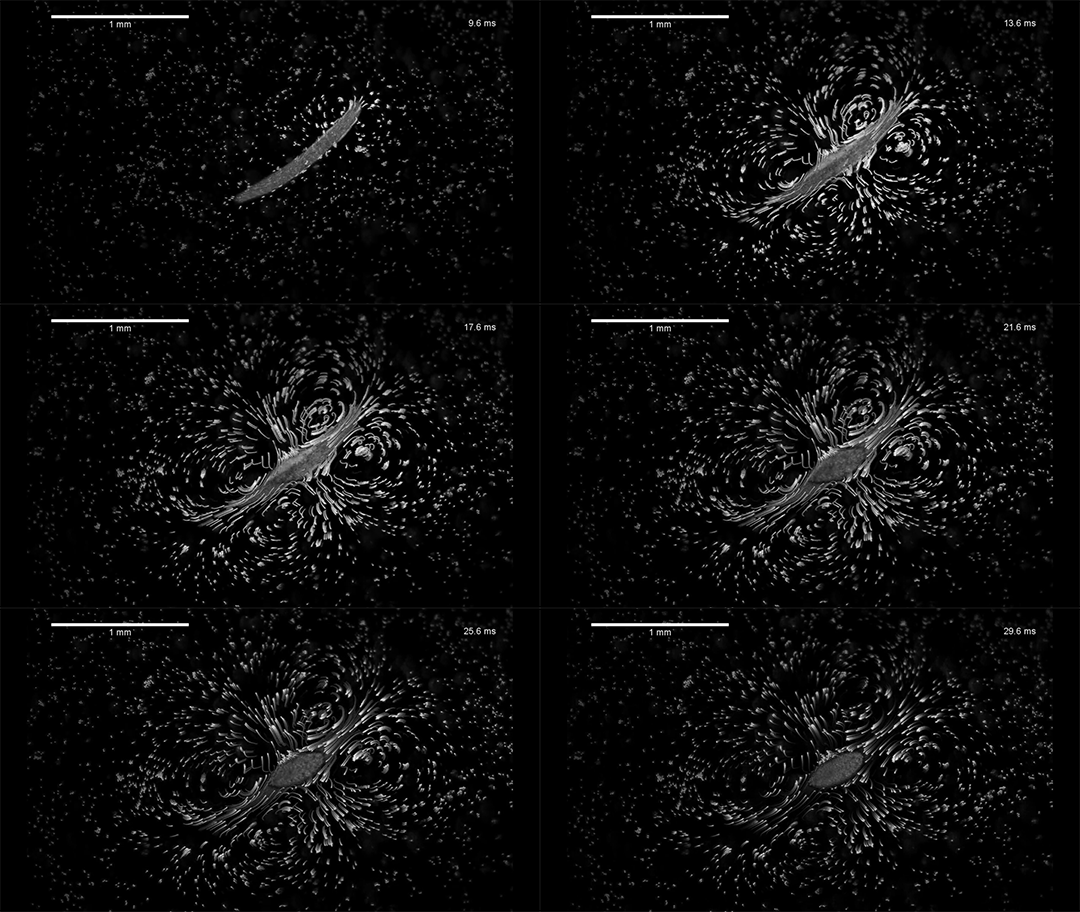
    Vaucheria is a genus of yellow-green algae (think pond scum), and some species within this genus reproduce asexually by releasing zoospores. Once mature, the zoospore has to squeeze out of a narrow, hollow filament in order to escape into the surrounding fluid (top). To do so, it uses tiny hair-like flagella on its surface. Despite the minuscule size of these micron-length flagella, they generate some major flows around the zoospore (middle and bottom). Even several body lengths away, the flow field shows significant vorticity. All this active entrainment of fluid from the surroundings helps the zoospore escape its confinement and swim away to start a new plant. (Image and research credit: J. Urzay et al., source)

  • A Golden Swirl

    A Golden Swirl

    As much as I love exploring flashy examples of fluid dynamics, like shock waves around aircraft or what happens when non-Newtonain fluids get crushed by a hydraulic press, my favorite moments are the simple, everyday ones. Getting to see fluid dynamics in my daily life, whether I’m standing in the kitchen cooking or trying to wash my hands, is what excites me the most. The photo above is an example of this kind of simple, satisfying fluid experience. The image shows wax being melted in a crockpot. As it melts and its optical characteristics change, the wax reveals the mixing pattern inside the container. There’s nothing earth-shattering or scientifically important about something like this. But it’s still a moment where the otherwise unseen and unnoticed becomes visible and beautiful. It’s the fluid dynamical equivalent of stopping to smell the roses. When did you last pause to appreciate the flows around you? (Image credit: A. Unger et al.)

  • Review: “How to Walk on Water and Climb Up Walls”

    Review: “How to Walk on Water and Climb Up Walls”

    “An eight-year-old girl kicked her feet back and forth on the seat of a Long Island Railroad train. I beckoned her to cover over and pointed to the top of my winter jacket, which I slowly unzipped. Inside, nestling against me for warmth, were ten snakes, their forked tongues waving back and forth. The child shrieked and ran back over to her mother, who was napping. ‘That man has a coat full of snakes,’ she shouted.”

    So begins Chapter 2 of Dr. David Hu’s new book, How to Walk on Water and Climb Up Walls (*), a captivating and funny journey through animal locomotion and biorobotics. Don’t let that fool you, though; this book has plenty of fluid dynamics to it. Long-time FYFD readers will recognize some of the topics, such as the fluid-like behavior of fire ants, how eyelashes keep our eyes clean and moist, and why swimming behind an obstacle is so easy even a dead fish (like the one shown above) can do it.

    There are plenty of exciting, new stories as well, like how sandfish – a type of lizard – can swim under sand and why a lamprey’s nervous system may lead to better robots. The explanation of how cockroaches are virtually unsquishable and able to squeeze themselves into crevices a quarter of their height absolutely floored me. 

    Hu’s book offers a front-row seat to research at the cutting edge of biology, engineering, and physics, with anecdotes, explanations, and applications that will stick with you long after you put the book down. If you’re looking for a holiday gift for yourself or another science-lover, check this one out for certain (*).

    *Disclosures: I purchased my copy of this book using my own funds, and this review is not sponsored in any way. This post contains affiliate links – marked with (*); if you click on one of these links and purchase something, FYFD may receive a small commission at no additional cost to you.

    (Image credits: book – Princeton University Press; fish – D. Beal et al.; ants – Vox/Georgia Tech; eyelashes –  G. Diaz Fornaro; shark denticles – J. Oeffner and G. Lauder)

  • Featured Video Play Icon

    How Water Towers Work

    You may have noticed a water tower rising up over your town, but you may not have given much thought to how it works. Practical Engineering has a nice video overview of this important piece of infrastructure, which municipalities use to store and pressurize water in public distribution systems.

    During off-peak hours, pumps fill the water tower, which creates potential energy (and therefore, water pressure) that depends on the height of the water level. If you’ve ever lost power, you can appreciate how the water tower ensures that your faucet still runs. Without power, there are no pumps to pressurize the water line. But with the hydrostatic pressure of water in the tower, your water will still run like normal. For many people who live outside of municipal water zones, that’s not the case. A loss of power means an immediate loss of water also since the pumps that work their wells go offline. (Video and image credit: Practical Engineering)

  • Water-Walking Geckos

    Water-Walking Geckos

    Many animals can run on water. The tiniest creatures, like water striders, use surface tension to keep themselves atop the water.  Larger creatures like the basilisk lizard or the grebe slap the water’s surface to generate a vertical impulse that keeps them aloft. Geckos, it turns out, can run on water, too, but they’re too big to stay up with surface tension and too small to support their weight by slapping. So they’ve developed their own method.

    As you see in the top image, geckos use the slapping method for part of their support. Their slaps generate a little less than half of the force needed to keep them out of the water. 

    Surface tension is an important component, too. Geckos are extremely water repellent, which helps boost the lift they get from surface tension. In the bottom image, you see a gecko attempting to run on soapy water, which has a lower surface tension. The gecko is mostly submerged and more swimming than running – a clear demonstration that surface tension is important to its water-walking.

    Finally, the gecko undulates its body as it runs, much the way an alligator swims. The researchers suspect this helps the gecko generate forward thrust. Altogether, it creates a water-walking gait that, for now, is unique among observed mechanisms. (Image and research credit: J. Nirody et al.; via Ars Technica; submitted by Kam-Yung Soh)

  • Blackwater Rivers

    Blackwater Rivers

    Blackwater rivers, like the Suwannee River in Florida, carry waters so laden with organic material that they’re dyed a deep, dark brown. For the Suwannee, most of this material comes from the rich peat deposits of the Okefenokee Swamp that lies upstream. As vegetation in the swamp decays, tannins from the plants dissolve into the water, giving it its distinctive color, which the river maintains along its full 400-kilometer journey to the Gulf of Mexico. The dark waters of the river act as a tracer, revealing how the fresh river water mixes with the ocean in the enhanced-color satellite image above. It’s amazing to see how far the river’s influence spreads before delicate wisps of color pierce the darkness. (Image credit: U.S. Geological Survey; via NASA Earth Observatory)