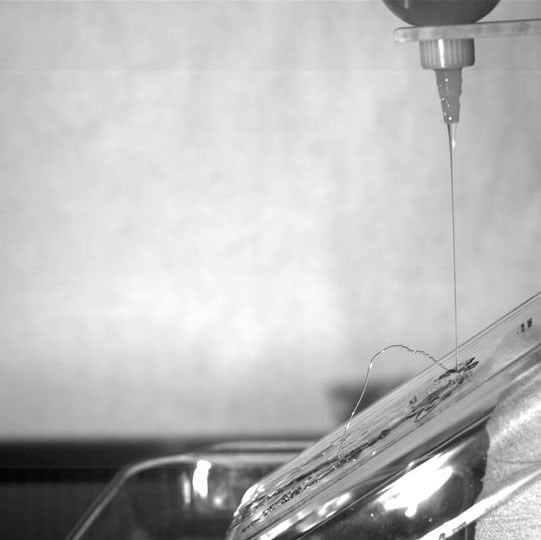
Viscoelastic fluids are a type of non-Newtonian fluid in which the stress-strain relationship is time-dependent. They are often capable of generating normal stresses within the fluid that resist deformation, and this can lead to interesting behaviors like the bead-on-a-string instability shown above. In this phenomenon, a uniform filament of fluid develops into a series of large drops connected by thin filaments. Most fluids would simply break into droplets, but the normal stresses generated by the viscoelastic fluid prevent break-up. For this particular photo, the stresses are generated by clumps of surfactant molecules within the wormlike micellar fluid. Similar effects are observed in polymer-laced fluids. (Photo credit: M. Sostarecz and A. Belmonte)
Tag: non-Newtonian fluids

Cornstarch Physics
Oobleck, a non-Newtonian fluid made up of water and cornstarch, is a perennial Internet favorite for its ability to dance and the fact that one can run across a pool of it. It’s typically described as a shear-thickening fluid and only exhibits solid-like behavior under impact. Strictly speaking, oobleck is a suspension of solid grains of cornstarch in water. When struck, the initially compressible grains jam together, creating a region more like a solid than a liquid. From this point of impact, a solidification front expands through the suspension, jamming more grains together and enabling the fluid to absorb large amounts of momentum. The process is known as dynamic solidification. (Video credit: University of Chicago; research credit: S. Waitukaitis & H. Jaeger)

Fluids Round-up – 11 August 2013
Time for another fluids round-up! Here are your links:
- Back in January 1919, a five-story-high metal tank full of molasses broke and released a wave of viscous non-Newtonian fluid through Boston’s North End. Scientific American examines the physics of the Great Molasses Flood, including how to swim in molasses. If you can imagine what it’s like to swim in molasses, you’ll know something of the struggle microbes experience to move through any fluid. They also discusses some of the strange ways tiny creatures swim.
- In sandy desert environments, helicopter blades can light up the night with so-called helicopter halos. The effect is similar to what causes sparks from a grinding wheel. Learn more about this Kopp-Etchells effect.
- Check out this ominous footage of a tornadic cell passing through Colorado last week.
- If you want more of a science-y look to your drinkware, you should check out the Periodic TableWare collection over on Kickstarter.
- Finally, wingsuits really take the idea of gliding flight to some crazy extremes. Check out this video of in-flight footage. Watch for the guy’s wingtip vortices at 3:16 (screencap above)! (submitted by Jason C)
(Photo credit: Squirrel)
Bubbles With Tails
In water and other Newtonian fluids, a rising bubble is typically spherical, but for non-Newtonian fluids things are a different story. In non-Newtonian fluids the viscosity–the fluid’s resistance to deformation–is dependent on the shear rate and history–how and how much deformation is being applied. For rising bubbles, this can mean a teardrop shape or even a long tail that breaks up into fishbone-like ligaments. The patterns shown here vary with the bubble’s volume, which affects the velocity at which it rises (due to buoyancy) and thus the shear force the bubble and surrounding non-Newtonian fluid experience. (Video credit: E. Soto, R. Zenit, and O. Manero)

The Kaye Effect
When a viscous fluid falls onto a surface, it will form a heap, like honey coiling. But for shear-thinning liquids like soap or shampoo something a little wild can happen as the heap grows. A dimple can form and, when the incoming jet of fluid hits that dimple, it slips against it and is ejected outward. If you wonder why you don’t see this every day in the shower, it’s because the outgoing jet usually hits the incoming jet, causing the whole system to collapse in less than 300 ms. By dropping the fluid on an inclined surface, one can keep the two jets from colliding, thereby creating a stable Kaye effect. (Photo credit: E. Eichelberger)
Magnetic Putty
For a little Friday fun, enjoy this timelapse of magnetic putty consuming magnets. Really this is a bit of slow-motion magnetohydrodynamics. The magnet’s field exerts a force on the iron-containing putty, which, because it is a fluid, cannot resist deformation under a force. As a result, the putty will flow around the magnet, eventually coming to a stop once it reaches equilibrium, with its iron equally distributed around the magnet. Assuming the putty is homogeneously ferrous (i.e. the iron is mixed equally in the putty), that means the putty will stop moving when the magnet is at its center of mass. (Video credit: J. Shanks; submitted by Neil K.)

Fishbones
When two liquid jets collide, they can form an array of shapes ranging from a chain-like stream or a liquid sheet to a fishbone-type structure of periodic droplets. This series of images show the collision of two viscoelastic jets–in which polymer additives give the fluids elasticity properties unlike those of familiar Newtonian fluids like water. The jet velocities increase with each image, changing the behavior from a fluid chain (a and b); to a fishbone structure (c and d); to a smooth liquid sheet (e); to a fluttering sheet (f and g); to a disintegrating ruffled sheet (h), and finally a violently flapping sheet (i and j). The behavior of such jets is of particular interest in problems of atomization, where it can be desirable to break an incoming stream of liquid up into droplets as quickly as possible. (Photo credit: S. Jung et al.)
The Kaye Effect
The Kaye effect is an instability particular to a falling stream of non-Newtonian fluids with shear-thinning properties. When these fluids are deformed, their viscosity decreases; this, for example, is why ketchup flows out of a bottle more easily once it’s moving. Like most fluids, the falling shampoo creates a heap on the surface. The Kaye effect is kicked off when the incoming jet creates enough shear on part of the heap that the local viscosity decreases, causing the streamer–or outgoing jet–to slip off the side of the heap. As the incoming jet continues, a dimple forms in the heap where the streamer originates. As the dimple deepens, the streamer will rise until it strikes the incoming jet. This perturbation to the system collapses the streamer and ends the Kaye effect. This video also has a good explanation of the physics, along with demonstrations of a stable form of the Kaye effect in which the streamer cascades down an incline. (Video credit: Minute Laboratory; inspired by infplusplus)
Viscoelastic Jets
Unlike Newtonian fluids, such as air and water, viscoelastic fluids exhibit non-uniform reactions to deformation. In this video, researchers explore the effects of this behavior when a liquid jet falls into another fluid. When fluids move past one another at different speeds in this manner, there is a shearing force which often leads to the wave-like Kelvin-Helmholtz instability between the fluids. Here we see for a variety of wavelengths how the breakdown of a Newtonian and viscoelastic jet differ. The Newtonian jets form clean lines and complicated tulip-like shapes, but the viscoelasticity of the non-Newtonian jets inhibits the growth of these instabilities, surrounding the central jet with wisps of escaping fluid. For more, see Keshavarz and McKinley. (Video credit: B. Keshavarz and G. McKinley)
When Fluids Behave Like Solids
Many common fluids–like air and water–are Newtonian fluids, meaning that stress in the fluid is linearly proportional to the rate at which the fluid is deformed. Viscosity is the constant that relates the stress and rate of strain, or deformation. The term non-Newtonian is used to describe any fluid whose properties do not follow this relationship; instead their viscosity is dependent on the rate of strain, viscoelasticity, or even changes with time. A neat common example of a non-Newtonian fluid is oobleck, a mixture of cornstarch and water that is shear-thickening, meaning that it is resistant to fast deformations. Like the cornstarch-based custard in the video above, these fluids react similarly to a solid when struck, resisting changing their shape, but if deformed slowly, they will flow in the manner of any liquid.