Combining water-repelling superhydrophobic surfaces with water-loving hydrophilic surfaces allows scientists and engineers to manipulate common fluids. Here a hydrophilic track surrounded by a superhydrophobic background collects and distributes drops of dyed water. The wetting characteristics of the surface combined with surface tension in the liquid drives the flow. No pumping or power input is necessary. This kind of manipulation of droplets can be especially useful in biomedical applications where fast-acting, low-cost devices could be used to diagnose diseases or measure blood glucose levels. (Image credit: A. Ghosh et al., via NSF; see also source video)
Tag: microfluidics

The Churning of Corals


Corals may appear static, but near the surface the tiny hair-like cilia of these polyps are churning the water. Although it has been known for some time that corals have cilia, scientists had previously assumed they only moved water parallel to the coral’s surface. Instead recent flow visualizations show that the cilia’s movements generate larger-scale vortical flows near the coral that can help draw fresh nutrients in as well as flush waste away. This means that, instead of being reliant on currents and tides, corals can exert some control on their environment in order to get what they need. This insight into coral cilia may shed some light on the micro- and macroscopic flows generated by other cilia, like those in our lungs. For a similar example of seemingly-passive organisms generating their own flows, check out how mushrooms create air currents to spread their spores. (Image credits: O. Shapiro et al. and MIT News; source video; h/t to Katie B)

Forming a Jet
Many situations can generate high-speed liquid jets, including droplet impacts, vibrated fluids, and surface charges. In each of these cases, a concave liquid surface is impulsively accelerated, which causes the flow to focus into a jet. The image above shows snapshots of a microjet generated from a 50 micron capillary tube visible at the right. This jet formed when the meniscus inside the capillary tube was disturbed by a laser pulse that vaporized fluid behind the interface. Incredibly, the microjets generated with this method can reach speeds of 850 m/s, nearly 3 times the speed of sound in air. Researchers have found the method produces consistent results and suggest that it could one day form the basis for needle-free drug injection. You can read more in their freely available paper. (Photo credit: K. Tagawa et al.)

Bubbles Through Constrictions
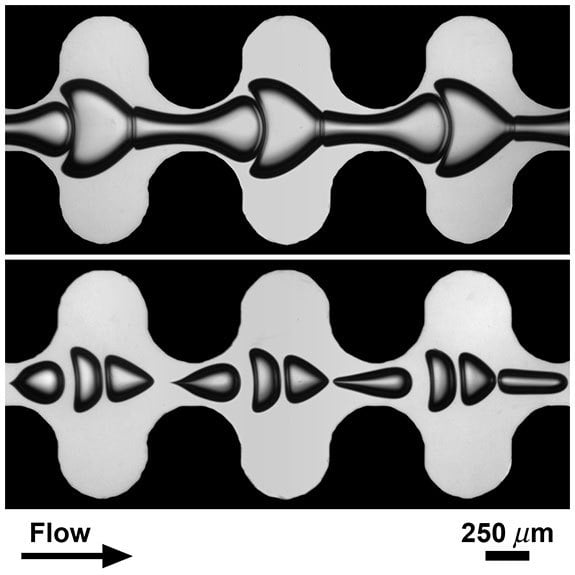
Surface tension usually constrains bubbles to the smallest area for a given volume – a sphere – but sometimes other forces generate more complicated geometries. The images above show bubbles flowing through microfluidic channels filled with a highly viscous carrier fluid. The bubble size and packing affects the shapes they assume, but so does the geometry of the channel. The narrow constrictions accelerate the flow, elongating the bubbles, whereas the wider channel regions slow the carrier fluid and squish the bubbles together. (Image credit: M. Sauzade and T. Cubaud (Stony Brook University))

Fluids Round-up – 16 November 2013
Time for another fluids round-up. Here are your links:
- PhysicsBuzz takes a look at the use of plasma actuators to control airflow.
- Over at Deep Sea News, you can learn about parasitic capillary waves.
- NanoWerk reports on self-steering particles in microfluidic devices.
- The 9th drop of the Queensland pitch drop experiment–believed to be the longest continuously running experiment in the world–is expected to fall at any time. Want to be part of the historic moment? Check out their Ninth Watch website.
- Aatish Bhatia examines the concepts behind the Fourier transform, an important mathematical technique used throughout fluid dynamics and physics. (via io9)
- Fluid dynamics and adaptive control might help alleviate traffic jams. (via @AIP_Publishing)
- On the whimsical side, take a look at these beautiful flying model boats built by Luigi Prina. (submitted by jshoer)
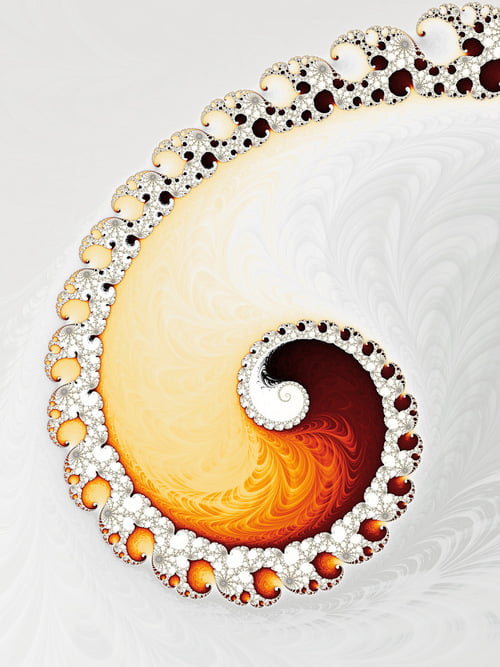
- Finally, our lead image was created with the app Frax, which allows users to make their own fractal-based art. Fluid dynamics has a lot of fractal behaviors. iOS users who want to play with fractals should check it out.
(Image credit: Ath3na)
Selective Suction
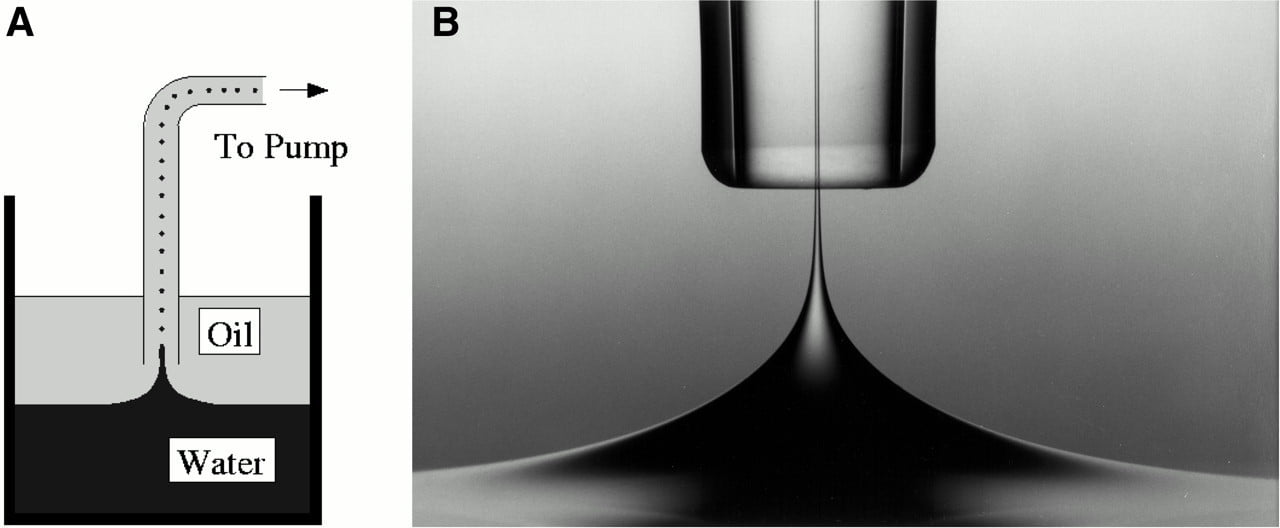
A thin spout of water is drawn up through a layer of oil in the photo on the right. This simple version of the selective withdrawal experiment is illustrated in Figure A, in which a layer of viscous oil floats above a layer of water. A tube introduced in the oil sucks fluid upward. At low flow rates, only the oil will be drawn into the tube, but as the flow rate increases (or the tube’s height above the water decreases), a tiny thread of water will be pulled upward as well. The viscous outer fluid helps suppress instabilities that might break up the inner fluid, and their relative viscosities determine the thickness of the initial spout. In this example, the oil is 195 times more viscous than the water. (Photo credit: I. Cohen et al.)

Fluids Round-up – 7 September 2013
Lots of great links in this week’s fluids round-up!
- Scientific American discusses how dogs use adhesion of water to their tongues to drink. We’ve mentioned this previously, as well as how it’s the same method cats use.
- Wired has a great look inside the NASA Ames Vertical Gun Range and how it’s used for impact cratering studies.
- Artist Fabian Oefner, whose work we’ve featured previous (1, 2, 3), gave a TEDx talk on mixing art and science, using acoustics and ferrofluids.
- Veritasium’s video on vibrating oobleck on a speaker has some nice visuals, and his suggestion of the behavior of highway traffic as a non-Newtonian fluid is intriguing. I generally consider such traffic to be a prime example of compressible flow, but that’s a whole post in and of itself.
- GE’s 6secondscience fair challenges participants to fit their science into 6 seconds of video. There are some great fluids examples, as seen in this compilation video. (submitted by jshoer) For a breakdown of each scientific concept, check out It’s Okay to be Smart’s list.
- I don’t know about you, but this bus window would keep me entertained for my whole commute. It’s like a 2D lesson in Newton’s laws and sloshing. (submitted by Erik M)
- There are some epic and beautiful examples of fluid dynamics in this collection of Red Bull Illume photo contest winners. (via +Jennifer Ouellette)
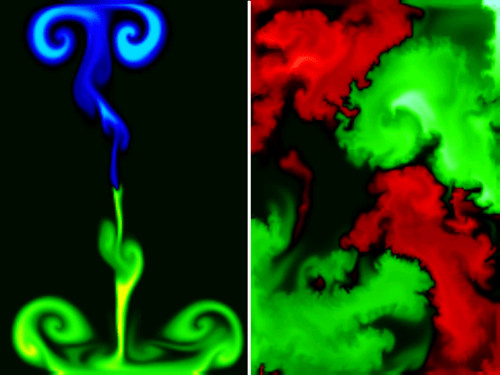
- Finally, this week’s lead image is a collage of gorgeous microfluidic multi-fluid emulsions. Learn more about them over at Physics in Drops.
(Photo credit: L. L. A. Adams)
Fluids Round-up – 23 June 2013
Time for another round-up! Here are the recent fluidsy links I’ve collected:
- A new study on Mars suggests that dry ice may be forming gullies in dunes in a fashion akin to the Leidenfrost effect. Personally, I’m reminded of Death Valley’s roaming rocks.
- A recent episode of It’s Okay to Be Smart explains what wind is.
- xkcd’s What If blog explores what would happen if you row a boat on different fluids such as mercury, bromine, and liquid helium (for you superfluid aficionados).
- Those who love microfluidics may want to follow Physics in Drops for some small-scale fluid fun.
- Not explicitly fluid dynamical, but this video of a peregrine falcon chasing a downhill mountain biker has some great examples of aerodynamics and the in-flight agility of birds.
- For the Android users among you, be sure to check out Fleya, a multi-touch, real-time fluids simulator. (via Jeremy M/Flow Visualization)
(Photo credit: Fixed Point Code)

Encapsulating Droplets
In applications like drug delivery, it’s often desirable to encapsulate one or more liquid droplets in an additional immiscible fluid. These drops-within-drops, called double emulsions, are typically a multi-step process, created from the innermost drop outward. In this new microfluidic technique, though, researchers are able to create multi-component emulsions in a single step. A double-bored capillary tube creates the two inner droplets (both water, dyed different colors) while oil flows down the outside of the injection tube to encapsulate the droplets. The multi-component double emulsions then flow as one to the right in the outer carrier fluid. The spacing of the capillary tubes is critical to prevent the inner droplets from coalescing with one another. (Video credit: L. L. A. Adams et al.)
Self-Assembly via Evaporation
When working at the microscale, engineering structures like those used for drug delivery systems requires ingenuity. Since it isn’t possible to manipulate particles manually, researchers harness physical effects to do the work for them. Here a droplet filled with millions of polystyrene microparticles sits on a hydrophobic surface, which helps keep the drop’s spherical shape. As the drop evaporates, surface tension and internal flow in the drop help the microparticles self-assemble into a microscopic soccer-ball-like shape. (Video credit: A. Marin et al.; submission by A. Marin)