Tag: microfluidics

  • Moving Droplets

    Moving Droplets

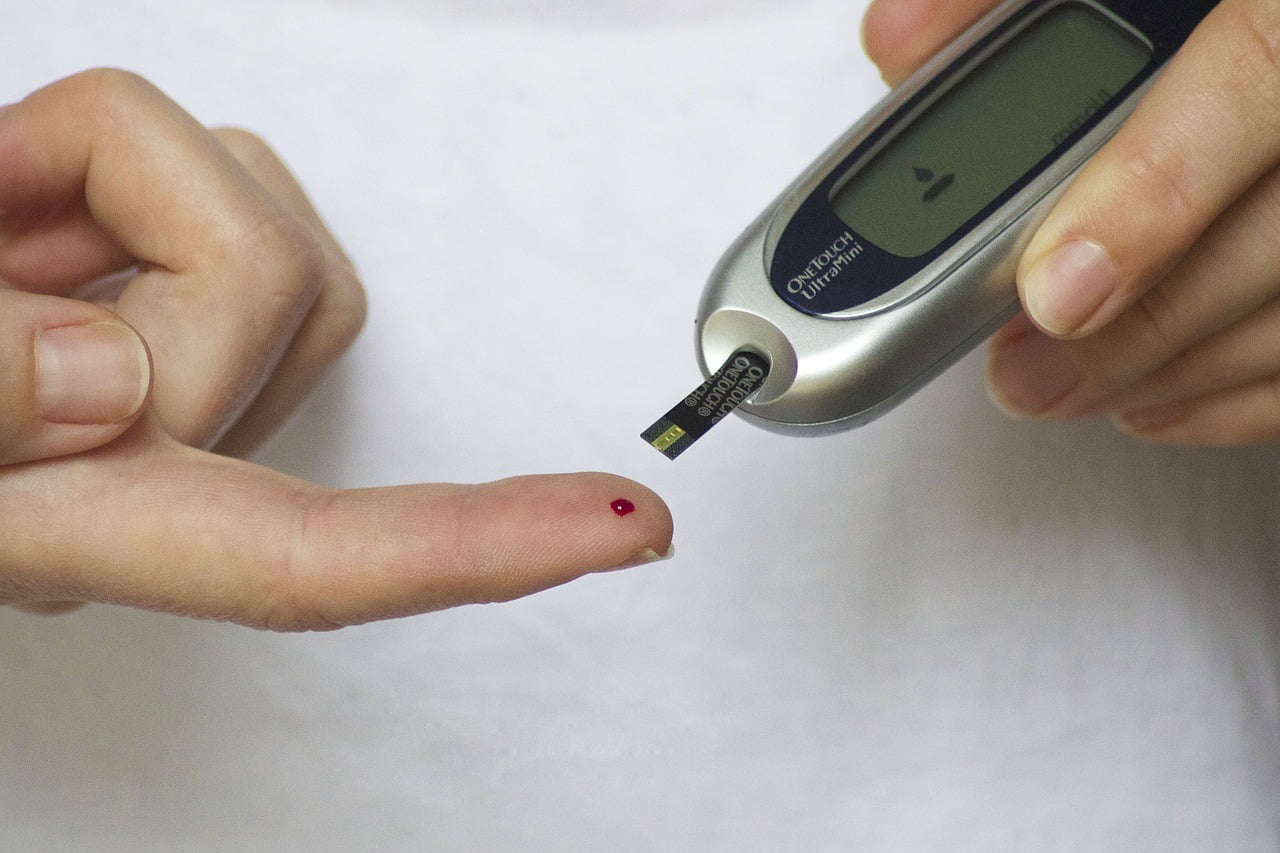
    Microfluidic devices – such as those used by individuals with diabetes to monitor their blood glucose levels – are all about transport. Typically, these devices use some kind of externally applied force, like a temperature gradient or electrical field, to force liquids through the device’s narrow channels. But a new study describes a way to move droplets without an external force.

    The researchers built their devices using two slips of glass, coated with an oil-attracting, water-repellent mixture. They attached the glass slips with a narrow spacer at one end, leaving the other end free. This made a narrow, but slightly flexible gap. When the scientists placed an oil drop inside the closed end, it spread on the glass, pulling the two sides closer to one another. Water drops, on the other hand, tried to force the walls apart, in an effort to minimize contact. Both sets of drops, interestingly, moved toward the open end of the device.

    The researchers found that the shapes assumed by the droplets create an internal pressure gradient, which, in both cases, slowly moves the drops. They call this method bendotaxis, a type of self-propulsion driven by the drops’ ability to bend the material they’re touching. It’s not a fast way to transport fluids – the drops moved only a few micrometers per second – but it may be useful for applications like drug deliveries where the liquid needs to be administered slowly over a longer period. (Image credit: TesaPhotography; research credit: A. Bradley et al.; via APS Physics; submitted by Kam-Yung Soh)
  • Sorting Blood Cells

    Sorting Blood Cells

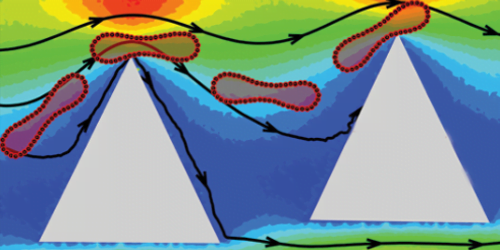
    Many diseases – like sickle-cell anemia and malaria – are accompanied by changes in the stiffness of red blood cells. And while microfluidic devices capable of sorting blood cells by size exist, few have made microfluidic devices capable of sorting blood cells by their deformability. But a new set of simulations suggests we could do so relatively easily.

    Existing devices sort blood cells by size using an array of tiny posts – kind of like a cellular pachinko machine. Through simulation, researchers found that by changing the shape of these posts – specifically by turning them from circles into sharper triangles –  they could sort the red blood cells by their stiffness. Because the sharp corners create large local stresses in the fluid, the blood cells get deformed when passing the corner. That ends up deflecting stiffer cells into a different stream. Build a whole array of posts and you can sort the blood cells by their degree of stiffness – ideally allowing you to isolate the most diseased cells. (Image and research credit: Z. Zhang et al.; via APS Physics)

    ETA: Added a clarification: some researchers, like Beech et al., have investigated deformability-based sorting devices.

  • Fighting a Viscous World

    Fighting a Viscous World

    Vaucheria is a genus of yellow-green algae (think pond scum), and some species within this genus reproduce asexually by releasing zoospores. Once mature, the zoospore has to squeeze out of a narrow, hollow filament in order to escape into the surrounding fluid (top). To do so, it uses tiny hair-like flagella on its surface. Despite the minuscule size of these micron-length flagella, they generate some major flows around the zoospore (middle and bottom). Even several body lengths away, the flow field shows significant vorticity. All this active entrainment of fluid from the surroundings helps the zoospore escape its confinement and swim away to start a new plant. (Image and research credit: J. Urzay et al., source)

  • Featured Video Play Icon

    Underwater Snakes, Gusty Flying, and Microswimmers

    If you like your fluid dynamics with a healthy dose of biology, this video’s for you! Learn about the hydrodynamics of snake strikes, how birds fly in gusty crosswinds, and the mathematical underpinnings of a microswimmer’s journey. This is the final video in our FYFD/JFM collaboration featuring research from the 2017 APS DFD meeting. If you missed any of the previous videos, you can see them all here. Which one is your favorite? Would you like to see the series continue? Let me know in the comments or on Twitter! (Image and video credit: N. Sharp and T. Crawford)

  • Boiling with Sound

    Boiling with Sound

    Ultrasonic vibrations can boil nanoscale liquid layers, according to a new simulation-based study. Above you see a layer of water initially about 2 nm thick. When the surface it’s on vibrates at frequencies in the 100 GHz range – about a billion times faster than a hummingbird flaps – it superheats the thin layer of water. In this case, the film undergoes nucleate boiling, forming the same kinds of bubbles you see when boiling a pot of water. When the water layer gets too thin to support nucleate boiling, it stops boiling but evaporation continues. The transition occurs when van der Waals forces become significant. The technique only works with ultrathin layers of a liquid, but the authors envision broad application possibilities in industry as well as in micro- and nano-scale fluid systems. (Image and research credit, and submission: R. Pillai et al.)

  • Bubble Trains in a Microchannel

    Bubble Trains in a Microchannel

    Trains of bubbles flowing through a microchannel get distorted by periodic expansions and constrictions. In these images, flow is from left to right, and the narrow point of the channel is about 250 microns across. In narrow regions, the front of the bubble tends to move faster, while in wider areas, the back of the bubble speeds up. This causes the distinctive shape changes we see. Microfluidic channels with these exaggerated shifts in geometry allow researchers to study the physics behind liquids and gases seeping through the interstitial gaps of a porous media, like when water and gases move through rock and soil. (Image and research credit: M. Sauzade and T. Cubaud)

  • Microfluidic Legos

    Microfluidic Legos

    Microfluidic devices are valuable tools in a lab, but they are difficult and time-consuming to manufacture. Researchers looking to simplify the building of such fluidic circuits have turned to toys. The uniformity and modularity of LEGO bricks makes them a promising platform for modifiable microfluidics. Using a micromilling machine, researchers cut narrow channels into bricks, then sealed the channel with clear adhesive and a set of tiny O-rings. Their results allow them to build and rebuild simple microfluidic devices in moments. There are limitations, though. Micromills cannot cut the smallest size channels used in today’s microfluidic devices, and the plastic of the LEGO bricks restricts the chemicals and temperatures scientists can use. Nevertheless, this could be a useful teaching tool and a new method for testing and prototyping microfluidic devices. (Image credit: MIT, source; research credit: C. Owens and A. Hart)

  • Featured Video Play Icon

    Swimming Microdroplets

    Simple systems can sometimes have surprisingly complex behaviors. In this video, the Lutetium Project outlines a scheme for swimming microdroplets. Most of the droplets shown are just water, but they’re released into a chamber filled with a mixture of oil and surfactants. All flow through the chamber is shut off, but the droplets swim around in complicated, disordered patterns anyway. To see why, we have to zoom way in. The surfactant molecules in the oil cluster around the droplets, orienting so that their hydrophobic parts are in the oil and their hydrophilic parts point toward the water. They actually draw some of the water out of the droplets. This creates a variation in surface tension that causes Marangoni flow, making the droplets swim. Over time, the droplets shrink and slow down as the surfactants pull away more and more of their water and the variations in surface tension get smaller. (Image and video credit: The Lutetium Project; research credit: Z. Izri et al.)

  • Microfluidic Chips in Action

    Microfluidic Chips in Action

    Earlier this year, The Lutetium Project explored how microfluidic circuits are made, and now they are back with the conclusion of their microfluidic adventures. This video explores how microfluidic chips are used and how microscale fluid dynamics relates to other topics in the field. Because these techniques allow researchers very fine control over droplets, there are many chemical and biological possibilities for microfluidic experiments, some of which are shown in the video. Microfluidics in medicine are also already more common than you may think. For example, test strips used by diabetic patients to measure their blood glucose levels are microfluidic circuits! (Video and image credit: The Lutetium Project; submitted by Guillaume D.)

  • Moving Fluids in the Right Direction

    Moving Fluids in the Right Direction

    One challenge in creating miniature labs-on-a-chip is keeping fluids moving in the desired direction. The top image above shows red and blue droplets being moved toward one another on the top and bottom of a vibrating surface. Eventually, they meet and mix in the middle. To force the fluids in the right direction, the surface is highly textured, as seen in the lower image. These tiny posts and arcs help trap air between the surface and the drop. This makes the drop’s contact area with the superhydrophobic substrate quite small. The arcs provide directionality, and, as the surface shakes, the drops inch along, releasing the arc on the trailing edge as they make contact with a new one. In effect, the droplets walk themselves just where their designers want them to go. (Image and research credit: T. Duncombe et al.; via SciTechDaily)