Tag: microfluidics

  • Building Liquid Circuits

    Building Liquid Circuits

    Building microfluidic circuits is generally a multi-day process, requiring a clean room and specialized manufacturing equipment. A new study suggests a quicker alternative using fluid walls to define the circuit instead of solid ones. The authors refer to their technique as “Freestyle Fluidics”. As seen above, the shape of the circuit is printed in the operating fluid, then covered by a layer of immiscible, transparent fluid. This outer layer help prevent evaporation. Underneath, the circuit holds its shape due to interfacial forces pinning it in place. Those same forces can be used to passively drive flow in the circuit, as shown in the lower animation, where fluid is pumped from one droplet to the other by pressure differences due to curvature. Changing the width of connecting channels can also direct flow in the circuits. This technique offers better biocompatibility than conventional microfluidic circuits, and the authors hope that this, along with simplified manufacturing, will help the technique spread. (Image and research credit: E. Walsh et al., source)

  • Hair in the Flow

    Hair in the Flow

    Humans are hairy on the inside. Not in the way that we are on the outside, but in the sense that many interior surfaces of our bodies are covered in small, flexible, hair-like protrusions like the papillae on our tongues or the cilia in our intestines. Many of these fibers are immersed in fluids, raising the question of how the flow and the hairs interact. An elastic fiber immersed in a flow will bend in the direction of the flow (bottom); this helps reduce the drag and widens the channel flow goes through compared to a stiff, upright fiber. 

    But what happens when the fibers are all mounted at an angle? In this case, researchers found an asymmetric response. If flow moves in the direction of the fibers’ bend, the hairs don’t impend the flow at all. If flow moves against that direction, however, the hairs start to stand upright, blocking the flow channel and increasing the drag. The researchers suggest this sort of mechanism could be use in micro-hydraulic devices in the same way as a diode in a circuit – allowing flow in only one direction. For another biological example of flow control, check out how a shark’s denticles can prevent flow separation. (Image credits: hairy surface – J. Alvarado et al., flow around a hair – J. Wexler et al.; research credit: J. Alvarado et al.)

  • Graphene Swirls

    Graphene Swirls

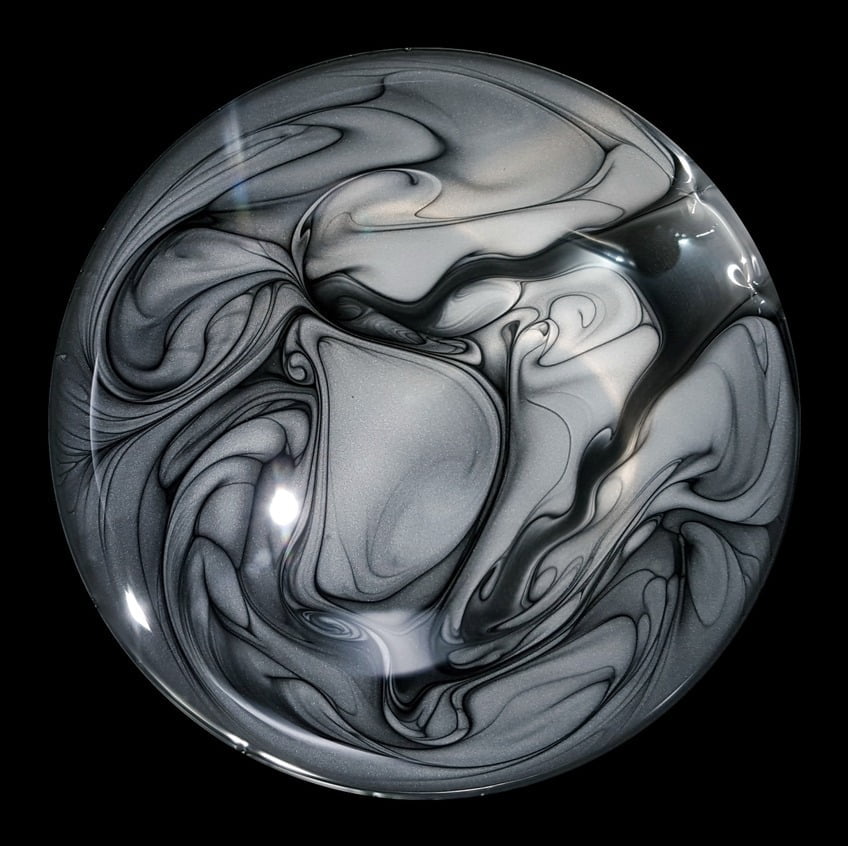
    Graphene powder swirls in alcohol in this prize-winning photo from this year’s Engineering and Physical Sciences Research Council photography competition in the UK. The image was captured while producing graphene ink that can print circuits directly onto paper. According to the researcher’s description, this ink is forced through micrometer-sized capillaries at high pressure to rip the layers apart and produce a smooth, conductive ink in solution. In this photo, we seem to see more conventional mixing driven by the powder’s injection and the variations in surface tension due to the alcohol and its evaporation. The graphene leaves behind beautiful streaklines that highlight its path as it mixes. (Image credit: J. Macleod; via Discover)

  • Sorting by Bubble

    Sorting by Bubble

    Microfluidic devices, also known as labs-on-a-chip, require clever techniques for processes like sorting particles by size. One such technique uses an oscillating bubble to sort particles. When the bubble vibrates back and forth (left) it creates what’s known as a streaming flow – large regions of recirculation (shown as gray ellipses in the right image). If the bubble is placed inside a channel, we say that two flows have been superposed; the device combines both the left-to-right flow of the channel and the recirculating streaming flow.

    Introduce a micron-sized particle into this combined flow, and it will get carried to the bubble and then bounced around by its effects (left). In fact, the larger the particle is, the more the bubble deflects it relative to the flow. You can see this in the image on the right as well. Here the frame rate has been matched to the bubble’s vibration, so the bubble appears stationary, and the particle paths look smooth. The gray lines show the fluid’s path, and individual solid particles are introduced at the left. The largest particle gets strongly deflected as it passes the bubble and exits at the top-right. A fainter, smaller particle follows after it. Being smaller, the bubble’s deflection on it is weaker, and this second particle exits along a path to the center-right. The result is a fast and simple method for particle sorting. (Image and research credit: R. Thameem et al., source)

  • Featured Video Play Icon

    Building Labs on a Chip

    In their second video on microfluidics, the Lutetium Project takes viewers inside the process of creating microfluidic circuits, also known as labs-on-a-chip. When you want to build pipes only a few microns across, you need to use special techniques. As the video shows, manufacturing starts with photolithography, a process used to selectively mask parts of the substrate which are then etched away chemically. This creates a mold that’s later covered in a polymer solution. Once hardened, the polymer is removed from the mold, treated and attached to a glass slide. The result is a tiny fluid circuit that’s only a few square centimeters in total size. To really appreciate the process, check out the video, which helpfully takes you inside the clean room to see the chip manufacturing process firsthand. (Video and image credit: The Lutetium Project)

  • How We Sweat

    How We Sweat

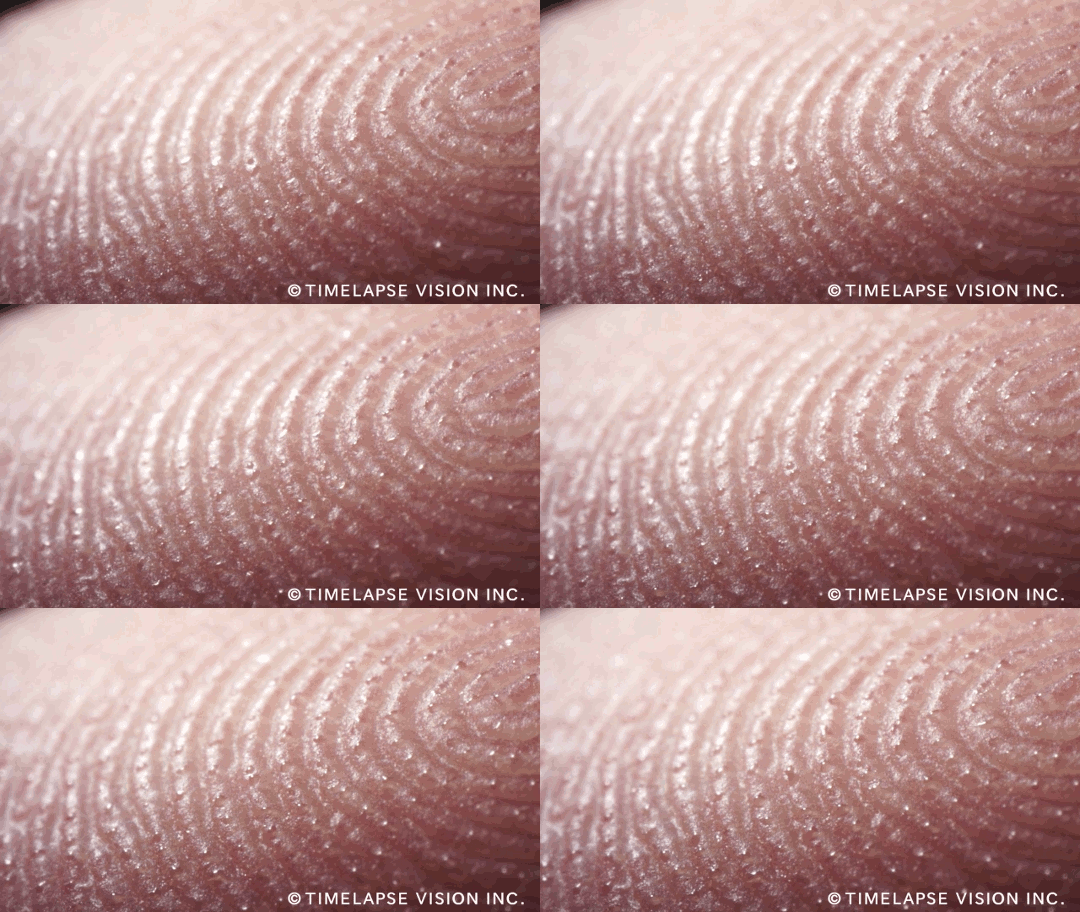
    Sweat plays a critical role in controlling body temperature for humans. Most of the sweat glands on our bodies are eccrine sweat glands, which pump out a mixture of water and electrolytes in response to temperature changes or emotional stimuli. Beneath the surface, these glands consist of three major areas, the tightly bunched secretory coil, where the cells that produce sweat are located; a long dermal duct that transports sweat to the skin surface; and the upper coiled duct just below the pore where sweat exits. Eccrine glands can produce an impressive amount of pressure – about 70 kN/m^2, equivalent to 70% of sea-level atmospheric pressure – to help drive sweat up and out onto the skin. Flow from pores is not steady; like many other biological processes, sweat flow is pulsatile. (Image credit: Timelapse Vision Inc., source; Z. Sonner et al.; submitted by Marc A.)

    image
  • Microscale Rockets

    Microscale Rockets

    Shown above are a trio of microscale rockets, each about 10 microns in length. These tiny rockets are roughly cylindrical in shape, with a narrower diameter at the front than the back. Like their space-faring brethren, these microrockets are chemically propelled. They draw in fuel from their surroundings, which reacts with the catalysts coating the interior of the microrocket to produce gases. Those gases bubble out the back end of the microrocket, creating thrust capable of propelling the rockets more than 1000 body lengths/second. Researchers have already demonstrated that these tiny rockets can haul cargo along with them. Scientists hope one day to use these self-propelled microrockets to help deliver drugs or isolate cancer cells. (Image credit: J. Li et al., source)

  • Drawing With Microfluidic Tweezers

    Drawing With Microfluidic Tweezers

    One of the challenges of dealing with objects at the microscale is finding ways to manipulate them. This is what techniques like optical tweezers or magnetic traps are used for. The downside to these methods is that they often require complex experimental set-ups or place restrictions on the kinds of particles that can be manipulated. Recently, however, researchers have developed a new hydrodynamic alternative: the Stokes trap.

    Using a six-channel microfluidic device like the the ones shown in A) and B) above, scientists can alter the flow in the device in such a way that they trap and manipulate two particles at the same time. The simultaneous inflow and outflow in the device creates streamlines like those shown in C) and D) above. The large white areas where the streamlines converge and diverge are stagnation points–areas of little to no velocity. The scientists trap their particles at the stagnation points and then carefully shift the flow rates into and out of the device to move the stagnation points–with particles in tow–wherever they want them. In the animation, you can see part of a movie where they use the particles to write out a capital I (for University of Illinois). The researchers hope the technique will be used in the future for studying the physics of soft materials and biologically-relevant molecules like DNA. For more, check out the full paper or the group’s website.  (Image credit and submission: C. Schroeder et al.)

  • Dancing Droplets

    Dancing Droplets

    What makes drops of food coloring able to dance, chase, sort themselves, or align with one another? This unexpected behavior is a consequence of food coloring consisting of two mixed liquids: water and propylene glycol. Both have their own surface tension properties and evaporation rates, which ultimately drives the behavior you see in the animations above. Both long-range and short-range interactions are observed. The former are due to vapor from each droplet adsorbing onto the glass around the droplet, thereby changing the local surface tension and causing nearby drops to feel an attractive force. The short-range effects are also surface-tension-driven. Droplets with lower surface tension will naturally try to flow toward areas of higher surface tension, which causes them to “chase” dissimilar adjacent drops. You can learn more about the research in the videos linked below (especially the last two), or you can read about the work in this article or the original research paper. (Image credit: N. Cira et al., source videos 1, 2, 3, 4; GIFs via freshphotons; submitted by entropy-perturbation)

  • Encapsulating Drops

    Encapsulating Drops

    Building and manipulating drops containing multiple chemicals is useful in pharmaceutical applications. But it can be a challenge to encapsulate multiple fluids without mixing them immediately. The research poster above describes a clever and simple method of building these compound drops. It uses a crosswise array of fibers, as seen in the top image. Dyed water droplets are placed at each intersection, pinning them in place. Then a larger drop of oil is added to the vertical fiber. As it runs down the fiber, it collects and encapsulates the individual droplets, creating the compound drop seen in the bottom photo. (Photo credit: F. Weyer et al.)