Tag: jets

  • Bubbles Rising

    Bubbles Rising

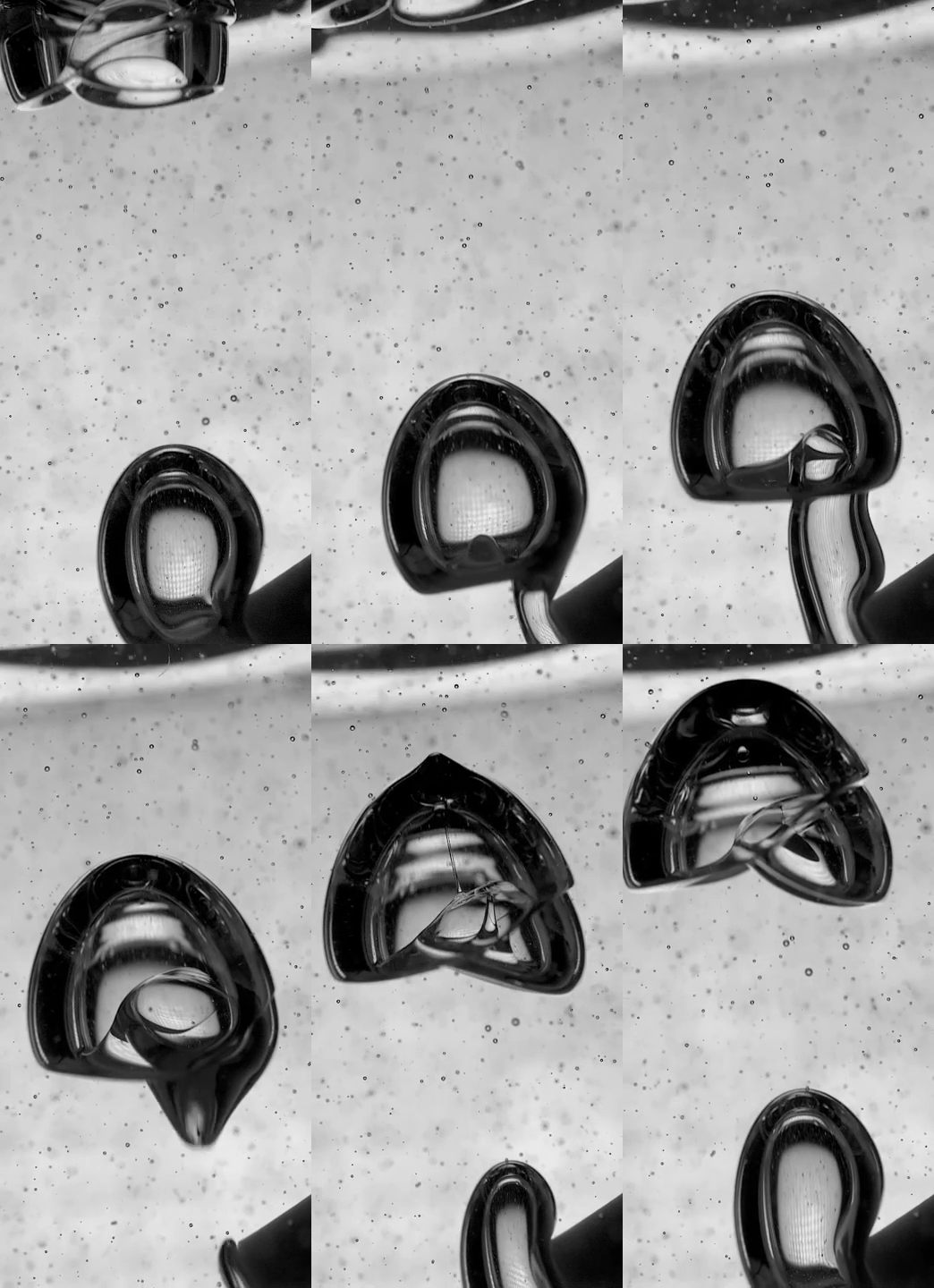
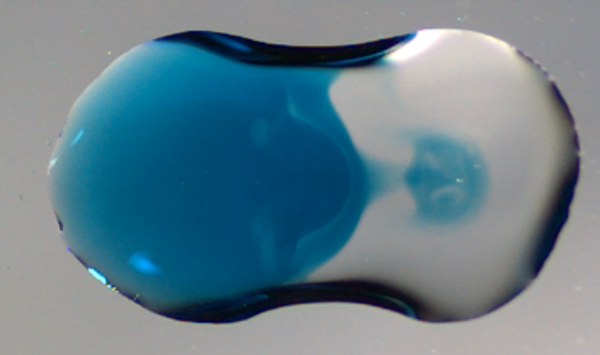
    Here we see high-speed video of air bubbles rising through sesame oil. The flow rate of air is just right for one bubble to catch up to and merge with the previous bubble. As it the trailing bubble pinches off from the valve, it shoots a small jet through itself and into the prior bubble. For information on how to recreate this and related experiments, check out this article. (Image credit: C. Kalelkar and S. Paul, source; see also C. Kalelkar)

  • Decelerating Jets

    Decelerating Jets

    For more than a century, scientists have been fascinated by the jet that forms after a drop impacts a liquid. In this study, researchers tracked fluorescent particles in the fluid to understand the velocity and acceleration of flow inside the jet. They found that, within the first 10ms after the jet appears, it decelerates at up to 20 times the gravitational acceleration. That’s much too fast for gravity to cause, pointing instead to the critical importance of surface tension in dictating the behavior of these fast-moving jets. (Image and research credit: C. van Rijn et al.; via APS Physics; submitted by Kam-Yung Soh)

  • Jets Beneath Leidenfrost Drops

    Jets Beneath Leidenfrost Drops

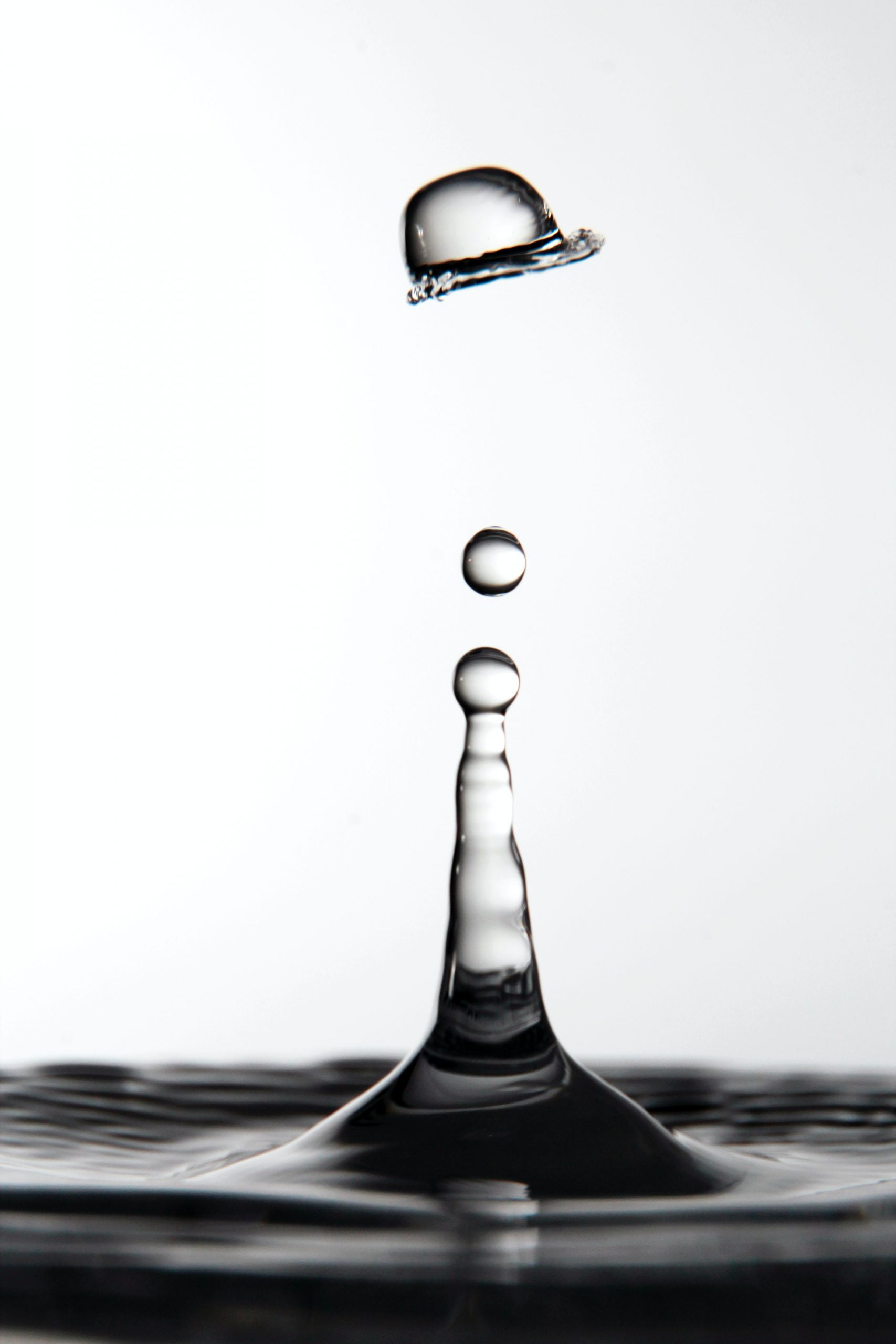
    When a droplet impacts, it’s not unusual for converging ripples to form an upward jet, like the one seen here. But under the right circumstances, jets can form downward, too. This study looks at the ultrafast jets that can form beneath an impacting Leidenfrost drop.

    These Leidenfrost drops are striking a surface much hotter than their boiling point, so a large vapor cavity forms quickly beneath them. Using x-ray imaging, the researchers were able to capture the dynamics of this cavity’s formation and collapse (Image 2). The field of view in the animation shows only a portion of the drop’s cavity, so Image 3 may help you orient relative to the drop at large.

    Initially, we see the center of the droplet hitting the surface, followed by the fast growth of a vapor cavity. Rippling capillary waves converge on top of the cavity, creating a pinch-off. From there, a bubble rises up while a fast jet shoots downward. (Image credit: water jet – A. Min, others – S. Lee et al.; research credit: S. Lee et al.)

  • Featured Video Play Icon

    Coalescing Drops

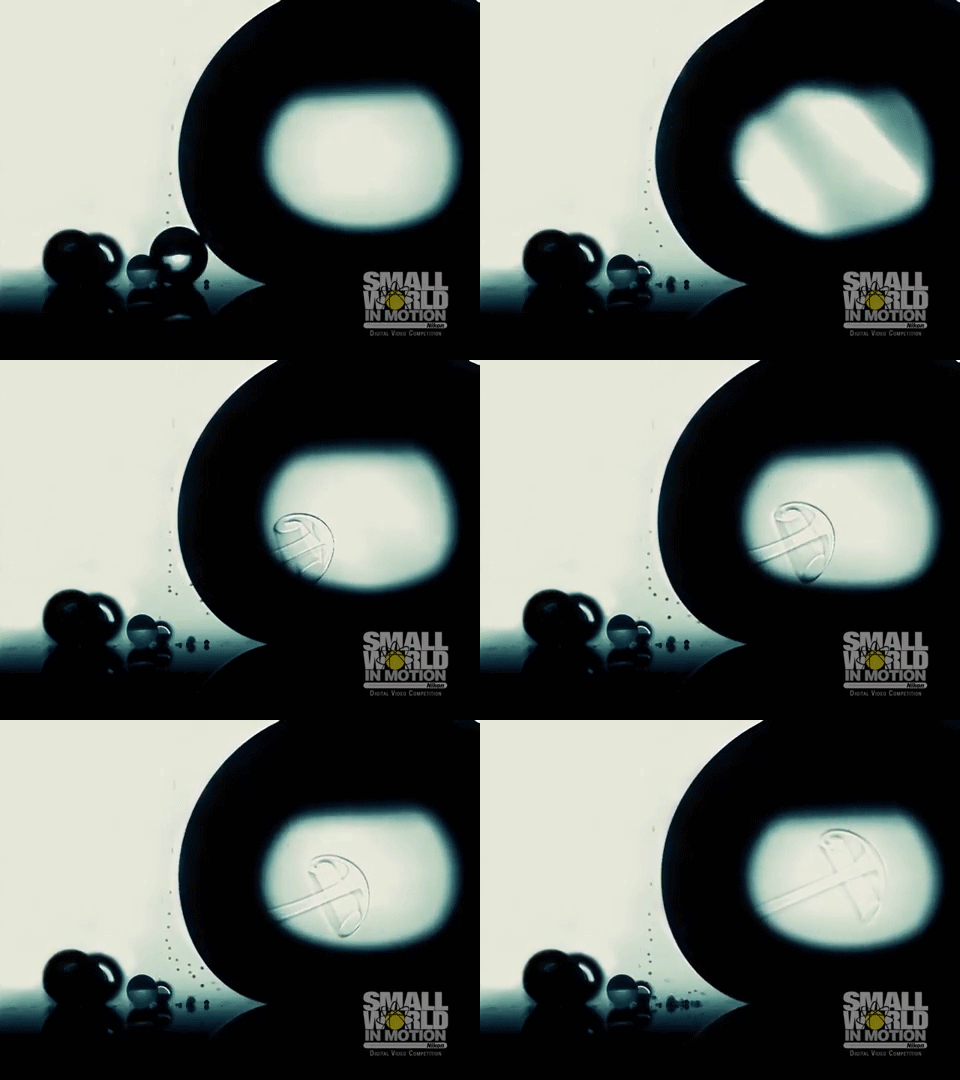
    This year’s Nikon Small World in Motion competition was won by fluid dynamics! The first place video shows droplets on a superhydrophobic surface coalescing. The droplets are a mixture of water and ethanol. Their initial merger creates a ripple of waves that’s followed by a ghostly vortex ring that jets into the interior. Previous research on coalescence during impact shows jets driven by surface tension but the jet here doesn’t appear to be confined to the surface. (Image and video credit: K. Rabbi and X. Yan; via Nature; submitted by Kam-Yung Soh)

    Droplets on a superhydrophobic surface coalescing.

  • Surface Jets in Coalescing Droplets

    Surface Jets in Coalescing Droplets

    What goes on when droplets merge is tough to observe, even with a high-speed camera. There are many factors at play: any momentum in the droplets, surface tension, gravity, and Marangoni forces, to name a few. A new study that simultaneously records multiple views of coalescence is shedding some light on these dynamics.

    The results are particularly interesting for droplets that are somewhat physically separated so that they only coalesce after one drop impacts near the other. In this situation, with droplets of equal surface tension, researchers observed a jet that forms after impact (Image 1) and runs along the top surface of the coalescing drops (Image 2). That location is a strong indication that the jet is created by surface tension and not other forces.

    To test that further, the researchers repeated the experiment but with droplets of unequal surface tension. They found that when the undyed droplet’s surface tension was higher (Image 3), Marangoni forces enhanced the surface jet, as one would expect for a surface-tension-driven phenomenon. But if the dyed droplet had the higher surface tension (Image 4), it was possible to completely suppress the jet’s formation. (Image, research, and submission credit: T. Sykes et al., arXiv)

  • Featured Video Play Icon

    Swinging Jets

    In the tiny realm of microfluidics, flows are, in general, completely laminar. That makes mixing a challenge. But it turns out that pumping water steadily into multiple inlets can spontaneously generate oscillations between the jets, allowing dramatic mixing even at low Reynolds numbers. Two inlets in a parallel channel (first image) oscillate steadily over a small range of conditions, but widening the channels (second image) allows the jets to switch back and forth over a larger range. And adding additional inlets (third image) can create even more complex fluid oscillators! (Image, video, and research credit: A. Bertsch et al.)

  • Recreating Volcanic Lightning

    Recreating Volcanic Lightning

    Some natural phenomena, like volcanic eruptions or tornado formation, don’t lend themselves to fieldwork — at least not at the height of the action. The danger, unpredictability, and destructiveness of these environments is more than our equipment can survive. And so researchers find clever ways to recreate these phenomena in controllable ways. The latest example comes from a lab in Germany, where researchers are recreating volcanic lightning.

    To do so, they heat and pressurize actual volcanic ash in an argon environment and let the mixture decompress into a jet, like a miniature eruption. The lightning that accompanies the jet is thought to depend on friction between ash particles, which build up electric charges when rubbed, just like a balloon rubbed against one’s hair. When the charges get large enough, lightning discharges the build-up.

    Small-scale experiments like this one allow researchers to vary the temperature and water content of the ash and observe how this changes the lightning. Drier ash generates more lightning, but it’s hard to distinguish whether this is inherent to the ash or the result of the denser jets that form without the added eruptive force of steam. (Image credit: eruption – M. Szeglat, lab lightning – Sönke Stern/Ludwig-Maximilians-Universität München/Gizmodo; research credit: S. Stern et al.; via Gizmodo)

  • Champagne’s Shock Wave

    Champagne’s Shock Wave

    The distinctive pop of opening a champagne bottle is more than the cork coming free. The sudden release of high-pressure gas creates a freezing jet that’s initially supersonic. It even creates a Mach disk, like those seen in rocket exhaust. That supersonic flow can only be maintained, though, with a large enough pressure difference between the gas in the bottle and the atmosphere outside. Once the pressure drops below that critical point, the jet slows down and becomes subsonic. For more on champagne popping and its colorful plume, check out this previous post. (Image and research credit: G. Liger-Belair et al.; via Nature; submitted by Kam-Yung Soh)

  • Jets from Lasers

    Jets from Lasers

    Laser-induced forward transfer (LIFT) is an industrial printing technique where a laser pulse aimed at a thin layer of ink creates a tiny jet that deposits the ink on a surface. In practice, the technique is plagued with reproducibility issues, in part because it’s difficult to produce only a single cavitation bubble when aiming a laser at the liquid layer. This is what we see above. 

    The laser pulse creates its initial bubble just above the middle of the liquid layer. Shock waves expand from that first bubble and quickly reflect off the liquid surface (top) and wall (bottom). When reflected, the shock waves become rarefaction waves, which reduce the pressure rather than increasing it. This helps trigger the clouds of tiny bubbles we see above and below the main bubble. 

    The effect is worst along the path of the laser pulse because that part of the liquid has been weakened by pre-heating, but impurities and dissolved gases in the liquid layer are also prone to bubble formation, as seen far from the bubble. The trouble with all these unintended bubbles is that they can easily rise to the surface, burst, and cause additional jets of ink that splatter where users don’t intend. (Image and research credit: M. Jalaal et al.; submitted by Maziyar J.)

  • Catching Fire

    Catching Fire

    Citrus fruits like oranges house tiny pockets of oil in their peels. When squeezed, the oils jet out in tiny micro-jets that are about the width of a human hair. Despite their small size, the jets reach speeds of about 30 m/s and quickly break into a stream of droplets. When exposed to the flame of a lighter, like in the animation above, those microdroplets combust easily, creating a momentary fireball used to augment some cocktails. For more on how the citrus peel generates these jets, check out this previous post. (Image credit: Warped Perceptionsource; research credit: N. Smith et al.)