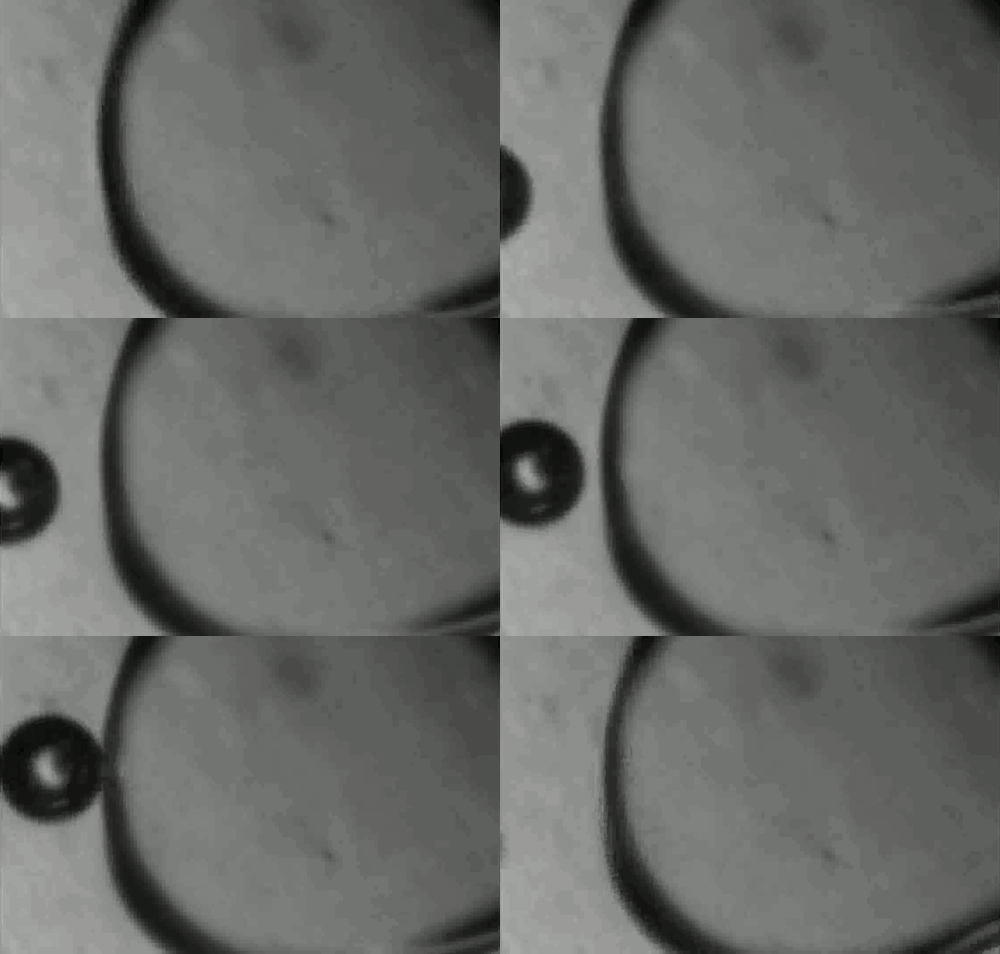
High-speed video is wonderful for appreciating fluid motion in ways we can’t on our own. In this video from Warped Perception, we see what happens when a vibrating tuning fork is lowered into water. The tines of the tuning fork create a spray of tiny droplets, reminiscent of what happens in ultrasonic atomization or when blowing through an immersed straw. The ejected droplets fall slowly back onto the disturbed surface; many of them bounce rather than coalescing. This is because the surface’s vibration pushes the drops aloft again before the air layer separating the drop from the surface has the time to drain away. (Video credit: Warped Perception)
Tag: jets

The Challenges of Blowing Bubbles


Although every child has experience blowing soap bubbles with a wand, only in recent years have scientists dedicated study to this problem. It turns out to be a remarkably complex one, with subtleties that can depend on the size of the wand relative to the jet a bubble-blower makes as well as the speed at which the air impacts the film. A recent study found that, at low or
moderate speeds, the film takes on a stable, curved shape (top image), but once you increase to a critical speed, the film will overinflate and burst. The key to forming a bubble, the authors suggest, is hitting that critical speed only briefly; if you slow down before the film ruptures, then the bubble has a chance to disconnect and form a sphere without breaking.The work also suggests there are two reliable methods for bubble making in this way. One is to impulsively move the wand through the background fluid, as shown in the lower animation. The other is the one familiar to children: blow a jet just fast enough to overinflate the film, then let up so the bubble forms without breaking. (Image and research credit: L. Ganedi et al.; via Ars Technica; submitted by Kam-Yung Soh)

The Driver of Hydraulic Jumps
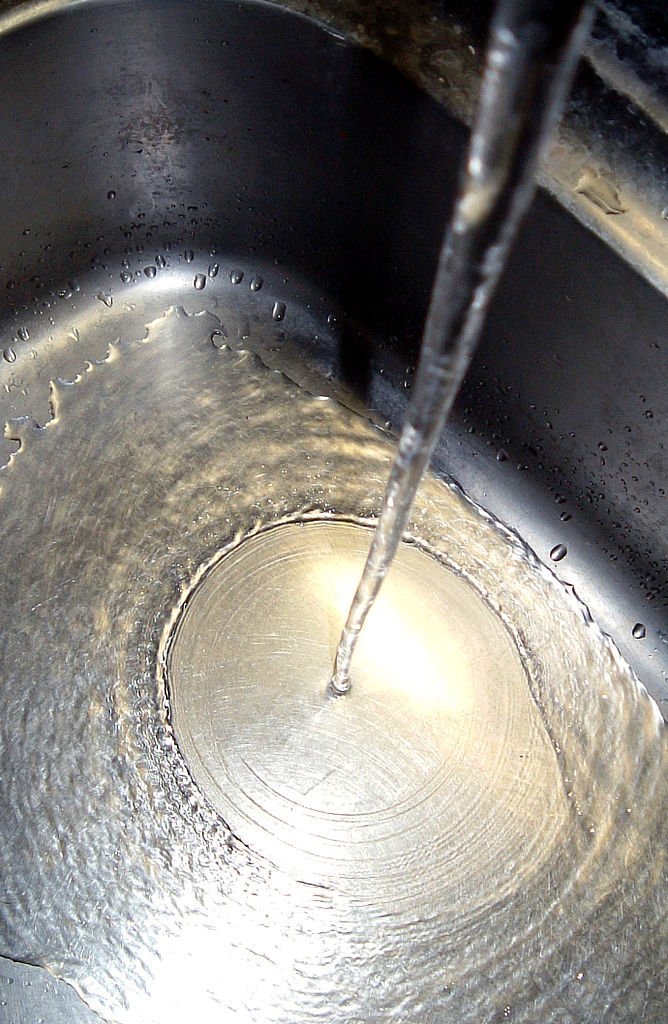
You’ve seen it a million times. When you turn on your kitchen faucet, the falling water forms a distinctive ring – known as a hydraulic jump – in the bottom of your sink. First described by Leonardo da Vinci, this phenomenon has been studied for centuries, and, for nearly all of that time, scientists assumed that gravity played a major role, even in kitchen-sink-sized hydraulic jumps. But that’s not the case.
A newly published study shows that gravity can’t be a major player in setting the radius of these small-scale hydraulic jumps because they form the same whether the jet impinges from above, below, or sideways. Instead, the researchers found that surface tension and viscosity are the parameters that determine the jump’s formation. It’s not every day that you get to overturn a centuries-old theory in physics! (Image credit: J. Kilfiger; research credit: R. Bhagat et al.; via Silicon Republic; submitted by Patrick D.)

A Burst of Microdroplets
If you hold a bubbly beverage like champagne or soda near your face, you’ll feel a light mist of tiny, nearly invisible droplets.These droplets form when bubbles reach the surface and pop, generating a tiny jet that ejects an even tinier droplet, as shown in the animation above. This process is remarkably common; its occurrence in the ocean results in billions of tons of sea salt entering our atmosphere each year. Since these tiny microdroplets stay aloft for far longer than their larger brethren, understanding how they form and just how small they can be is vital for understanding their impact on climate, pathogen spreading, and other topics. A new study suggests that the minimum size for an ejected droplet is just 1% of the size of the bubble that births it. (Image and research credit: C. F. Brasz et al., source)

The Kaye Effect
Allow a stream of shampoo to fall into a pile and you’ll catch a glimpse of the bizarre Kaye effect. A jet of shampoo will briefly rise up before becoming chaotic and falling. The key to this behavior is the shear-thinning of the shampoo. When the shampoo is just sitting on a surface, it’s quite viscous, but slide your hand across it, and the shampoo will become much less resistant to flowing.
When the jet of falling shampoo hits the pile, it creates a little dimple. Sometimes the incoming jet hits that dimple and slips along it, thanks to a sudden decrease in viscosity. That can send an outgoing jet of shampoo riding off the dimple like a ramp. As the dimple deepens, the outgoing streamer rises up until it hits the incoming jet and becomes unstable. The shampoo streamer collapses, only to be restarted when a new dimple forms. (Image and video credit: S. Mould; h/t to Guillaume D.)

Breaking With a Wave
For rocket combustion and other applications, like watering your lawn with a hose, a stream of fluid may need to be broken up into droplets. While simply spraying a liquid jet will make it break up, waving that jet back and forth will break it up faster. A recent study simulated this problem numerically to determine the exact mechanisms driving that break-up. The researchers found two major culprits.
The first is a Kelvin-Helmholtz, or shear-based, instability. When a jet leaves the nozzle, there’s friction between it and the comparatively still air surrounding it. This creates tiny ripples in the surface that eventually grow into the distortions we can see, and it’s found in all jets, regardless of their side-to-side motion.
The second culprit, which is only found in the oscillating jet, is a Rayleigh-Taylor instability. By moving the jet side-to-side, you’re driving the dense liquid into less dense air, which creates a different set of disturbances that also help break up the jet. The final result: swinging the jet side-to-side breaks it into smaller droplets faster. (Image and research credit: S. Schmidt et al.)

Sandy Splashes
Sand and other granular materials can be strikingly fluid-like. Here the impact of a solid sphere on sand generates a splash remarkably similar to what’s seen with water. When the ball hits, it creates a crater in the surface and sends up a bowl-like spray of sand. As the ball continues falling through the sand, the grains try to fill the empty space left behind. The walls of sand collapsing around the void meet somewhere between the surface and the depth of the ball. This generates the tall jet we observe, as well as a second one under the surface that we can’t see. We know that collapse traps an air bubble under the surface because of the eruption that occurs as the jet falls. That’s the air bubble reaching the surface. (Image credit: T. Nguyen et al., source; see also R. Mikkelsen et al.)
Can Zooplankton Mix Oceans?
Krill and other tiny marine zooplankton make daily migrations to and from the ocean surface. Previously, models of ocean mixing ignored these migrations; these animals are tiny, researchers argued, so any effects they could have would be too small to matter. But zooplankton make these migrations in huge swarms, and studies of a laboratory analog of their migrations (using brine shrimp rather than krill) reveal that, when moving en masse, these tiny swimmers create turbulent jets and eddies far larger than an individual. Their collective motion is enough to mix salty water layers 1000 times faster than molecular diffusion alone! Learn more in the latest FYFD video, embedded below. (Image and video credit: N. Sharp; research credit: I. Houghton et al.; h/t to Kam-Yung Soh)

Plasma From a Jet of Water
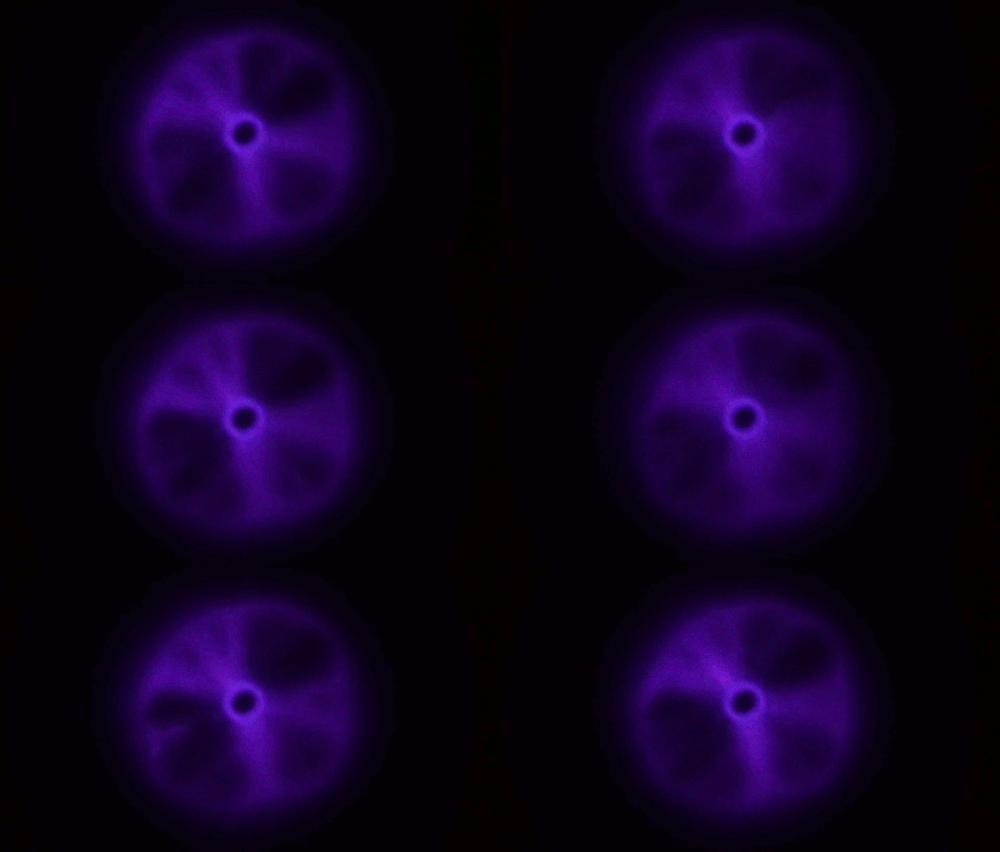
There aren’t many naturally occurring plasmas in our daily lives; by far the most common one is lightning. So it’s something of a surprise that a stream of water hitting a material like glass is able to produce a toroid of plasma like the one above. The key here, though, is that the jet has to be fast – to the tune of 200 meters per second or faster. When a jet of deionized water strikes a surface at that speed, the water has to take a very sharp, 90-degree turn, and, thanks to the polar nature of water, this causes a (negative) charge to build up at that turn. It’s akin to rubbing a balloon to build up a static charge, and it’s known as a triboelectric effect. At rest (and without high shear rates), water and glass in contact tend to create in a positive charge in the water. The plasma is created when an arc forms through air between those two charged areas.
Experiments in helium environments create a different color of plasma, confirming that the arc definitely travels through the gas. Similarly, if you use regular water instead of deionized water, the conductivity of the dissolved salts in the water is enough to prevent the necessary build up of charge. (Image and research credit: M. Gharib et al.; video credit: Applied Science; submitted by Kam-Yung Soh)
Bouncing, Floating, and Jetting


Get inside some of the latest fluid dynamics research with the newest FYFD/JFM video. Here researchers discuss oil jets from citrus fruits, balls that can bounce off water, and self-propelled levitating plates. This is our third entry in an ongoing series featuring interviews from researchers at the 2017 APS DFD conference. Missed one of the previous ones? Not to worry – we’ve got you covered. (Video and image credit: N. Sharp and T. Crawford)