Efficient mixing of fluids is vital for many applications, including fuel injection for all types of combustion and masking the exhaust of stealth fighters. Star-shaped lobed nozzles can produce jets that mix more effectively than conventional jets. This photo shows cross-sections of the jet at several downstream distances from the nozzle exit. (Photo credit: H. Hu et al)
Tag: jets

Splash Sheets


When a falling liquid jet hits a horizontal impacter, it is deflected into a sheet. The shape of the sheet is dependent upon the velocity of the jet and the viscosity of the fluid. At sufficiently high speeds the sheet will be circular; at lower speeds it may sag into a bell-shape. The circular sheets can also develop an instability that causes them to become polygonal, as shown in the photos above. The fluid then flows out along the sheet, into and along the rim, and then spouts outward in jets at the polygon’s corners. For some conditions, the jets at the corners even form a sort of fluid chain (top photo). (Photo credit: R. Buckingham and J. W. M. Bush; via 14-billion-years-later)

Atomizing Jets
The breakup of impinging jets into droplets (also called atomization) and the subsequent dynamics of those droplets are important in applications like jet and rocket engines where the mixing of liquid fuel with oxygen is necessary for efficient combustion. This video showcases recent efforts in high fidelity numerical simulation and modeling of such flows. The complexity of the problem requires clever ways of reducing the computational efforts required. One such method uses adaptotive meshing to concentrate grid points in areas where variables are changing quickly while leaving the grid sparse in areas of less interest. Because the flow is constantly evolving, the mesh must be able to adapt as the simulation steps forward in time. Even so, such calculations typically require supercomputers to complete. (Video credit: X. Chen et al)
Underwater Plumes
During 2010’s Deepwater Horizon oil spill there were reports of underwater plumes of oil escaping collection. This video demonstrates how such a plume can form. There are two clips shown here; in both the tank is filled with salt water of varying salinity, with denser saltwater at the bottom. The first jet is a green alcohol/water mixture and the second is a red gauge oil. Both jets have the same density and flow rate, but they vary in their Reynolds number. The first turbulent jet gets trapped at the interface between the denser and lighter saltwater while the less turbulent red jet passes the interface with no difficulty. The researchers suggest that strong turbulence can create an emulsion, a mixture of two normally immiscible fluids–imagine shaking a container of oil and vinegar really well–which can lead to underwater trapping.
Cavity Collapse
When a solid object is driven into a quiescent liquid, a cavity is formed. As the cavity collapses jets–a type of singularity–form. In this video, researchers explore the effect of the geometry of a disk being driven into water on the shape of the cavity formed and how it collapses. As in this video of droplet impacts on posts of different geometries, there’s a lovely symmetry in the results. (Video credit: O. Enriquez et al)
Bullet Shock Wave and Cavitation
A 9mm bullet impacts a falling jet of water. High-speed video reveals the formation of a shock wave inside the jet. Because this shock wave is confined inside the jet, it causes strong secondary cavitation–the bubble that seems to explode in front of the bullet.
Smoke Transition
Smoke issuing from a round jet undergoes transition from laminar to turbulent flow. As the smoke moves past the unmoving ambient air, the friction between these two layers creates shear and triggers a Kelvin-Helmholtz instability, recognizable by the formation and roll up of vortices along the edges of the jet. Those vortices then roll together in pairs, detach, and devolve into a generally turbulent flow. Because turbulence is far more efficient at mixing than a laminar flow is, the smoke seems to disappear.
Coughing Contagions
Schlieren imaging has applications even in public health. This video demonstrates the spread of contagion via coughing with and without a mask on. Although air from the cougher’s lungs escapes the sides of the mask, it mostly rises on a thermal plume rather than projecting 1 to 2 meters forward in a turbulent jet as in the maskless case. Flu season is just starting. Don’t forget to get your flu shot!

Impinging Without Coalescing
Three impinging jets of silicone oil rebound without coalescence due to thin-film lubrication between the jets. The motion of the oil replenishes the thin layer of air separating the streams. The same phenomenon keeps droplets from coalescing as well. (Photo credit: BIF Lab, Department of Engineering Science and Mechanics, Virginia Tech) #

Fishbone Jet Collision
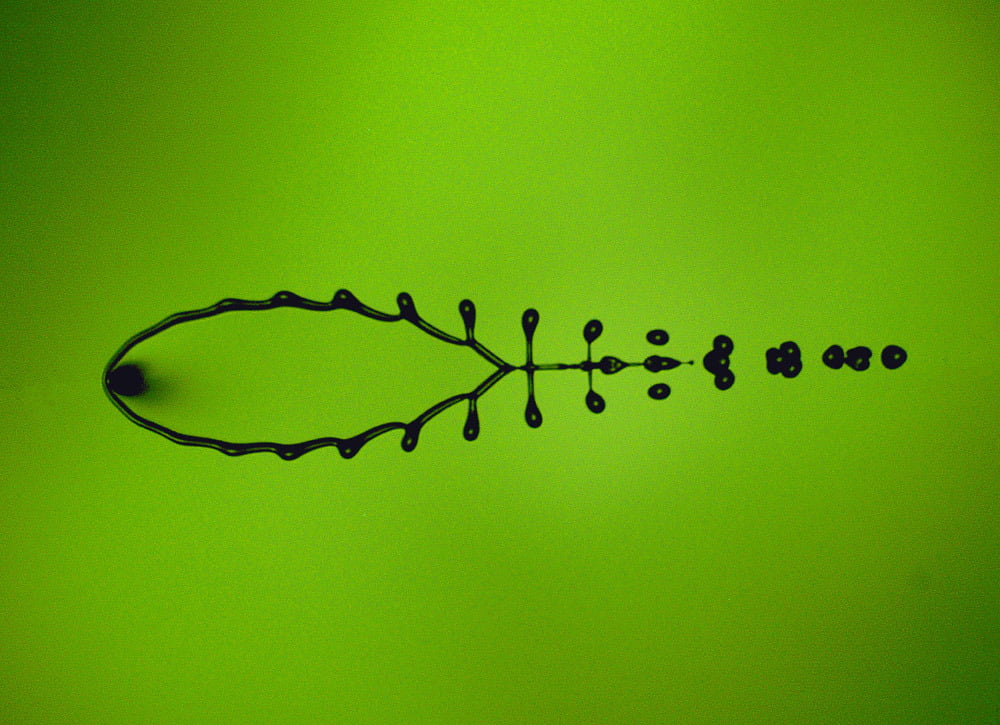
The collision of two jets of radius 420 μm results in a fishbone-like structure. The fluid contains a dilute polymer mixture whose viscoelastic effects resist the tendency of the droplets to detach from the ligaments. The breakup of the jets into droplets is important for applications in inkjet printing. The photo has been rotated 90-degrees for effect. (Photo credit: Sungjune Jung)