This high-speed video shows the behavior of oil on a vibrating surface. As the amplitude of the vibration is altered various behaviors can be observed. Initially small waves appear on the surface of the oil, then the surface erupts into a mass of jets and ejected droplets, reminiscent of a vibrated interfaces within a prism or vibration-induced atomization. When the amplitude is reduced after about half a minute, we see Faraday waves across the surface, as well as tiny droplets that bounce and skitter across the surface. They are kept from coalescing by a thin layer of air trapped between the droplet and the oil pool below. Because of the vibration, the air layer is continuously refreshed, keeping the droplet aloft until its kinetic energy is large enough that it impacts the surface of the oil and gets swallowed up.
Tag: jets

Frozen Fluid Illusion
This video creates the illusion of a jet of water frozen in mid-air. The effect is achieved by vibrating the water at the frequency of the speaker, then filming at a frame rate identical to the vibrational frequency. Thus the water pulses at the exact rate that the camera captures images, making the water appear stationary even though it is moving. (submitted by Simon H)
Granular Eruptions
Granular flows, which are made up of loose particles like sand, often display remarkably fluid-like behavior. Here researchers explore the behavior of granular flows when a solid impacts them at high speed. The sand, unlike a fluid, does not have surface tension, yet we still observe many of the same behaviors. Like a fluid, the sand splashes and creates cavities and jets as it deforms around the fallen object. The sand even “erupts” as submerged pockets of air make their way back to the surface.

Colliding Jets


Two jets colliding can form a chain-like fluid structure. With increasing flow rate, the rim of the chains becomes wavy and unstable, forming a fishbone structure where droplets extend outward from the fluid sheet via tiny ligaments. Eventually, the droplets break off in a pattern as beautiful as it is consistent. (Photo credits: A. Hasha and J. Bush)

Flying Squid
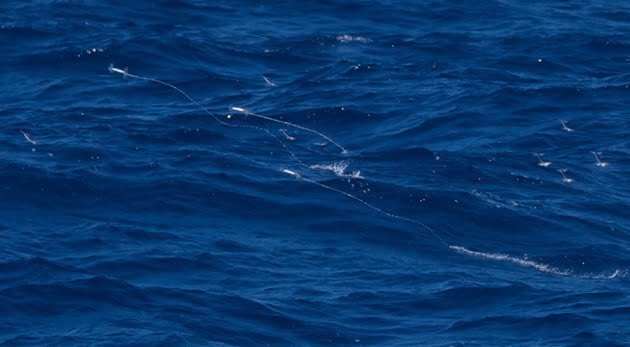
Ever seen a squid fly? Not many have, but the behavior may be more common than you think. Thanks to a set of photos from an amateur photographer, scientists have managed to estimate the velocity and acceleration of squid as they propel themselves out of the water by squirting a jet behind them. Researchers found that their speeds in air are roughly five times that in water, thanks to decreased drag. Previously it was thought that the flying behavior might be linked to escaping predators, but some now suggest that it enables migration over long distances by saving energy.
The Gobbling Drop
A little polymer goes a long way when it comes to changing a fluid’s behavior. Normally, a falling jet of fluid will develop waviness and be driven by surface tension and the Plateau-Rayleigh instability to break up into a stream of droplets. We see this at our water faucets all the time. But when traces of a polymer are dissolved in water, the behavior is much different. The viscoelasticity of the polymer chains creates a force that opposes the thinning effects caused by surface tension. So, instead of thinning to the point of breaking into droplets, a drop is able to climb back up the jet until it reaches a critical mass where it reverses direction, accelerates downward due to gravity and eventually breaks off the jet. Then the whole process begins again with a new terminal drop. (Video credit: C. Clasen et al)
Smoke Flow Viz
Smoke visualization, illuminated by a laser sheet, shows a 2D slice from an axisymmetric jet as it breaks down to turbulence. The flow is laminar upon exiting the nozzle, but the high velocity at the edge of the jet and low velocity of the surrounding air causes shear that leads to the Kelvin-Helmholtz instability. This instability leads to the formation of small vortices that grow as they are advected downstream until they are large enough to interrupt the jet and it breaks down into fully turbulent flow. (Video credit: B. O. Anderson and J. H. Jensen)
Supersonic Stellar Jets
Astronomers studying stellar jets–massive outflows of gases and particles pouring from the poles of newborn stars–are finding reasons to turn to fluid dynamicists to understand the timelapse videos they’ve stitched together from multiple exposures from the Hubble telescope. Usually astronomical events unfold on such a slow timescale that our only view of them is as a snapshot frozen in time. Stellar jets can move relatively quickly, though, with portions of the jet flowing at supersonic speeds. Over the course of Hubble’s lifetime, these jets have been imaged multiple times, allowing astronomers to create movies that reveal swirling eddies and shock wave motion previously unseen. (submitted by sakalgirl)

Colliding Jets
Two jets of sugar syrup collide and interact to form very different patterns. On the left, the two jets have a low flow rate and create a chain-like wake. The jets on the right have a higher flow rate and produce a liquid sheet that breaks down into filaments and droplets. The result is often likened to fish bones. (Photo credit: Rebecca Ing)
The Invisible Forces Behind a Lighter
This high-speed schlieren video reveals the ignition of a butane lighter. The schlieren optical technique exaggerates differences in refractive index caused by density variations, enabling experimentalists to see thermal eddies, shock waves, and other phenomena invisible to the naked eye. Here a jet of butane shoots upward from the lighter as a valve is released. Then the spark from the lighter ignites the butane gas near the bottom of the jet. A flame front the propagates outward and upward, completing the lighting process. (submitted by @Mark_K_Quinn)