Tag: fluids as art

  • Making Droplets

    Making Droplets

    If you’ve ever wondered how fluid dynamicists create those tiny perpetually bouncing droplets they study, wonder no further. A typical method, shown here, is to use a simple toothpick. First, you take a shallow container of silicone oil and vibrate it vertically. Then you dip the tip of the toothpick into the oil and pull it out, stretching the oil into a long filament. When it detaches from the toothpick, a droplet will start to form at the tip of the filament as it falls back toward the pool. But the bouncing of the surface is enough to keep the new drop from coalescing back into the pool, leaving the little drop to bounce along on its liquid trampoline. (Image credit: S. Lapointe)

  • Featured Video Play Icon

    Soap Film Turbulence

    The brilliant colors of a soap film reveal the fluid’s thickness, thanks to a process known as thin film interference. The twisting flow of the film depends on many influences: gravity pulls down on the liquid and tends to make it drain away; evaporation steals fluid from the film; local air currents can push or pull the film; and the variation in the concentration of molecules – specifically the surfactants that stabilize the film – will change the local surface tension, causing flow via the Marangoni effect. Together these and other effects create the dancing turbulence captured above. (Video credit: A. Filipowicz)

  • Fog Over Marin

    Fog Over Marin

    Fog rolls over the hills of Marin County in this long-exposure photograph by Lorenzo Montezemolo. One of the most beautiful aspects of fluid dynamics is the way the same patterns and forms show up across situations. The slow flow of fog over hills in moonlight can echo the blurring speed of rivers pouring over a rocky streambed. Despite the differences in speed, lengthscale, and fluid, the physics remain the same. (Photo credit: L. Montezemolo; via Colossal)

  • Bioluminescent Shrimp

    Bioluminescent Shrimp

    Trevor Williams and Jonathan Galione of Tdub Photo captured these beautiful images of bioluminescent shrimp along the Japanese coast. The duo collected the tiny shrimp and poured them over and near rocks to create the effect they wanted. With their blue light, the shrimp act like tracer particles in the water, and with long exposures, the photos track the movements of the shrimp and waves. Technically speaking, they trace out pathlines – the trajectory that a specific fluid (or shrimp) particle takes in a flow. It’s a lovely way of capturing the water’s dynamic motion in a still photo. (Image credit: Tdub Photo; via Colossal)

  • Soap Film Wakes

    Soap Film Wakes

    Soap films can create remarkable flow visualizations when illuminated with monochromatic (single color) light. Each of the photos above shows a flow moving from left to right with a small object near the left creating an obstruction. In the top two images, the objects are cylinders; in the lower one it’s a flat plate tilted at 45 degrees. All of the objects shed vortices as the flow moves past. These vortices alternate in direction – the first spins clockwise, the next counter-clockwise, then clockwise again and so on. This pattern is known as a von Karman vortex street and can even show up in the atmosphere! (Image credit: D. Araya et al.)

  • Featured Video Play Icon

    “Vorticity”

    Photographer Mike Olbinski is back with another storm-chasing timelapse entitled “Vorticity”. Like his previous work, this film is a breath-taking example of physics in action. It is well worth taking a few minutes to watch in fullscreen, at high resolution, and with headphones. Olbinski’s timelapses beautifully capture the incredible dynamic motion of our atmosphere. Fittingly, “Vorticity” is all about the swirling, roiling motion of supercell thunderstorms and the tornadoes they can spawn, but the film also captures many other great phenomena from the convection that builds clouds to unusual formations like undulatus asperatus and mammatus clouds. (Video credit: M. Olbinski; submitted by Paul vdB)

  • Featured Video Play Icon

    “Memories of Paintings”

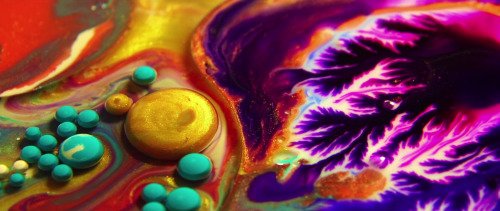
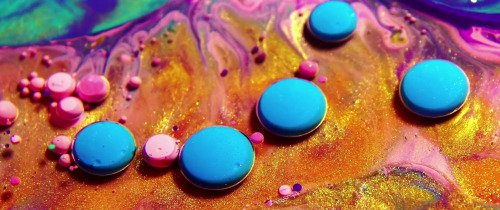
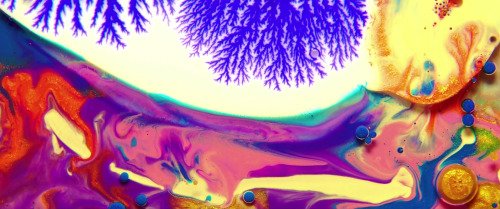
    In “Memories of Paintings,” Thomas Blanchard gives us an up-close view of fluids and mixing. It’s a calming and curious video made from combinations of paint, oil, oat milk, and soap. The fluids feather and intertwine, driven by differences in surface tension. Paint gets encapsulated by immiscible oil to create little islands of color that float and dance against the background. It’s a fun journey through effects that we witness daily but rarely take the time to watch. (Video credit: T. Blanchard; via Gizmodo)

  • Featured Video Play Icon

    Sublimation

    Sublimation is a transition directly from a solid phase to a gaseous one. Given typical Earth atmospheric conditions, one of the most commonly observed examples of sublimation is that of solid carbon dioxide, a.k.a. dry ice. Submerging dry ice in water both speeds up the sublimation–since water is a better conductor of heat than air–and creates ethereal fog that’s a combination of the expanding carbon dioxide and condensate from the water. This gorgeous video from Wryfield Lab lets you admire the process close-up. As the dry ice sublimates, watch for the ice crystals that grow on its surface. This is deposition–the opposite of sublimation–and comes from water vapor freezing onto the dry ice. (Video credit: Wryfield Lab; via Gizmodo)

    A warning for those who want to try this at home: only do this in well-ventilated spaces. The shift from solid to gas requires a huge increase in volume. Carbon dioxide is denser than air, so it does stay low to the ground, but you can still suffocate yourself (or children or pets) if you do this in an enclosed space.

  • Featured Video Play Icon

    Paper Marbling

    Fluid dynamics and art have gone hand-in-hand for centuries. In this video, artist Garip Ay demonstrates one of the coolest fluids-based art techniques: paper marbling. In this technique, artists float ink or paints on a liquid surface, manipulate the colors as desired–in this case to recreate Van Gogh’s “Starry Night”–and then float a piece of paper atop the surface to transfer the image. Multiple cultures around the world developed marbling techniques, dating all the way back to the Middle Ages. Ay is an expert in ebru, a Turkish form of the art. For more of Ay’s art, check out his website and YouTube channel. (Video credit: G. Ay; via Gizmodo)

  • Bubble Tricks

    [original media no longer available]

    Everyone remembers playing with soap bubbles as a child, but most of us probably never became as adept with them as magician Denis Lock. In this video, Lock shows off some of the clever things one can do with surface tension and thin films. My favorite demo starts at 1:25, when he constructs a spinning vortex inside a bubble. He starts with one big bubble and adds a smaller, smoke-filled one beneath it. Then, using a straw, he blows off-center into the large bubble. This sets up some vorticity inside the bubble. When he breaks the film between the two bubbles, the smoke mixes into the already-swirling air in the larger bubble. Then he pokes a hole in the top of the bubble. Air starts rushing out the deflating bubble. As the air flows toward the center of the bubble, it spins faster because of the conservation of angular momentum and a miniature vortex takes shape.  (Video credit: D. Lock/Tonight at the London Palladium/ via J. Hertzberg)