Dyed milk pulls away after a drop of acetone is added. The acetone creates a gradient in the surface tension, which causes mass flow due to the Marangoni effect. See a video of the effect (or try it yourself at home!) here.
Tag: fluids as art

High-Speed Leidenfrost Levitation
The Leidenfrost effect occurs when a liquid encounters a surface with a temperature much higher than its boiling point. Some of the liquid is instantly vaporized and then a droplet will skate across the surface on that vapor. This video shows the process at 3000 frames per second.
Flying Paint
High speed footage of flying paint demonstrates a world of viscosity and surface tension, as well as another great example of fluid dynamics as art. (via Gizmodo)
If you enjoy FYFD, why not take a minute to recommend us in the Tumblr directory? Thanks!

Butterfly Soap Spiral
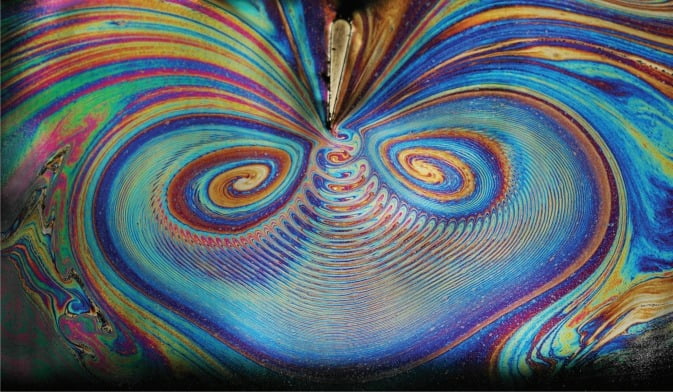
A stationary soap film disturbed by a flapping foil (seen in the top center) creates a butterfly-like double spiral roll. Two vortices form at the tip of the foil each time it changes direction; look carefully and you can see those tiny vortices all the way through the spirals. (From the 2010 Gallery of Fluid Motion; pdf)

Droplet Impact in 3D
This stereo photo of a droplet by John Hart shows the formation of a crown and droplet breakup. It’s possible to see the picture in 3D by crossing one’s eyes. #

Viscous Fingers
This photo shows the Saffman-Taylor instability in a Hele-Shaw cell. Here a viscous fluid has been placed between two glass plates and a second less viscous fluid inserted, resulting in a finger-like instability as the less viscous fluid displaces the more viscous one. This is an effect that can be easily explored at home using common liquids like glycerin, water, dish soap, or laundry detergent. #

Soap Bubble Shapes
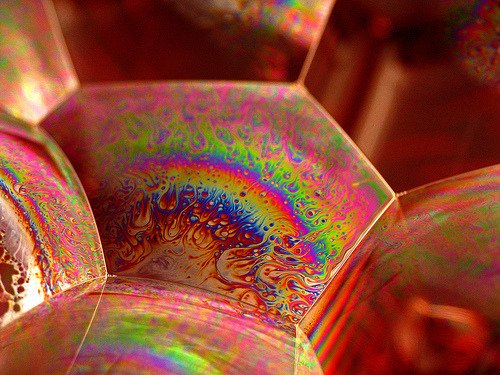
The shapes of soap bubbles are determined by surface tension, which ensures the smallest surface area for a given contained volume. (#) Their iridescent colors are created by the interference and refraction of light waves passing through the nonuniform thickness of the bubble, as well as to the motion of the soap mixture itself.
Photo credit: found via fuckyeaheyegasms, originally from teacupofmoons

The ABCs of Physics
b=buoyancy is part of Ashley JM’s photo set The ABCs of Physics. In her words:
Buoyancy is what causes less dense objects to float in a more dense fluid, such as a helium balloon in air. There is a buoyant force that pushes up on the object, equal to the weight of the displaced fluid.
That little diagram up there is called a force diagram, they can be even more daunting than equations at times. This one shows that the buoyant force up on the balloon is equal to the force of tension in the string, this keeps the balloon in equilibrium.
Be sure to look at the rest of her physics photos! # (via physicsphysics)

Tears of Wine
Tears of wine are caused by the Marangoni effect, in which a gradient in surface tension causes mass flow. The water in the wine has a higher surface tension than the alcohol in the wine, causing the wine to be drawn away from regions of higher alcohol concentration. #
Morpho Towers
Artists Sachiko Kodama and Yasushi Miyajima use ferrofluids and magnetic fields to create their “Morpho Towers – Two Standing Spirals” artwork. Ferrofluids are formed from a suspension of ferrous material in a oil or water and are a popular subject for fluid dynamics as art. You can even make your own ferrofluid at home. (via ageekmom)