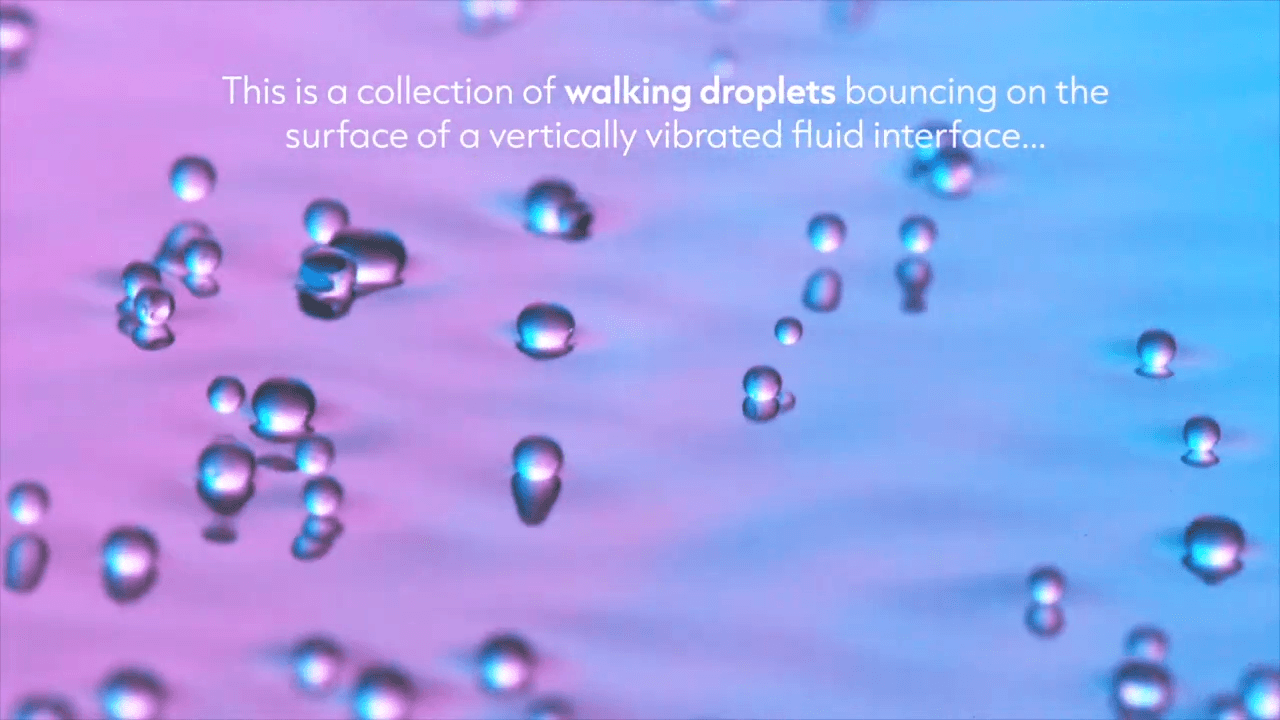
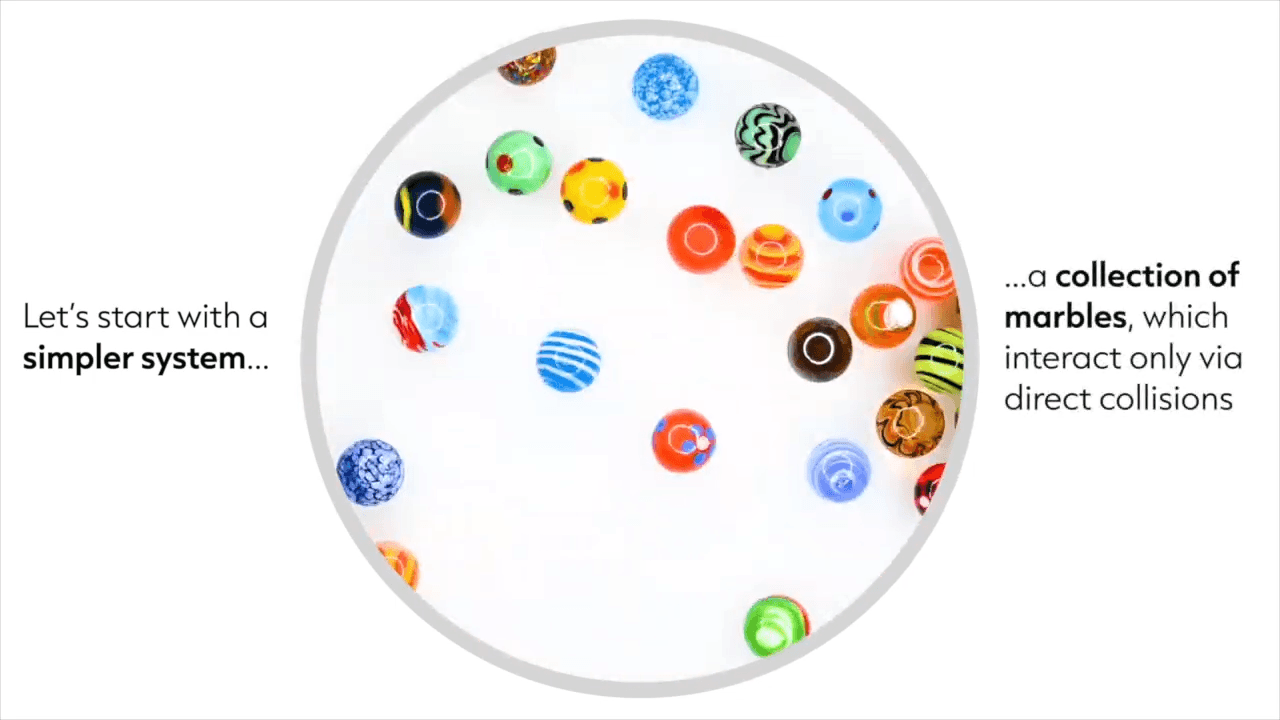
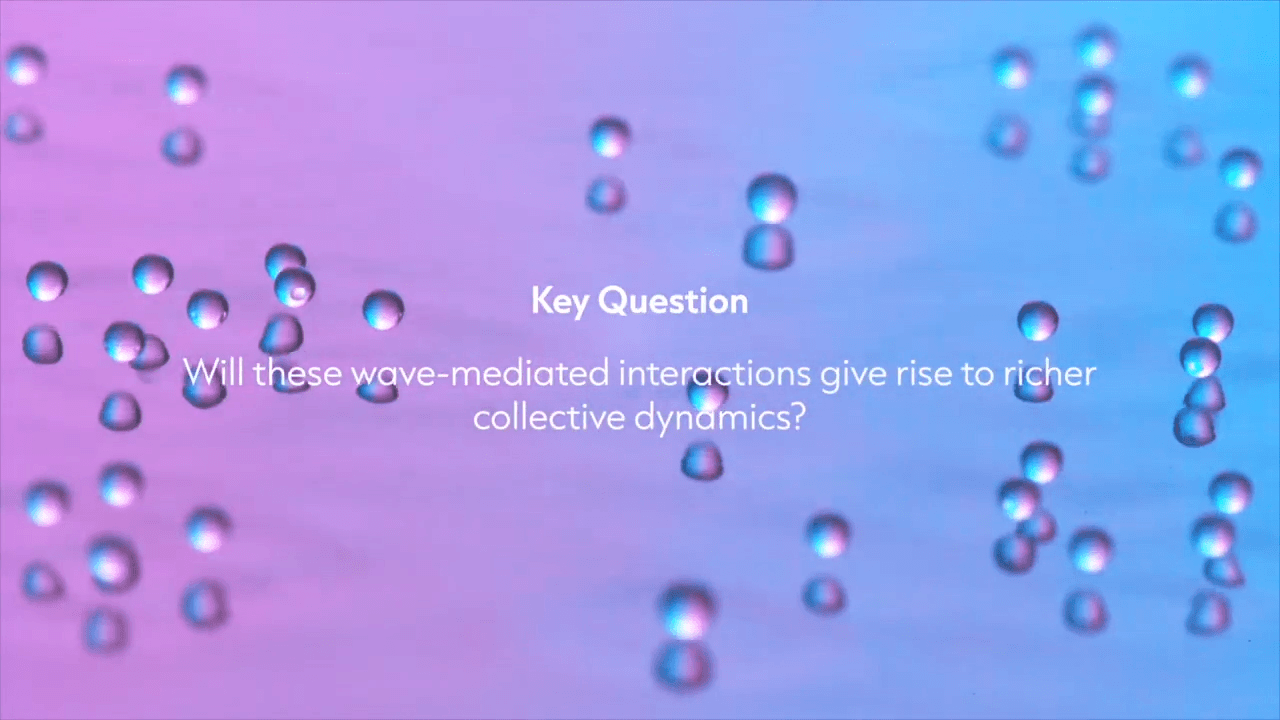
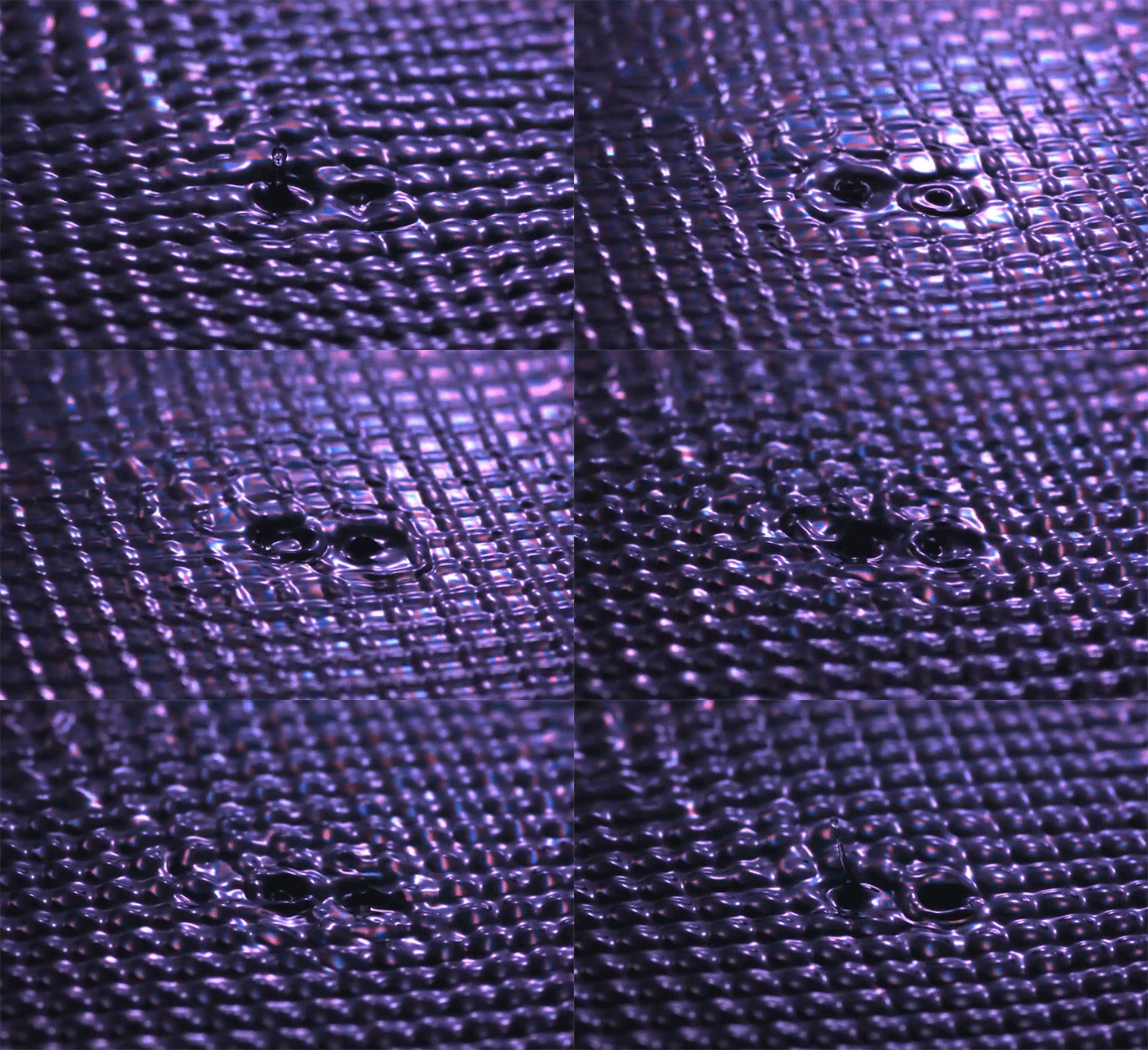
On a vibrating fluid, droplets can bounce and interact in complex ways. Here, researchers demonstrate some of the peculiar dynamics of these wave-guided droplets, showing how they can do things like pair up in waltzes. To keep the droplets from coalescing with one another, they perform their experiments in a pressurized chamber; the higher air pressure makes it harder for the air film between droplets to drain during a collision, making the droplets unable to coalesce. Under these conditions, the authors show that the droplet-wave system has quantum-like statistics. (Video and image credit: J. Clampett et al.)
Tag: quantum mechanics

Mimicking Quantum Effects
Over the last 15 years or so, researchers have been exploring pilot-wave theory–originally proposed by De Broglie in the 1920s as a way to understand quantum mechanics–using hydrodynamic quantum analogs. In these experiments, researchers vibrate pools of silicone oil, which allows oil drops to bounce–and in some conditions, walk–indefinitely on the pool. By mixing in obstacles that mimic classic quantum mechanical experiments, they reproduce effects like the double-slit experiment in a macroscopic system.
In this video and the accompanying papers, a team recreates the Kapitsa-Dirac effect where a standing electromagnetic wave diffracts electrons. Here, the standing wave is instead a Faraday wave in the surface of the pool. Yet the droplets, too, diffract in a manner resembling the quantum version. (Video credit: B. Primkulov et al.; research credit: B. Primkulov et al. 1, 2)

Quantum Rayleigh-Taylor Instability
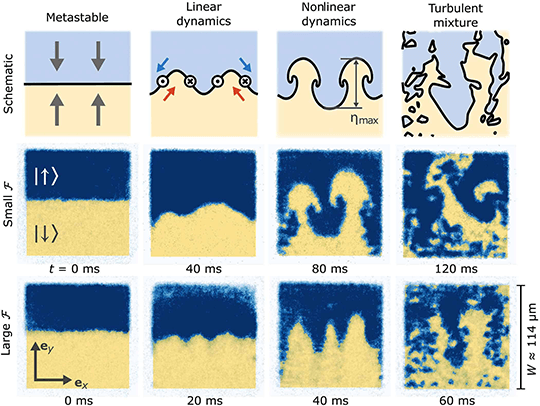
The Rayleigh-Taylor instability–typically marked by mushroom-shaped plumes–occurs when a dense fluid accelerates into a less dense one. But researchers have now demonstrated the effect at quantum scales, too.
For their experiment, the group used a Bose-Einstein condensate of sodium atoms and made the interface between them by exciting half of the atoms into a spin-up state and half into a spin-down one. With the interface is place, they reversed the magnetic field gradient, inducing a force on the atoms equivalent to the buoyant force seen in conventional Rayleigh-Taylor instabilities. As shown above, the interface first warped, then developed Rayleigh-Taylor mushrooms and eventually became turbulent. (Image and research credit: Y. Geng et al.; via Physics World)

Superradiance in Fluids
A group of excited atoms can collectively emit more photons than they could individually in a phenomenon known as superradiance. Now researchers have shown that vibrating fluids can produce superradiance as well.

Two different wave fields used in the experiment, each with a different distance between the circular cavities. Similar to other hydrodynamic quantum analogs, the researchers vertically vibrated a pool of liquid at a frequency that produced Faraday waves. Beneath the pool, they placed two circular wells, varying the distance between them to observe how their wave fields interacted. With a large enough vibration, the two circular wells emitted droplets (top image), and the number of droplets they produced was higher than expected for two independent wells, indicating superradiance. The results suggest that it may be possible to build even more hydrodynamic analogs of quantum systems than previously thought! (Image and research credit: V. Frumkin et al.; via APS Physics)

The Optical Atom
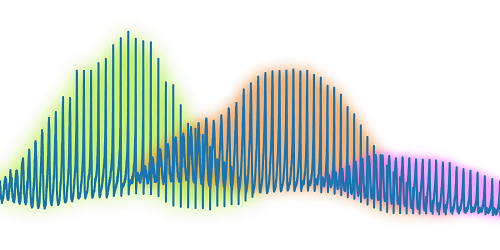
Researchers applied a quantum mechanical technique to study an evaporating drop in extreme detail. The team trapped a spherical water drop and collected the light scattered off it as it evaporated. Using an analytic technique originally developed for an atom, they were able to study changes in the drop down to the nanometric level without relying on numerical simulations to interpret the results. The authors suggest that their method is well-suited to studying the concentration of chemical or biological contaminants on the surface of a drop as it evaporates. (Image credit: droplet – Z. Kaiyv, Fano combs – J. Marmolejo et al.; research credit: J. Marmolejo et al.; via APS Physics)

Illustration of the Fano combs seen by analyzing light scattered from an evaporating drop. 
Electronic Friction
Years ago, physicists discovered that water flows with surprisingly little friction through narrow carbon nanotubes. At our scale, flow behavior is typically the opposite: there’s greater friction (and, thus, slower flow) in a narrower pipe. To unravel the mystery, researchers had to delve into quantum mechanics and model the interactions between the atoms of a water molecule and the electrons of the carbon atom. Essentially, this meant building a quantum picture of the liquid-solid interface inside the nanotube.
The team found that the electrons of the nanotube exert a drag-like force on the water molecules, creating friction that slows the flow. Since narrow nanotubes have fewer electrons than larger tubes, there is less friction on the flow and the water flows faster! (Image credit: cintersimone; research credit: N. Kavokine et al.; via SciAm; submitted by Kam-Yung Soh)

Quantum Instability
In our everyday lives, two fluids moving past one another often form a wave-like pattern thanks to the Kelvin-Helmholtz instability. We see it in the curl of waves on the ocean, in clouds in the sky, and even in spirals of lava on Mars. Here researchers explore an analogous instability in the quantum world.
By spinning a gas of ultracold atoms, the team observed a spontaneous transition from a needle-like configuration to a crystal made up of spirals. It’s a quantum Kelvin-Helmholtz instability! The authors found that wave’s phase is random; it arises purely from quantum interactions between the atoms. (Image, research, and submission credit: B. Mukherjee et al.; see also MIT News)

The spinning cloud of ultracold atoms breaks up into a series of spirals. 
Viscosity and Quantum Mechanics
Viscosity describes a fluid’s resistance to changing its shape. Like surface tension, it’s a fundamental property of a fluid that comes from the interactions between molecules. But viscosity is a slippery beast, and especially so for liquids. There is no generic way to calculate a liquid’s thermodynamic properties from quantum dynamical first principles. But that hasn’t stopped theoretical physicists from making progress on deducing the connections between quantum mechanics and liquids.
Although viscosity changes with temperature, all liquids have a minimum viscosity, and those minima are all fairly close to the same value as water’s (excluding any superfluids, which are their own brand of quantum weirdness). Why would liquids share a similar minimum viscosity? Because it turns out the minimum viscosity is quantum! Physicists found that the minimum viscosity is set by an equation depending on Planck’s constant and the mass of an electron — both fundamental constants.
Physicists sometimes like to conjecture about the habitability of the universe if fundamental quantities like Planck’s constant had a different value. This work shows that changing that value would alter water’s viscosity, completely changing the viability of microscopic life! (Image credit: A. Rozetsky; research credit: K. Trachenko and V. Brazhkin; via Physics Today)

Pilot-Wave Hydrodynamics: Resources
This is the final post in a collaborative series with FYP on pilot-wave hydrodynamics. Previous posts: 1) Introduction; 2) Chladni patterns; 3) Faraday instability; 4) Walking droplets; 5) Droplet lattices; 6) Quantum double-slit experiments; 7) Hydro single- and double-slit experiments; 8) Quantum tunneling; 9) Hydrodynamic tunneling; 10) de Broglie’s pilot-wave theory
Thanks for joining us this week as we explored nearly two centuries’ worth of scientific discoveries around vibration, fluid dynamics, and quantum mechanics. For those who’d like to learn more about these and related topics, we’ve compiled some helpful resources below.
Other Videos, Articles, and Resources by Topic
Chladni Patterns
- ANSYS, “Chladni Plates”
- Brusspup, “Amazing Resonance Experiment!”
- Kenichi Kanazawa, “Color Sound”
- Microfluidic Chladni patterns
- Nigel Stanford, “Cymatics”
- Peter Remco, “Chladni patterns in a violin plate”
- Steve Mould, “Random couscous snaps into beautiful patterns”
Faraday Instability
- FYFD, Alligators and water dancing
- FYFD, Liquid crystals vibrating on a tuning fork
- Gallery of Fluid Motion, “The Tibetan singing bowl”
- Nigel Stanford, “Cymatics”
- Slow Mo Guys, “Chinese spouting bowl in slow motion.”
Quantum Mechanics
Pilot-wave Hydrodynamics
- Dual Walkers, learn about the physics from the researchers themselves
- Gallery of Fluid Motion, “The pilot-wave dynamics of walking droplets.”
- Gallery of Fluid Motion, “Shedding light on pilot-wave phenomena.”
- The Lutetium Project, “Never-ending bouncing droplets.”
- The Lutetium Project, “Dual walkers: drops and waves.”
- Through the Wormhole, Interview with Y. Couder
- Wired, “Have we been interpreting quantum mechanics wrong this whole time?”
- Veritasium, “Is this what quantum mechanics looks like?”
Selected (Academic) Bibliography by Topic
Articles marked with an asterisk (*) are recommended for their approachability and/or broad overview of the subject.
Chladni Patterns
- (*) M. Faraday, “On a peculiar class of acoustical figures; and on certain forms assumed by groups of particles upon vibrating elastic surfaces,” 1831.
- Lord Rayleigh, “On the circulation of air observed in Kundt’s tubes, and on some allied acoustical problems,” 1884.
- H. van Gerner et al., “Air-induced inverse Chladni pattern,” 2011.
Faraday Instability
- (*) M. Faraday, “On a peculiar class of acoustical figures; and on certain forms assumed by groups of particles upon vibrating elastic surfaces,” 1831.
Pilot-wave Hydrodynamics
- Y. Couder and E. Fort, “Single-particle diffraction and interference at a macroscopic scale,” 2006.
- A. Eddi et al., “Unpredictable tunnel of a classical wave-particle association,” 2009.
- (*) Y. Couder et al., “Walking droplets: A form of wave-particle duality at macroscopic scale?”, 2010.
- J. Molacek and J. Bush, “Droplets bouncing on a vibrating bath,” 2013.
- J. Molacek and J. Bush, “Droplets walking on a vibrating bath: toward a hydrodynamic pilot-wave theory,” 2013.
- D. Harris et al., “Wave-like statistics from pilot-wave dynamics in a circular corral,” 2013.
- O. Wind-Willassen et al., “Exotic states of bouncing and walking droplets,” 2013.
- (*) J. Bush, “Pilot-wave hydrodynamics,” 2015.
- D. Harris et al., “Visualization of hydrodynamic pilot-wave phenomena,” 2016.
(Image credit: A. Labuda and J. Belina)

Pilot-Wave Hydrodynamics: Droplet Tunneling
This post is part of a collaborative series with FYP on pilot-wave hydrodynamics. Previous posts: 1) Introduction; 2) Chladni patterns; 3) Faraday instability; 4) Walking droplets; 5) Droplet lattices; 6) Quantum double-slit experiments; 7) Hydro single- and double-slit experiments; 8) Quantum tunneling
Quantum tunneling is a strange subatomic behavior that was first described to explain how alpha particles escape a nucleus during radioactive decay. Classically, a particle trapped in a well can only escape if its energy is sufficiently high, but in quantum mechanics, even a particle with lower-than-necessary energy can occasionally “tunnel” out.
To test whether hydrodynamic walkers can tunnel, researchers built corrals. In the central region, the pool on which the walker moves is relatively deep. Over the walls, the pool is much shallower. In this shallow area, the wave from the droplet’s bouncing decays quickly, creating a partially reflective barrier. For most collisions, the walker reflects off the barrier. Other times, apparently at random, a collision results in the walker crossing the wall and tunneling out of its well.
Over many experiments, researchers were able to construct a probabilistic view of walker tunneling. In quantum mechanics, a particle’s likelihood of tunneling out of a well depends on the particle’s energy and the well’s thickness. The analogs for a walker are velocity and barrier thickness. The thicker the barrier, the harder it is for a walker to tunnel through. Conversely, a faster walker has a higher probability of tunneling through a barrier of a given thickness. As the authors themselves observe:
“Although our experiment is foreign to the quantum world, the similarity of the observed behaviors is intriguing.” #
As we wrap up our series tomorrow, we’ll consider some of those similarities more deeply.
(Image credits: A. Eddi et al., sources)