Video footage of Iceland’s Grimsvotn volcano erupting shows a massive turbulent plume of ash. The largest scales of the plume are of the order of hundreds, if not thousands of meters, and the eddies of the plume appear to move very slowly, especially far from the base. According to Kolmogorov, however, at the smallest scales of the flow (< 1 mm), the turbulent motions are isotropic. No one has been able to achieve Reynolds numbers high enough to fully prove or disprove Kolmogorov’s hypothesis, but natural events like volcanic eruptions produce some of the largest Reynolds numbers on earth. (See also: interview with videographer; via Gizmodo, jshoer)
Tag: fluid dynamics

Flowing Up a Waterfall
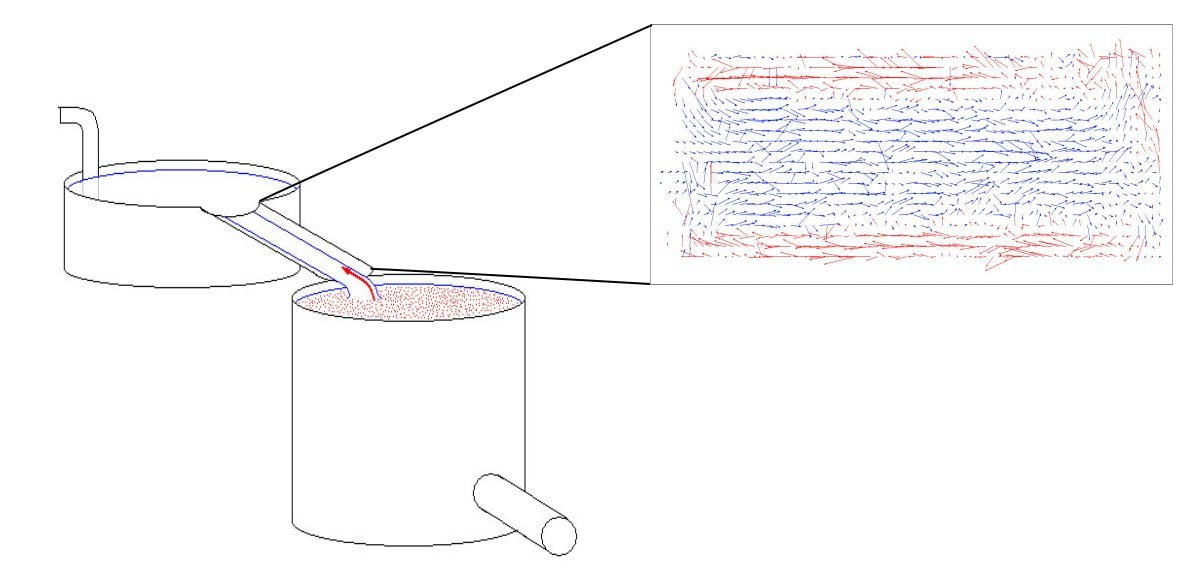
Tea-drinking physicists found that it’s possible for particles to flow up a short (< 1 cm) waterfall to contaminate pure upstream sources. Their apparatus is shown above, along with an inset showing the velocity field on the surface of the channel. The blue arrows indicate flow downstream and the red arrows indicate counterflow that carries particles upstream. The researchers suspect that Marangoni effects may play a role in setting up the counterflow. The finding could have implications for pollution control and manufacturing. # (submitted by Gabe)

Ferrofluid Self-Organization
The behavior of a ferrofluid subject to magnetic fields can be fascinating. Here a ferrofluid is subjected to a permanent magnet and thinner is added to the ferrofluid. As it spreads outward, the thinner carries ferrofluid with it. The thinner evaporates, increasing the concentration of ferrofluid in the outer ring and eventually forming peaks of ferrofluid that move inward toward the main body due to the attraction of the magnet. Near the main body, the peaks are repelled by the ferrofluid because they have the same magnetic orientation.
Feathering on SpaceShipTwo
Virgin Galactic and Scaled Composites recently performed their first feathered flight with SpaceShipTwo, which is on track to be the first commercial spaceship. Feathering is a re-entry technique devised by Scaled Composites founder Burt Rutan:
Once out of the atmosphere the entire tail structure of the spaceship can be rotated upwards to about 65º. The feathered configuration allows an automatic control of attitude with the fuselage parallel to the horizon. This creates very high drag as the spacecraft descends through the upper regions of the atmosphere. The feather configuration is also highly stable, effectively giving the pilot a hands-free re-entry capability, something that has not been possible on spacecraft before, without resorting to computer controlled fly-by-wire systems. The combination of high drag and low weight (due to the very light materials used to construct the vehicle) mean that the skin temperature during re-entry stays very low compared to previous manned spacecraft and thermal protection systems such as heat shields or tiles are not needed. During a full sub-orbital spaceflight, at around 70,000ft following re-entry, the feather lowers to its original configuration and the spaceship becomes a glider for the flight back to the spaceport runway. #
Though it works well for decelerating from sub-orbital speeds, feathering is sadly not useful for orbiting spacecraft due to the much higher kinetic energies that have to be dissipated.

White Hole Analogues
A white hole–the cosmological opposite of a black hole–is a singularity from which matter emerges but which matter can never enter from beyond the event horizon. Hydraulic jumps, those rings that sometimes appear in the kitchen sink, turn out to be a physical analog of this behavior. The photo above shows a hydraulic jump with a needle placed inside the event horizon. In the wake of a needle, there’s a Mach cone, just like when an object moves faster than the speed of sound. For more, see the Photonist. (via freshphotons)
Note that we mentioned this item a few months ago, but the full paper has just been published.

Venom Properties
Most venomous snakes deliver venom to their prey via grooves in their fangs, rather than through a pressurized bolus through hollow fangs. New research shows that these venoms are shear-thinning non-Newtonian fluids. The surface tension of the venom is such that a drop of venom will tend to flow into and down the groove. Once moving, the shear-thinning properties of the venom decrease the venom’s viscosity, increasing its flow rate down the fang and into the snake’s prey. (via Scientific American; Photo: green mamba, banded snake fang)

Airplane Vortex Wake
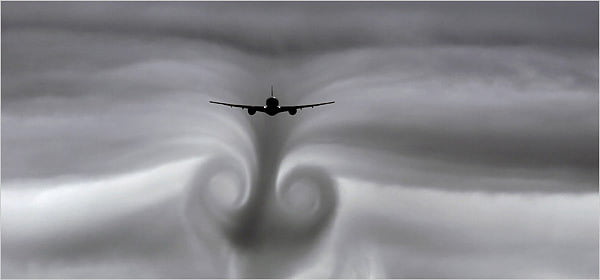
The wingtip vortices in the wake of a commercial airliner distort the clouds as the plane descends. Wingtip vortices form as a result of high pressure air from the underside of the wing accelerating around the wingtips to reach the low pressure on top of the wing. They can be hazardous to other (lighter) aircraft. They also contribute to downwash that decreases the effective lift of a wing. Geese use the same mechanism to their advantage when flying in a V-formation, and some snakes use it to glide.
Gelatin
Gelatins are actually colloidal gels, or a liquid dispersed inside a solid, cross-linked network. The crosslinks give the gelatin structure, but much of its dynamic behavior remains reminiscent of fluid motion.
Rayleigh-Taylor Art
The Rayleigh-Taylor instability occurs when a denser fluid lies atop a lighter fluid (relative to the gravitational field). The interface between the fluids deforms and the two fluids form finger-like protrusions that turn into mushroom caps and mix the dissimilar fluids together. This video, though based on a 2D Rayleigh-Taylor instability numerical simulation, was actually part of an art exhibit. (submitted by Mark S)
Personally, I recommend putting together a playlist of your favorite late 60s/early 70s rock (Pink Floyd, late Beatles, Jimi Hendrix, etc.) and sticking it on in the background while you watch the video in HD. It’s totally worth the 15 minutes. Especially in the later stages of each segment, the mixing between fluid layers really brings to mind cloud patterns on Jupiter or Saturn.

Stereo Liquid Sculpture
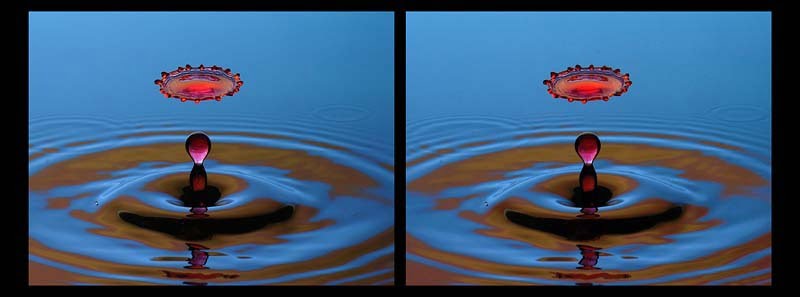
This stereo 3D photo shows the Worthington jet ejected when a droplet impacts a pool. The flat crowning drop is formed from an ejected droplet colliding with a falling droplet.