This clip shows high-speed video footage of a blackpowder explosion. As the blast wave expands, the surrounding air is heated, which changes its index of refraction. The strength of this change is great enough that we can distinguish the edges of the expanding shock wave by the visual distortion they cause to the view beyond the explosion.
Tag: fluid dynamics

Flow Viz of a Locust
Smoke visualization in a wind tunnel reveals the airflow over a flying locust. Researchers are unraveling the aerodynamics of insect flight in order to produce better Micro Air Vehicles (MAVs) and miniature flying robots. #

Singing Dunes
Some sand dunes can “sing”, but not because of the wind! When loose sand slides down over harder, packed sand, a standing wave is formed, causing the entire surface of the dune to vibrate on a single frequency. We hear this as a musical note – typically an E, F, or G. (via io9)
(Image credit: C. Larson)
Upside-Down Umbrellas
When a heavier fluid is suspended over a lighter fluid (as with ink or food coloring in water), the interface between fluids is subject to the Rayleigh-Taylor instability. As the heavier fluid starts to sink, it forms “fingers”, which develop into mushroom-cap shapes as the fluid continues falling. Sometimes the shear stress between the heavier fluid and lighter fluid causes secondary Kelvin-Helmholtz instabilities as well. (Photo by Leonardo Aguiar)

Happy Anniversary
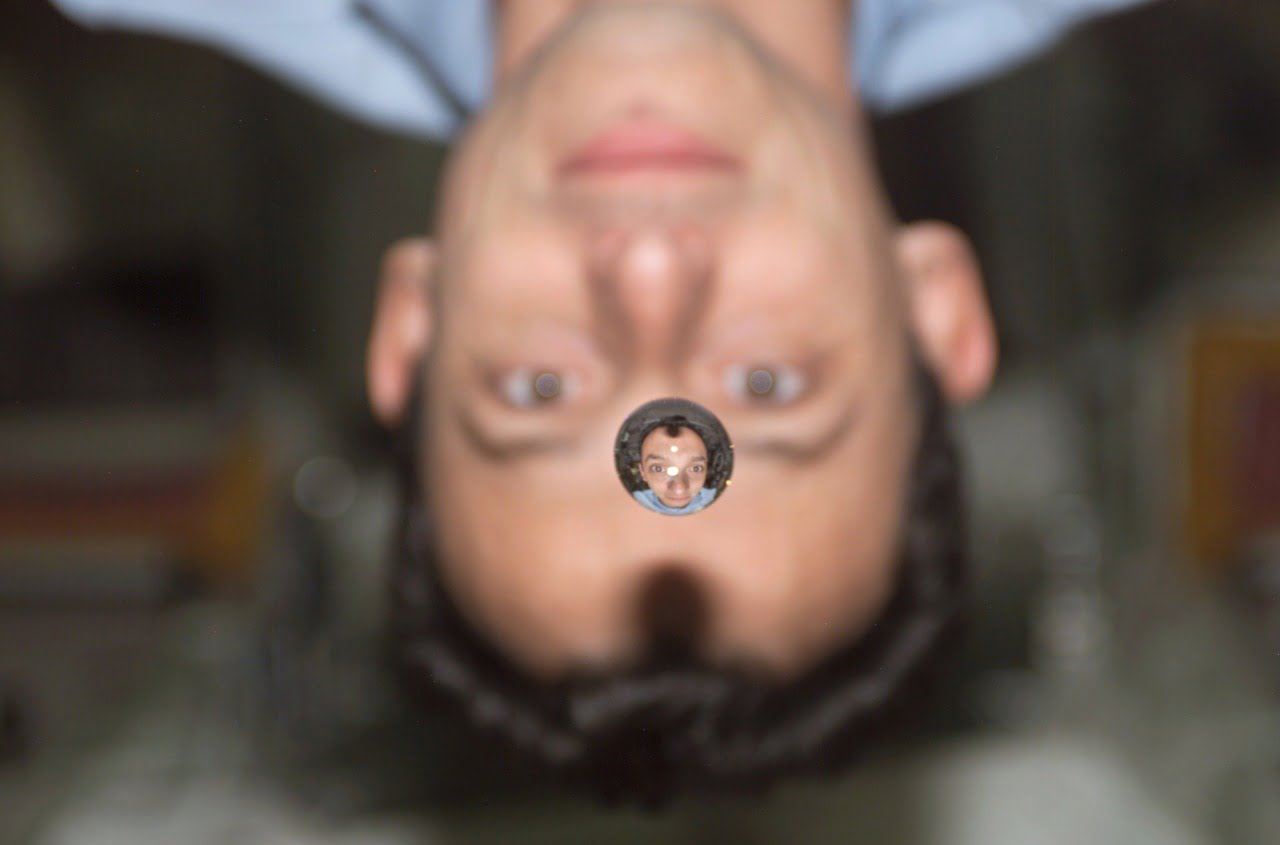
ESA astronaut Pedro Duque shown refracted through a water droplet in microgravity. Today marks the 50th anniversary of human space flight. #

Liquids Lens Breakup
A decane liquid lens floating on water (think drops of fat in chicken soup) displays different breakup and pinch-off than seen in three-dimensional droplet breakup. The pinch-off process in two dimensions relies on line tension rather than surface tension, and the quasi-2D liquid lens system is somewhere between these. The video above is a magnification of the filament connecting one liquid lens as it is broken into two smaller liquid lenses (the dark areas on the left and right of the screen). # (via scienceisbeauty)
Liquid Acrobatics
Imagine blowing through a straw into a nearly empty glass–we probably all did this as children and sent water, milk, and soda flying everywhere! In essence, this video shows that same act, but filmed by a high-speed camera. The “straw” blows a steady stream of helium into a shallow pool of silicone oil and slowly moves so that the angle the straw makes with the pool changes. As the angle changes, different regimes are visible. First waves appear on the surface of the pool, then a bulge forms, which develops into a droplet stream, then on into the chaos of bubbles and jets. It’s good I couldn’t see this in slow motion as a child or I would have never used my straw for drinking!
Mythbusters Walking on “Water”
The Mythbusters walk on “water” using non-Newtonian fluids. I think everyone wants to do this at least once in their life.
Leapfrogging Vortices
This numerical simulation shows two pairs of vortices interacting in a leap-frogging motion. Another version shows the same situation but with a small perturbation in the rotational alignment that causes even more interesting interactions. Both simulations are of potential flow–an idealized flow without viscosity where velocity can be described as the gradient of a scalar function. The mathematics governing potential flow are notably easier than the full Navier-Stokes equations that govern fluid mechanics. (submitted by jessecaps)

Rocket Exhaust
This image of the Apollo 11 launch shows the Saturn V’s underexpanded nozzle (identifiable by the excessive width of the exhaust jet) shortly after liftoff. The faint diamond shape of the exhaust is a series of shock waves and expansion fans that equalize the exhaust pressure to the ambient. In general, a rocket nozzle is most efficient when it expands the exhaust to ambient pressure, but, since ambient pressure changes with altitude, designers have to choose a particular altitude for peak efficiency or design a nozzle capable of changing its shape with altitude.