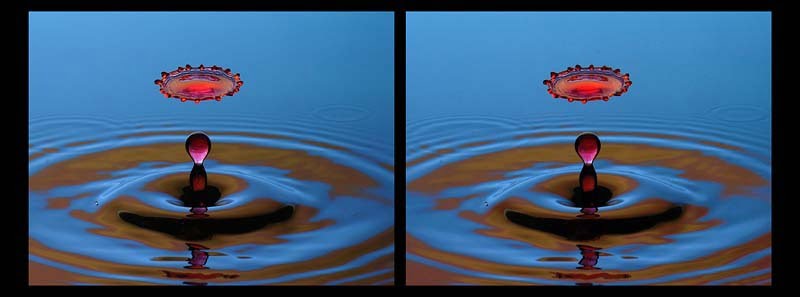
This stereo 3D photo shows the Worthington jet ejected when a droplet impacts a pool. The flat crowning drop is formed from an ejected droplet colliding with a falling droplet.
Tag: fluid dynamics
Supersonic Bullet
[original media no longer available]
This video shows a CFD simulation of a bullet passing through a parallel channel at Mach 2. The simulation captures 3 milliseconds of real-time and shows the Mach number in the top view and the temperature in the bottom view. Note how the bow shock near the front of the bullet and the trailing shock behind it reflect off the walls of the channel and interact. Even though the calculation is inviscid, the shock waves cause intense heating (white) in front of and behind the bullet.

Island Vortex Street
The von Karman vortex street is a series of vortices shed periodically in the wake of a bluff body. Although they are commonly observed in the lab behind cylinders, they also occur in nature, as seen here in the wake of Juan Fernandez Islands near Chile. The strong equatorward wind creates steady flow over the mountainous island, creating a pattern in the clouds that stretches 10,000 times longer than vortex streets created in a laboratory. (via freshphotons)

Cloud Ocean
Time-lapse photography is great for capturing the fluid motion of clouds over the course of a day.

Combustion
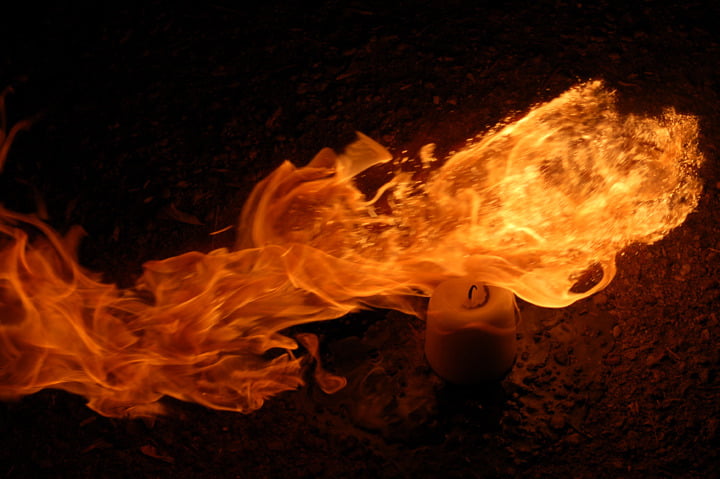
Fluid dynamics are vital to combustion. Like here, many practical flames–such as those responsible for internal combustion in automobiles, jet engines, and rockets–are turbulent. The turbulence aids mixing of the fuel and oxidizer, resulting in more complete combustion and greater efficiency. #
Giant Water Balloon Physics
Playing with a giant water balloon and high-speed cameras is like a giant experiment in surface tension, right up until the tensile strength of the balloon comes into play. The rippling in the balloon is reminiscent of the motion of droplet breakup or impact on superhydrophobic surfaces. (submitted by Daniel B)
DIY Non-Newtonian Fluids
[original media no longer available]
We’ve featured the non-Newtonian fluid oobleck here before, but it bears repeating as a fun and easy exercise for anyone to do at home or at school, especially with kids. For extra fun, try vibrating it, using it as liquid armor, or filling a pool and walking on it.

Meandering Mississippi
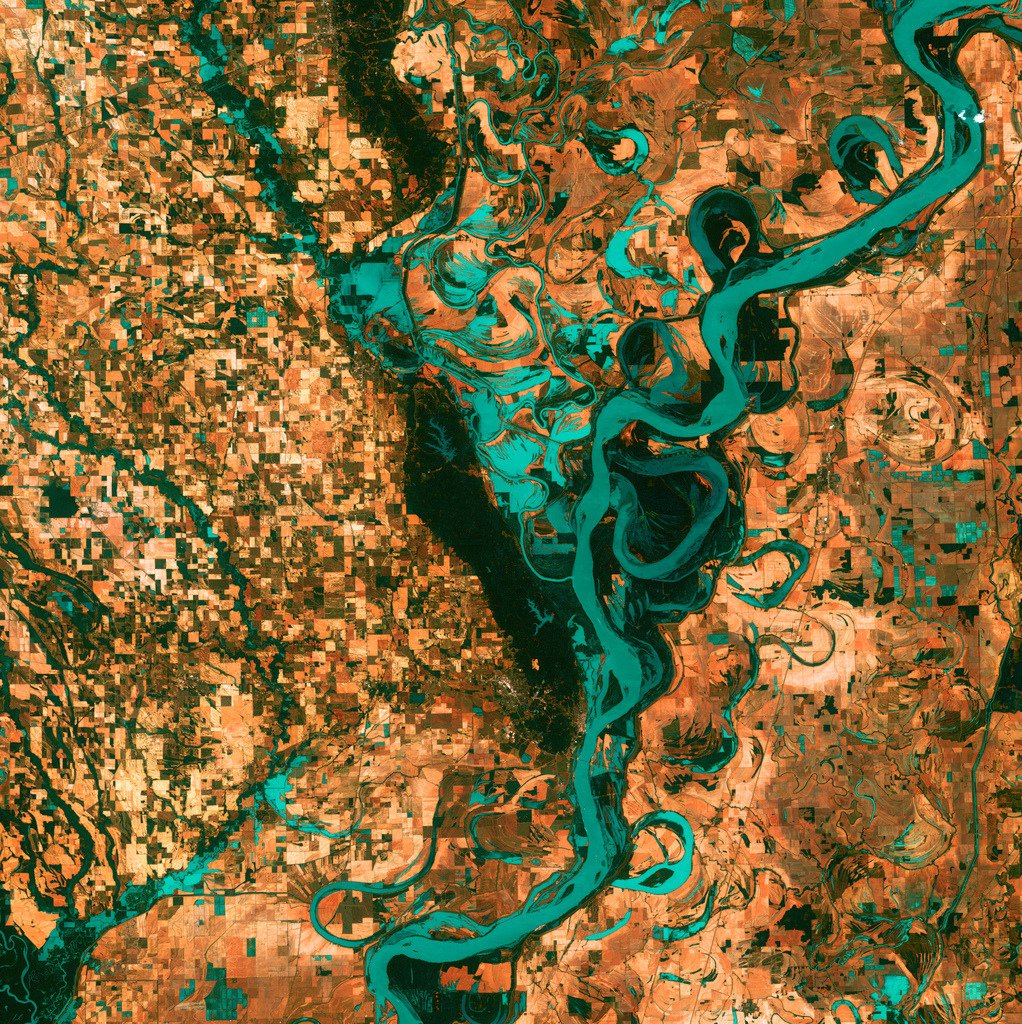
This satellite photo of the Mississippi River south of Memphis, TN shows how the river’s course has changed over time. When a river bends, the water near the inner bank flows faster than the water by the outer bank. This difference in speeds actually creates a vortical secondary flow in the boundary layer of the river that erodes sediment from the outer bank and deposits it on the inner bank. This increases the meander of the river bend. If this continues long enough, the river bend can get pinched off into an oxbow lake, like the ones scattered to either side of the current river path.
Tornado-Force Winds in a Wind Tunnel
[original media no longer available]
In order to demonstrate the effects of tornado-force winds, Fox News sent a reporter inside a wind tunnel and subjected him to 100 mph winds. Of course, actual measured winds in the recent storms topped 200 mph and four times the dynamic pressures the reporter experiences here. (via jerrodh)
How Not to Get Wet in the Rain
[original media no longer available]
Ever wonder how to minimize how wet you get if you’re caught in the rain without an umbrella? This lecture discusses just that problem and how to calculate an answer. I actually solved a version of this problem when studying for my PhD quals, only I first had to determine the terminal velocity of a rain drop (~10 m/s assuming a 4mm spherical drop) and work from there. We also had to compare moving upright to running at an angle. It makes for an interesting little diversion. (via physicsphysics)