NASA’s Solar Dynamics Observatory has found evidence of Kelvin-Helmholtz waves in the sun’s corona. These waves, which occur between two fluids of different densities or moving at different speeds, are similar to the iconic waves surfers ride. Researchers suspect that this turbulent motion may help explain why the corona is 1,000 times hotter than the surface of the sun. #
Tag: fluid dynamics

Brazilian Barrier Islands
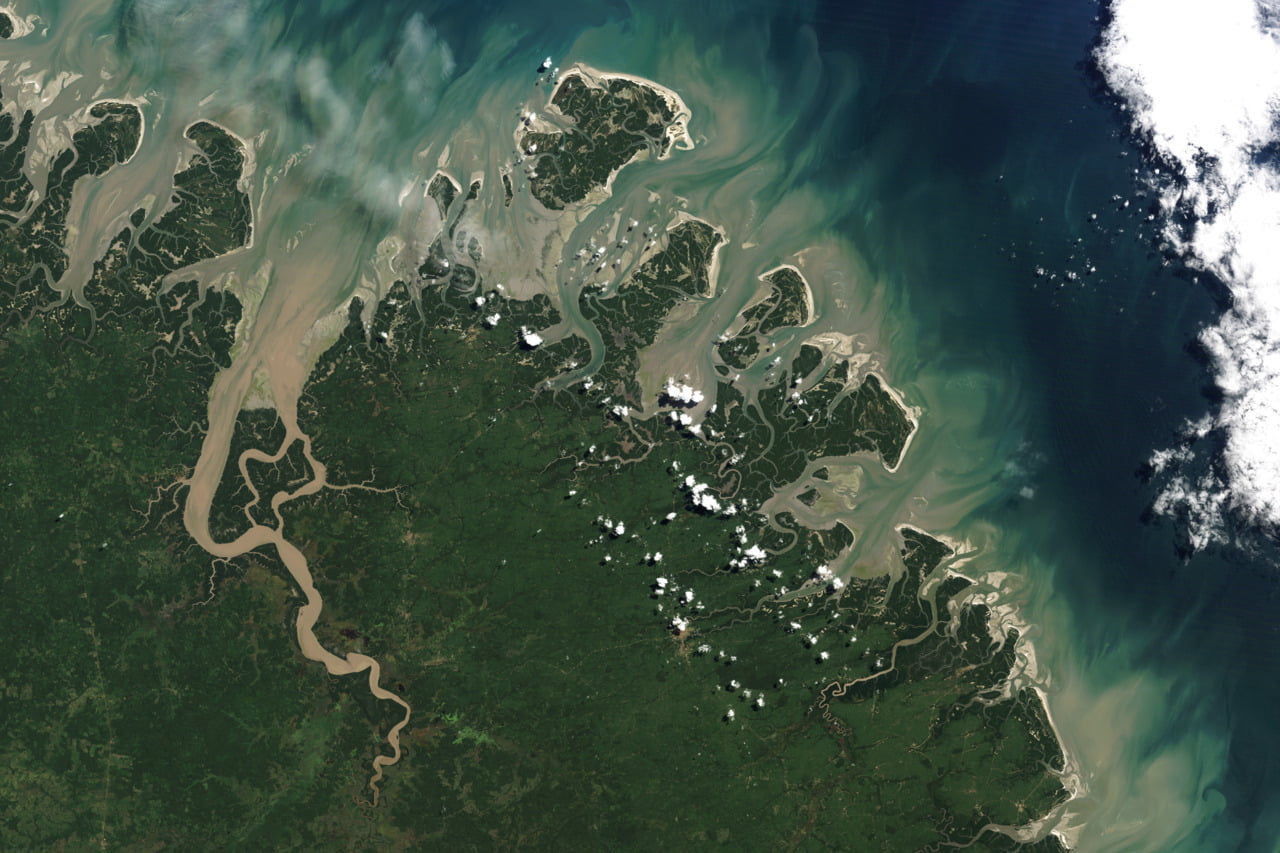
Barrier islands are in a constant state of flux due to the currents, tides, and winds that surround and shape them. This satellite image of islands off the Brazilian coast shows meandering waterways and the mixing of sediment from the land into the sea. Often, secondary flows are responsible for shaping of these sorts of geographic features. #

Landslide
Landslides, despite their inclusion of solid materials, function essentially as gravity-driven fluid flows. This timelapse video shows a recent earthflow in Wyoming near the Snake River. Rapid snowmelt and heavy rainfall combined to cause a seven day landslide over the highway and into the river. # (via Bad Astronomy)
Hot Spheres Sink Faster
New research shows that the Leidenfrost effect–which causes water droplets to skitter across a hot pan–can drastically reduce the drag on objects moving through a liquid. When raised to a high enough temperature, a sphere falling water will be coated in a protective layer of vapor (see video above) that acts like a lubricant as the sphere moves through the water. If the temperature of the object drops too low, the vapor layer will dissolve into a mess of bubbles (~35 secs into video). One way that this mechanism reduces drag is by keeping flow attached to the sphere for longer as shown in this video. Preventing this flow separation increases the pressure recovered after the point of lowest pressure (the shoulders of the sphere), which reduces overall drag.
See also:
- PRL Article and Supplemental Materials
- Wired article
- The Photonist
Water-Walking Basilisks
Some animals, like the common basilisk (a.k.a. the Jesus Christ lizard) are capable of running across water for short distances. The basilisk accomplishes this feat by slapping the water with sufficient force and speed to keep its body above the surface. This slap also creates a pocket of air around its foot. The lizard propels itself forward by kicking its leg back, then lifting its foot out of the water before the air bubble collapses. Water birds like the Western Grebe and tail-walking dolphins rely on similar physics to stay above the water line. # (submitted by Simon H)

Space Shuttle Flow Viz
When a space shuttle lands, a lucky few will hear twin sonic booms as it passes overhead. The double boom occurs due to the shock waves from in front of the shuttle and just behind it passing the observer on the ground. The colorized schlieren photograph above shows shock waves on a model of an early shuttle prototype. The fore and aft shocks that run from the craft to the ground are even clearer on this photo of a T-38 in flight. (Photo credit: Gary Settles)
Shock Waves from a Trombone
Shock waves emanating from a trombone have been captured on video for the first time using schlieren photography. With a harsh blast from the mouthpiece, it’s possible for pressure waves inside the trombone to build into a weak shock wave traveling about 1% faster than the speed of sound. It’s possible that musicians sitting in front of the trombones could receive hearing damage from these shock waves or similar ones from trumpets. # (submitted by jessecaps)

Microgravity Combustion
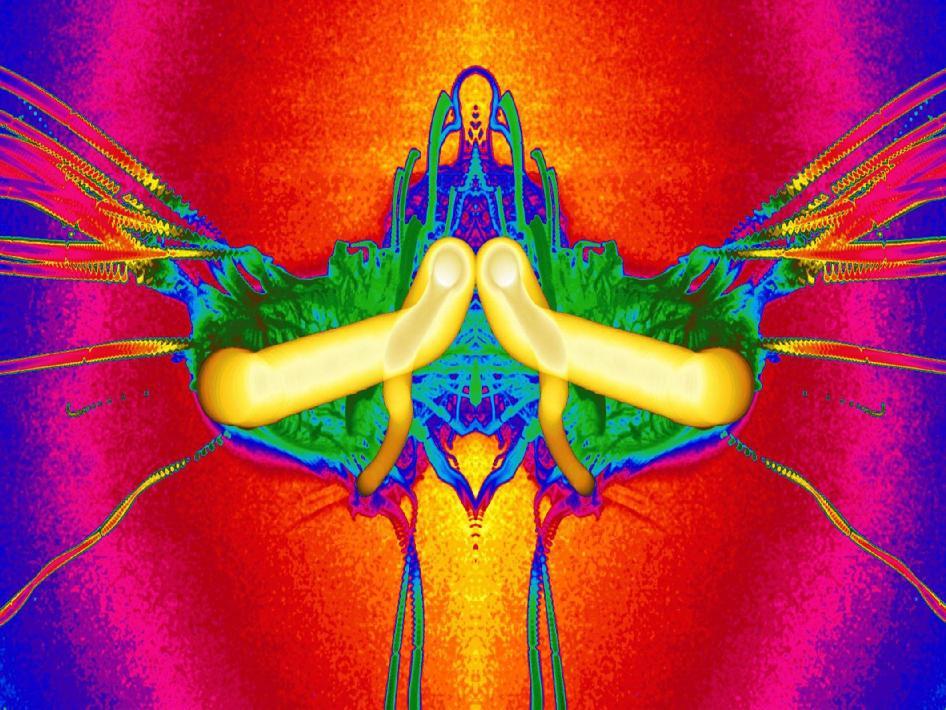
Combustion in microgravity is markedly different than that on earth, due to a lack of buoyant convection. The combustion of a droplet of heptane is shown here as a composite image. The bright yellow structure shows the path of the droplet, which gets smaller as it burns. The green structures show the initial development of soot, which eventually streams outward as long streaks. # (submitted by jshoer)
Viscous Fingers
The Saffman-Taylor instability occurs when a less viscous fluid is injected into a more viscous one, usually in a Hele-Shaw cell. Here oil paint and mineral spirits were painted onto flat surfaces that were pressed together before being pulled apart. The result is viscous fingering of the fluids. #
How Dogs Drink
Not long ago, researchers showed that cats use friction to their advantage when drawing liquids into their mouths. New research shows that dogs rely on the same mechanism–they’re just far less efficient with it. The dog touches its backwards-curled tongue to the surface of the water; when it draws the tongue back, friction causes a column of fluid to follow. The dog then closes its jaws around the water. Some water also gets picked up by the back of the tongue, but since dogs have no cheeks, it spills out the sides, creating a mess familiar to dog owners. #