Here on Earth a fascinating form of convection occurs every time we put a pot of water on the stove. As the fluid near the burner warms up, its density decreases compared to the cooler fluid above it. This triggers an instability, causing the cold fluid to drift downward due to gravity while the warm fluid rises. Once the positions are reversed, the formerly cold fluid is being heated by the burner while the formerly hot fluid loses its heat to the air. The process continues, causing the formation of convection cells. The shapes these cells take depend on the fluid and its boundary conditions. For the pot of water on the stove and in the video above, the surface tension of the air/water interface can also play a role in modifying the shapes formed. The effects caused by the temperature gradient are called Rayleigh-Benard convection. The surface tension effects are sometimes called Benard-Marangoni convection.
Tag: fluid dynamics

Bullet Shock Wave and Cavitation
A 9mm bullet impacts a falling jet of water. High-speed video reveals the formation of a shock wave inside the jet. Because this shock wave is confined inside the jet, it causes strong secondary cavitation–the bubble that seems to explode in front of the bullet.
Jellyfish Flow
Florescent dye reveals the flow pattern of ocean water around a swimming jellyfish. Some researchers posit that fluid drift associated with the swimming of marine animals may be as substantial a factor in ocean mixing as turbulence caused by the wind and tides. If true, modeling of climate change–past, present, and future–would need to take into account the biology of the ocean as well! #

Jovian Storms


Home to storms capable of lasting for a hundred years or more, Jupiter’s atmosphere is a highly turbulent place. Currently, no comprehensive theory exists to explain the symmetry of Jupiter’s bands of clouds and the persistence of vortices such as the Great Red Spot, however, the mixing and stratification visible on the planet remains a beautiful reminder of the power of fluid dynamics. (Photo credits:Cassini – 1, 2, Voyager 1, New Horizons – 1, 2)
Soap Bubble Burst
High-speed video of a soap bubble being popped reveals the directionality of the process. Like a the rubber of a bursting balloon, the soap film rushes away from the point of rupture, disintegrating as the information about a sudden lack of surface tension is propagated across the remaining film surface. In this regard, it is much like what happens when you drop a slinky toy.
How Scramjets Work
The scramjet–supersonic combustion ramjet–engine has been a holy grail of aerospace engineering for 50 years. It is an air-breathing engine with no moving parts capable of propelling crafts at hypersonic speeds beyond Mach 5. As indicated in the name, combustion in the scramjet occurs at supersonic speeds, where the heating due to air compression is sufficient to ignite fuel when injected into the engine. At present the record for the highest speed attained in scramjet flight is held by the NASA X-43A, which reached Mach 9.8 in 2004 after about 10 seconds of scramjet free-flight. The longest scramjet flight belongs to the Boeing X-51 Waverider with 140 seconds of burn time in a 2010 test flight. Few tests of these experimental hypersonic crafts have been completely successful; they represent the frontier of aerospace technology.
Vibration-Induced Atomization
Atomization–breaking a liquid into a fine spay of droplets–is common in engines, printers, and in the shower. Here a droplet of water is placed on a thin metal diaphragm that is vibrated at 1 kHz with increasing vibrational amplitude. Capillary waves form on the droplet, and once a critical vibrational amplitude is achieved, tiny droplets are ejected. Full atomization of the original droplet is achieved in about 0.3 seconds real-time. #
Smoke Transition
Smoke issuing from a round jet undergoes transition from laminar to turbulent flow. As the smoke moves past the unmoving ambient air, the friction between these two layers creates shear and triggers a Kelvin-Helmholtz instability, recognizable by the formation and roll up of vortices along the edges of the jet. Those vortices then roll together in pairs, detach, and devolve into a generally turbulent flow. Because turbulence is far more efficient at mixing than a laminar flow is, the smoke seems to disappear.
Solar Flare
An M-class solar flare with a towering prominence erupted from the Sun over the course of three hours in late September. Notice how the plasma does not fall straight back to the surface but flows back down following the Sun’s magnetic field lines. As an rarefied ionized gas, plasma follows coupled laws of electromagnetism and fluid dynamics. #

Stirred Up Sediment
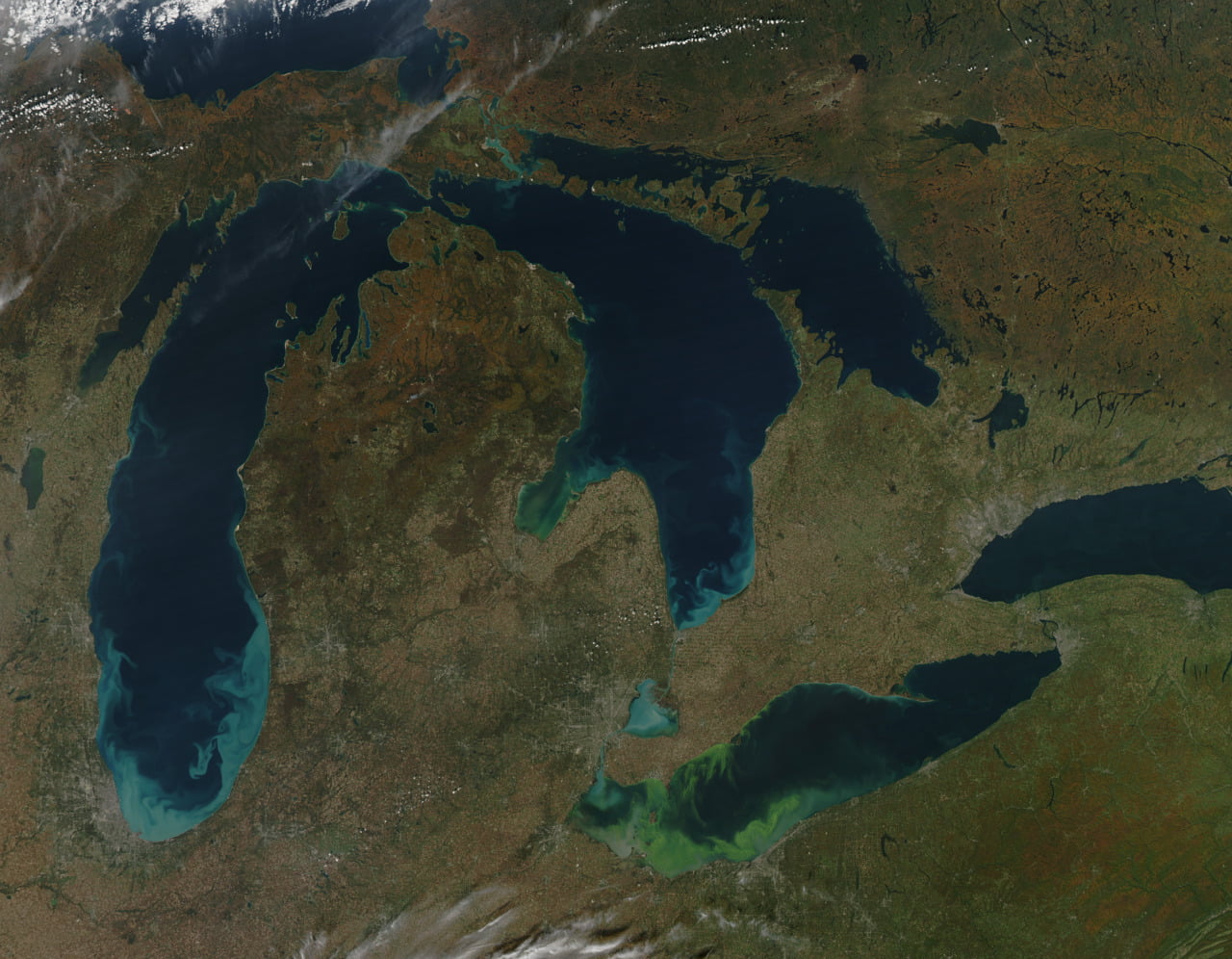
Swirls of blue in the Great Lakes mark locations of recent autumn storms whose winds have stirred up sediment in the lakes. The silt and quartz sand acts as a tracer particle, making visible the circulation patterns of the lakes. In contrast, the green streaks mark locations of calmer winds and warmer temperatures where algae blooms have grown. Note the fundamental dissimilarity in their structures. Blue eddies turn over and mix in a fashion reminiscent of convective instabilities while the green blooms are far more uniform in structure. #