A Hele Shaw cell is little more than two glass plates separated by a thin layer of viscous fluid. The cell serves as a good test bed for viscous, low Reynolds number flows such as those found in microfluidics. Here a less viscous fluid is injected into the center of the cell, causing the finger-like protrusions of the less viscous fluid into the more viscous one via the Saffman-Taylor instability.
Tag: fluid dynamics

Visualizing Fish Wakes
This novel flow visualization technique uses dilute solutions of the tobacco mosaic virus (TMV). These rod-shaped particles align with shear and produce a birefringent interference pattern visible when viewed between crossed polarizing filters. The intensity of the light is related to the magnitude of shear. The technique is benign to the fish but enables researchers to see fluid motion around fish that other techniques cannot capture. #

The Disintegrating Bowl
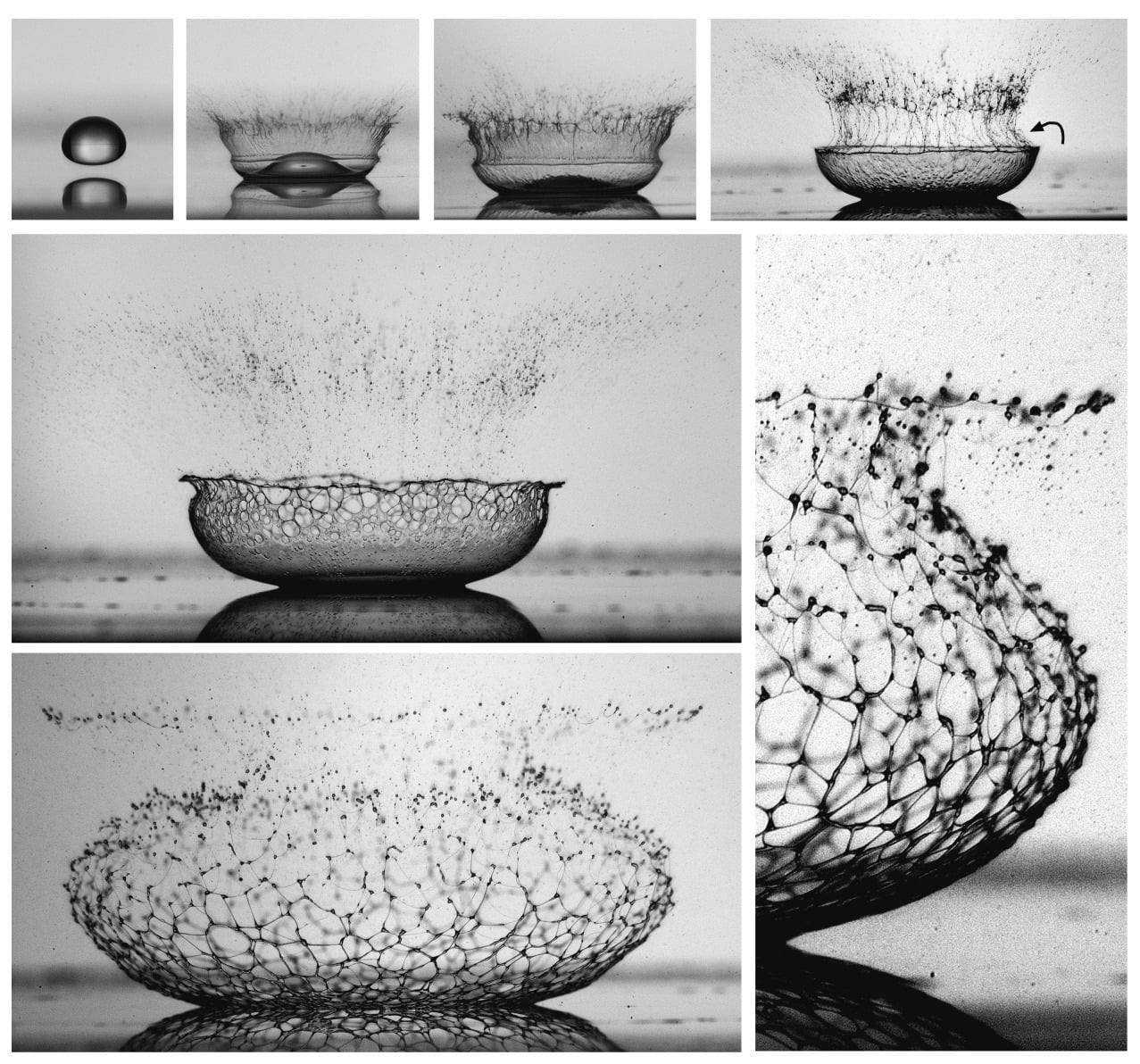
A viscous fluid droplet impacts a thin layer of ethanol, which has a lower surface tension than the viscous fluid. A spray of tiny ethanol droplets is thrown up while a bowl-shaped crown of the viscous fluid forms. As the ethanol droplets impact the bowl, the lower surface tension of the ethanol causes fluid to flow away from points of contact due to the Marangoni effect. This outflow causes holes to form in the crown, forming a network of thin fluid ligaments. For more, see this paper (PDF) and video. (Photo credit: S.T. Thoroddson et al)
Mapping Flames
Combustion remains a fascinating and only partially understood phenomenon. Here scientists work to map a flame in three dimensions using high-speed cameras and digital reconstruction. (submitted by Chi M)
Making Waves
A standing wave is created in a wave tank by fixing a wall at one end and moving the other wall–the wave generator–at a frequency such that the outgoing waves are superposed on those reflecting back from the wall. This doubles the amplitude of the wave. In the standing wave (also called clapotis), the surface rises and falls in a mirrored pattern: troughs become crests become troughs and so on. When the wave generator is turned off, the standing wave’s energy dissipates and eventually the tank stills. The sloshing motion that persists in the meantime is known as a seiche, which commonly occurs in nature in lakes, seas, bays, and any partially enclosed body of water. Some definitions include tides as a form of seiche due to the periodic nature of the moon’s force on Earth’s waters. See this animation of a seiche for more. (submitted by Daniel)

Jump Rope Aerodynamics
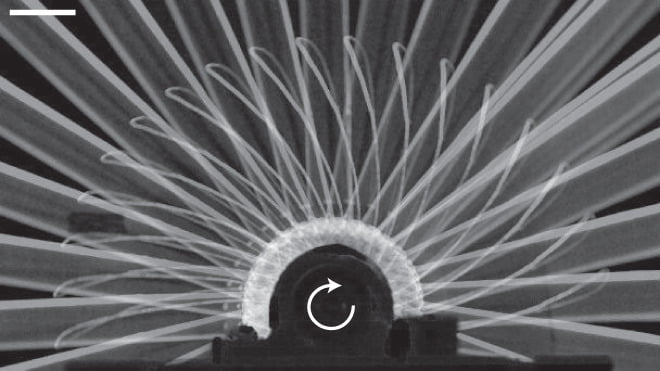
Researchers have used high-speed video and numerical simulation to capture the effects of aerodynamics on jump roping. After videoing an athlete jumping rope and constructing a jump roping robot (shown above imaged multiple times with a strobe light), they found that the U-shaped tip of the jump rope bends away from the direction of motion. When they built a computer model capable of deforming the jump rope based on its drag, they found the same behavior. They concluded that the “best” jump ropes are lightweight, short, and have small diameters to maximize speed and minimize the drag. #
Air Injection Patterns
This timelapse video demonstrates the pattern variations occurring when air is injected into a wet granular mixture in a Hele-Shaw cell. When the filling fraction–the percentage of the total volume between the glass sheets taken up by grains–is relatively small, the pattern formed by the injected air develops continuously and looks similar to Saffman-Taylor fingering seen in pure fluids. When the filling fraction is larger, however, the pattern forms in an intermittent fashion with new stick-slip bubbles of air forming as narrow sections of granular material slip and give way. #

Smoke-Wire Visualization


One common simple form of flow visualization is the smoke-wire technique. A thin wire is coated in oil, then heated. The resulting smoke flows over and around the object of study, providing a useful tracer for the flow. While not necessarily helpful as a quantitative measure, smoke-flow visualization helps researchers get a sense of what is going on in the flow. (Photo credits: TAMU Hypersonics Lab)
Voyager Explores the Edge of the Solar System
Though unconventional by our terrestrial concepts of fluids, the solar wind and its interaction with objects in and around our solar system can be considered a form of fluid dynamics. This NASA video discusses discoveries made by the Voyager spacecrafts as they leave our solar system and pass into interstellar space. The solar wind, a rarefied stream of charged particles, streams outward from the Sun at supersonic speeds. Eventually, the pressure from the interstellar medium surrounding the solar system is sufficient to slow the solar wind to subsonic speeds, causing a termination shock much like the hydraulic jump that forms in a kitchen sink when you turn the faucet on.