
Underwater explosions are incredibly dangerous and destructive, and this animation shows you why. What you see here are three balloons, each half-filled with water and half with air. A small explosive has been set off next to them in a pool. In air, the immense energy of an explosion actually doesn’t propagate all that far because much of it gets expended in compressing the air. Water, on the other hand, is incompressible, so that explosive energy just keeps propagating. For squishy, partially air-filled things like us humans or these balloons, that explosion’s force transmits into us with nearly its full effect, causing expansion and contraction of anything compressible inside us as our interior and exterior pressures try to equalize. The results can be devastating. To see the equivalent experiment in air, check out Mark Rober’s full video on how to survive a grenade blast. (Image credit: M. Rober, source)
Tag: fluid dynamics

Fluttering Feathers
Birds do not always vocalize in order to make their songs. The male African broadbill, shown in the top video above, makes a very distinctive brreeeet in its flight displays, but as newly published research shows, the sound comes from its wings, not its voice. During the display, the broadbill spreads its primary feathers and sound is produced on the downstroke, when wingtip speeds reach about 16 m/s. By filming a broadbill wing with a high-speed camera in a wind tunnel at comparable air speeds, researchers could localize the sound production to the 6th and 7th primary feathers.
In the second video above, you can see these feathers twisting and fluttering in the breeze. This is an example of aeroelastic flutter, a phenomenon in which aerodynamic and structural forces couple to induce oscillations. The same phenomenon famously caused the collapse of the Tacoma Narrows Bridge in 1940. In the birds, however, the flutter is non-destructive and the vibration produces audible sound which the other feathers modulate into the calls we hear. Broadbills aren’t the only birds to use this trick; some species of hummingbirds use flutter in their tail feathers during mating displays. (Video, image, and research credits: C. Clark et al.; additional videos here)

Bumblebees in Turbulence

Bumblebees are small all-weather foragers, capable of flying despite tough conditions. Given the trouble that micro air vehicles have when flying in gusty winds, bumblebees can help engineers to understand how nature successfully deals with turbulence. Under smooth laminar conditions like those shown in the animation above, bumblebees stay aloft by beating their wings forward and backward in a figure-8-like motion. On both the forward downstroke and the backward upstroke, you’ll notice a blue bulge near the front of the bee’s wing. This is a leading-edge vortex, which provides much of the bee’s lift.
Researchers were curious how adding turbulence would affect their virtual bee’s flight. The still image above shows the bee in moderate freestream turbulence (shown in cyan). Surprisingly, this outside turbulence has very little effect on the flow generated by the bee, shown in pink. In fact, the researchers found that the bees could fly through turbulence without a significant increase in power. Too much turbulence does make it hard for the bee to control its flight, though. The bee’s shape makes it prone to rolling, and the researchers estimated, based on a bee’s 20 ms reaction time, that bumblebees can probably only correct that roll and maintain controlled flight at turbulence intensities less than 63% of the mean wind speed. (Image credits: T. Engels et al., source; via Physics Focus)

Blowing Through a Straw
As kids, most of us got in trouble at some point for blowing through a straw into our nearly-empty drinks. What you see here is a consequence of such misbehavior, though in this case the fluid is silicone oil and the straw is a metal needle (not shown) through which helium is continuously injected beneath the liquid surface. Depending on the angle of the straw, different behaviors are observed, as seen in this video. The photo above shows an intermediate regime, in which tiny jets form at the surface and eject a stream of drops. Each drop sails in a little parabolic arc and briefly bounces on the surface, like the drops on the right, before coalescing into the pool. (Image credit: J. Bird and H. Stone; video)

Drawing With Microfluidic Tweezers

One of the challenges of dealing with objects at the microscale is finding ways to manipulate them. This is what techniques like optical tweezers or magnetic traps are used for. The downside to these methods is that they often require complex experimental set-ups or place restrictions on the kinds of particles that can be manipulated. Recently, however, researchers have developed a new hydrodynamic alternative: the Stokes trap.
Using a six-channel microfluidic device like the the ones shown in A) and B) above, scientists can alter the flow in the device in such a way that they trap and manipulate two particles at the same time. The simultaneous inflow and outflow in the device creates streamlines like those shown in C) and D) above. The large white areas where the streamlines converge and diverge are stagnation points–areas of little to no velocity. The scientists trap their particles at the stagnation points and then carefully shift the flow rates into and out of the device to move the stagnation points–with particles in tow–wherever they want them. In the animation, you can see part of a movie where they use the particles to write out a capital I (for University of Illinois). The researchers hope the technique will be used in the future for studying the physics of soft materials and biologically-relevant molecules like DNA. For more, check out the full paper or the group’s website. (Image credit and submission: C. Schroeder et al.)

Mushrooms Make Their Own Breeze
Plants and other non-motile organisms have developed some clever methods to disperse their seeds and spores for reproduction. Some plants use vortex rings for dispersal; others make their seeds aerodynamic. Low ground-dwellers like mushrooms must contend with a lack of wind to lift their spores and carry them away. Instead, they use evaporative cooling to generate their own air currents.
Mushroom caps contain a lot of water and, as that water evaporates, it cools air near the mushroom, just as sweat evaporating off your skin cools you. That cooler, denser air tends to spread, carrying the spores outward. At the same time, the freshly evaporated water vapor is less dense than the surrounding air, so it rises. This combination of rising and spreading is capable of carrying spores tens of centimeters into the air, where the wind is stronger and able to carry spores further. (Image credit: New Atlantis, source; research credit: E. Dressaire et al.)
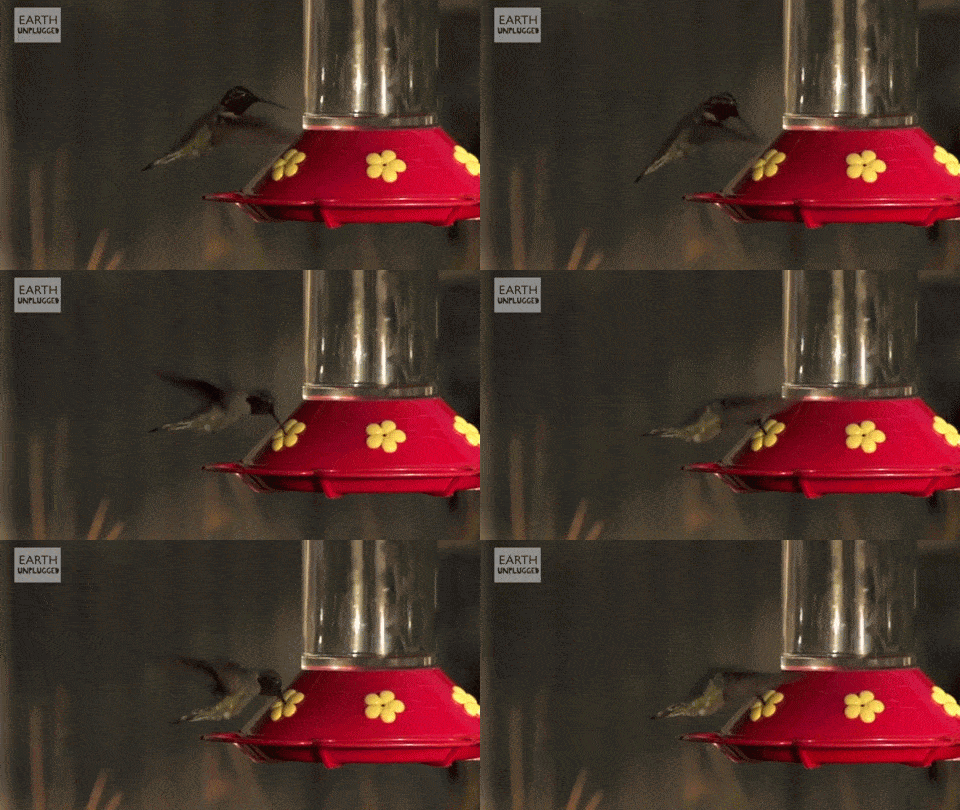
Hovering Hummingbirds
Hummingbirds are incredible flyers, especially when it comes to hovering. To hover stationary and stable enough to feed, the hummingbird’s flapping pattern not only has to generate enough lift, or vertical force, to counteract their weight, but the bird must balance any forward or backward forces generated during flapping.
As you can see in the animations above, when hovering the hummingbird’s wings move forward and back rather than up and down. When slowed down even further, the figure-8 motion of the wings becomes apparent. This careful motion is key to the hover; it allows the bird to generate about 70% of its lift on the downstroke when the wings move forward and creates the remainder of the lift needed on the upstroke. For much more high-speed footage of hummingbirds, check out the full BBC Earth Unplugged video, but be warned: you may experience a cuteness overdose! (Image credit: BBC Earth Unplugged, source)
Coffee-Making in Space
In this video, Kjell Lindgren demonstrates his technique for making coffee aboard the Space Station. Astronauts usually drink coffee reconstituted from powder, or, on special occasions, enjoy a beverage from their special espresso machine. But Lindgren uses a pour-over method by attaching a pod of coffee grounds to the underside of a Capillary Beverage Experiment cup – a specially-designed 3D printed cup that uses capillary action and surface tension to guide fluids. Then, by forcing hot water from a syringe through the grounds and into the cup, he gets a result that’s not too different from the way many people enjoy their coffee here on Earth. I must say, though, that my favorite part of this video is how he just starts spinning to separate the air and water in the syringe! (Video credit: NASA; via IRPI LLC)
Eulerian vs. Lagrangian

When I first studied fluid dynamics, one of the concepts I struggled with was that of Eulerian and Lagrangian reference frames. Essentially, these are just two different perspectives you can view the fluid from. Physics is the same in both, but mathematically, you approach them differently. In the Eulerian perspective one sits at a location and watches the flow pass, like an observer watching a river go by. It’s demonstrated in the top animation, where turbulent flow sweeps past in a pipe. This is the usual perspective experimentally – you put an instrument at a certain point in the flow and you gather information as the fluid streams past in time.
In the Lagrangian perspective, on the other hand, one follows a particular bit of fluid around and observes its changes over time. This means that one has to follow along at the mean speed of the flow in order to keep up with the fluid parcel one is observing. It would be like running alongside a river so that you can always be watching the same water as it flows downstream. The Lagrangian view of the same turbulent pipe flow is shown in the bottom animation. Notice how moving alongside the pipe makes it easier to see how the turbulence morphs as it goes along. Experimentally, this can be harder to achieve (at least in a flow with non-zero mean speed), but it’s a useful method of studying unsteadiness. (Image credit: J. Kühnen et al., source)






#/media/File:Aileron_roll.gif)