Tag: flow visualization

  • Featured Video Play Icon

    Columbia Glacier’s Retreat

    In southeastern Alaska, the Columbia Glacier once stretched as far as Heather Island in Prince William Sound. After a long period of stability, the glacier began retreating in 1980 and currently sits more than 15 miles from its previous extent. This video explores the glacier’s evolution through false-color satellite imagery, which allows researchers to distinguish the glacier from sea ice, open water, exposed rocks, and nearby vegetation. Though rapid overall, the glacier’s retreat takes place in fits and starts, due to a combination of influences including climate change, sea and ice interactions, and the effects of local topography. (Video and image credit: NASA Earth Observatory)

    False-color animation showing the retreat of Alaska's Columbia Glacier since 1980.
    False-color animation showing the retreat of Alaska’s Columbia Glacier since 1980.
  • Wild Patterns in Ionic Liquids

    Wild Patterns in Ionic Liquids

    Ionic liquids are essentially salts in a liquid form. In these images, a mixture of water and ionic liquid separates when heated. This phase separation causes the initial mixture to break into two regions: one low in ionic liquid and one rich in ionic liquid. Because the surface tensions of these two phases are different from one another, complex flow patterns form. (Image and research credit: M. Pascual et al.)

  • Ship Tracks in the Sky

    Ship Tracks in the Sky

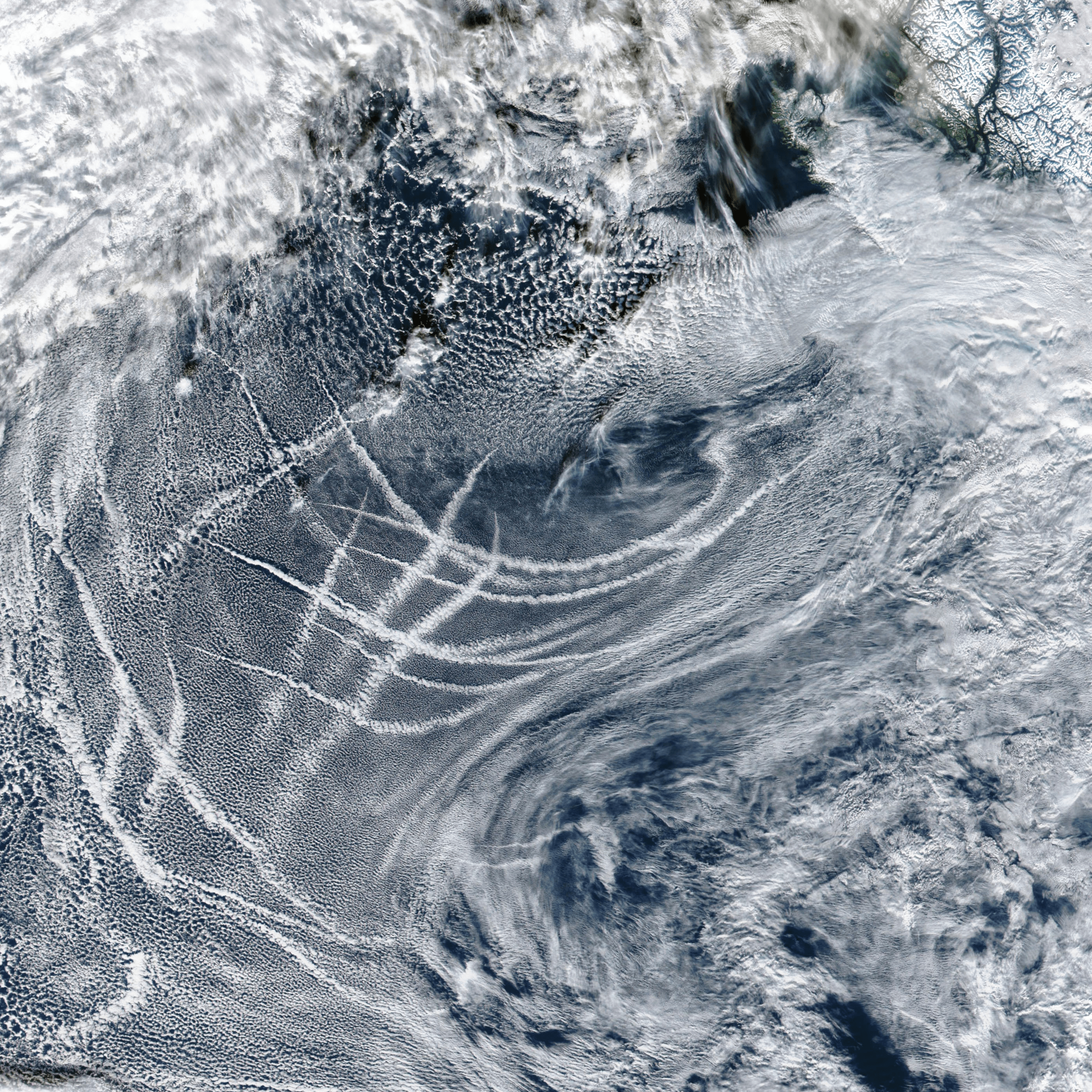
    Line-like clouds criss-cross the Pacific Ocean in this satellite image. Each one is a ship track, a remnant left behind a passing ship. As they travel, ships leave a trail of exhaust that seeds the atmosphere with aerosols that serve as additional nucleation sites for clouds. The tiny particles interact with existing low-level clouds, making them brighter. Of course, the aerosols are present in the wake of ships regardless of whether they seed clouds that we can observe. (Image credit: J. Stevens; via NASA Earth Observatory)

  • Elastic Turbulence

    Elastic Turbulence

    Decades ago, engineers pumping polymer-filled drilling liquids into porous rock noticed sudden and dramatic increases in the viscosity of the liquid. Within the tiny pores of the rock, conventional (i.e., inertial) turbulent flow should be impossible — the Reynolds number is simply too low. Now a new experiment points to the source of the high viscosity: elastic turbulence.

    To observe the phenomenon, researchers watched flow in the spaces between glass beads packed into a narrow channel. Videos of flow through one of these pores — roughly 250 microns across — are shown below. When flow rates are low (left), the fluid moves smoothly through the pore, but at higher flow rates (right), chaotic fluctuations emerge, creating the dramatic increase in apparent viscosity. In their analysis, the researchers found that the polymers’ motions generated the flow fluctuations, but most of the viscosity increase was inherent to the fluid’s movement, not to the polymers’ resistance to stretching. (Image credit: top – M. van den Bos, pore flow – Datta Lab; research credit: C. Browne and S. Datta; via Quanta Magazine; submitted by Kam-Yung Soh)

    Video of smooth flow through a pore (left) and flow with elastic turbulence (right).
    At low flow rates (left), the fluid moves smoothly through the tiny pores, but at higher flow rates (right), the polymers in the flow generate elastic turbulence that greater increases the fluid’s apparent viscosity.
  • Volcanic Shocks

    Volcanic Shocks

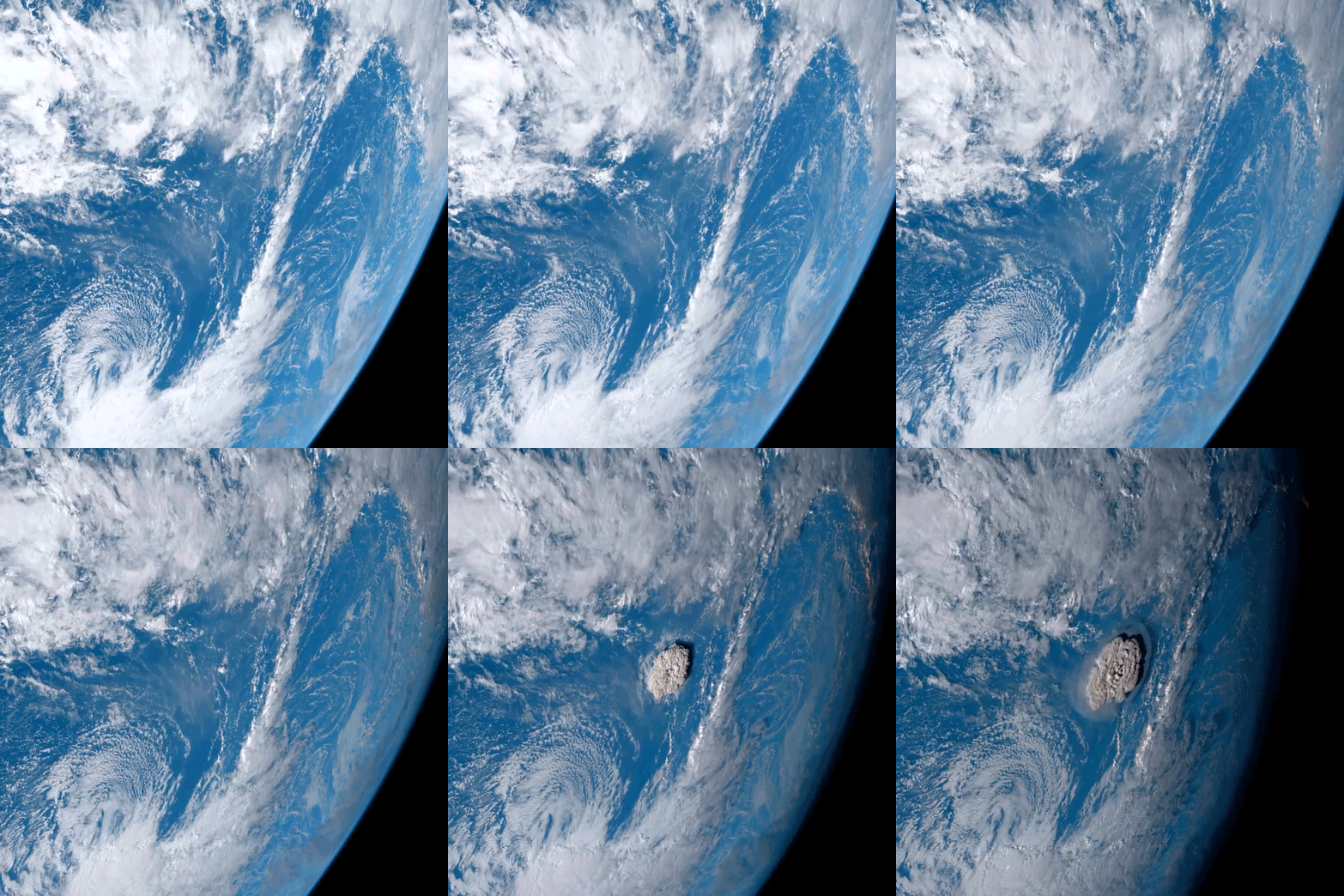
    A violent underwater eruption at the Hunga Tonga-Hunga Ha’apai caldera on January 15th sent literal shock waves around the world. This animation, based on satellite images from Japan’s Himawari 8, shows the fast-moving shock waves and the growing ash plume coming from the uninhabited island. Although most recent eruptions from this volcano have been small, experts suspect that this latest eruption is part of a major event, similar to the volcano’s last big eruption about 1,000 years ago.

    The explosiveness of the eruption comes from the interaction of seawater and fresh magma. When the magma erupts quickly underwater, the hot liquid contacts seawater directly rather than forming a protective layer of vapor (as in the Leidenfrost effect). The resulting explosion tears the magma apart, exposing more hot surfaces to the cold water and further driving the chain reaction. (Image credit: S. Doran/Himawari 8; submitted by jpshoer; see also S. Cronin)

  • December’s Derecho

    December’s Derecho

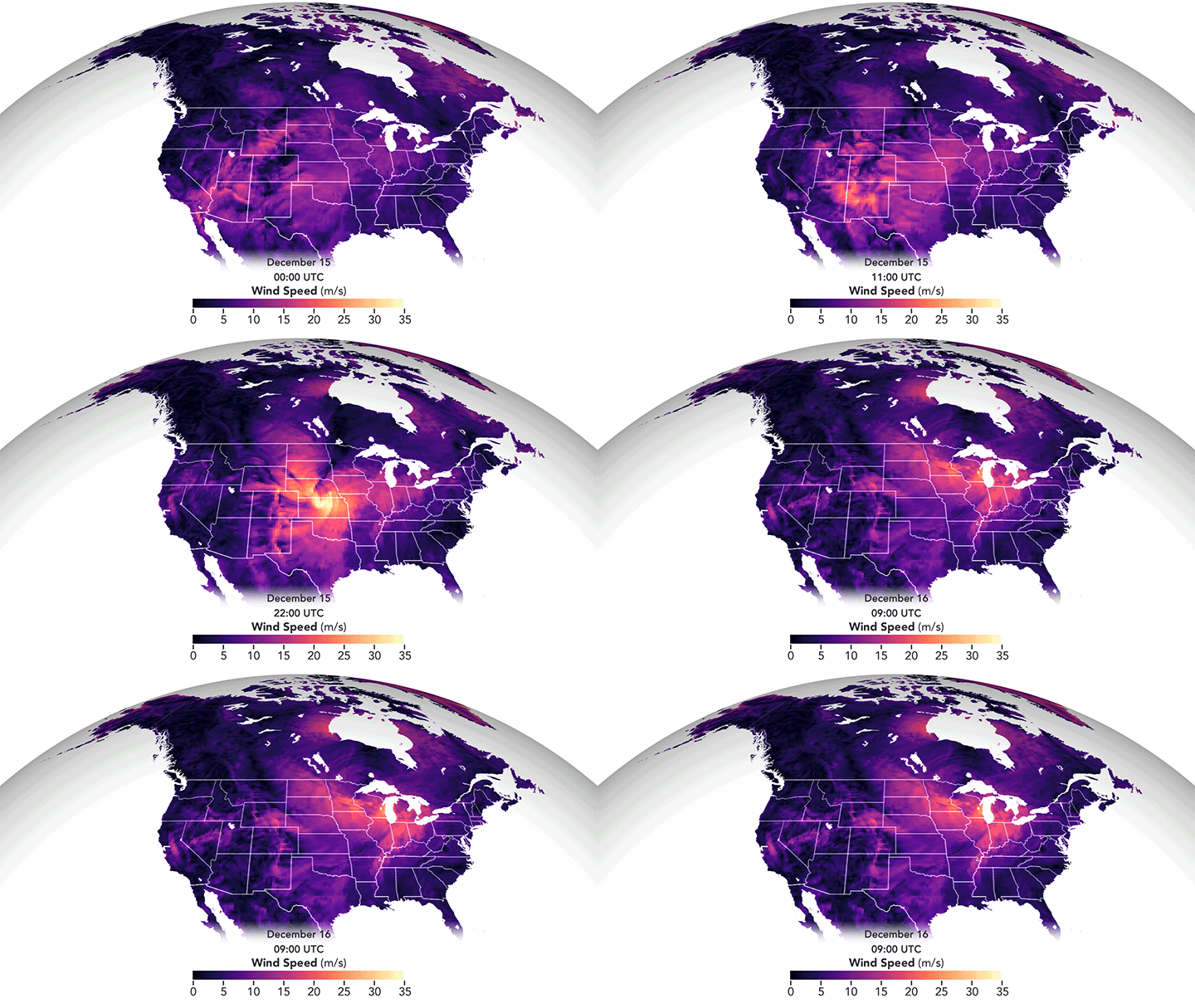
    I confess I’d never heard the term derecho before moving to Colorado, but I’ve experienced a few of these wind storms now. They’re intense! Last December’s derecho formed when a high-pressure system in the western United States met a strong low-pressure system over the northern plains. In fluids, flow moves preferentially from areas of high pressure to those with low pressure, and that’s no different when it comes to weather. The strong pressure gradient drove high winds from the Rocky Mountains to Minnesota. The animation above shows the strongest winds in in yellow-white but even the “weaker” pink areas saw winds comparable to a fast-moving car in speed. The visualization is constructed from data reported by ships, buoys, aircraft, satellites, and other sources, all processed through a NASA weather algorithm. (Image credit: J. Stevens/NASA; via NASA Earth Observatory)

  • Swirls in the Wake

    Swirls in the Wake

    Rocky islands make excellent atmospheric swirls, as seen here around Guadalupe Island. Winds blowing in from the ocean get forced up and around the island’s topography, resulting in vortices that shed alternately from either side of the island. The pattern they form is known as a von Karman vortex street and is easily seen in satellite imagery, thanks to the swirls that can persist for tens of kilometers downstream. Personally, I never get tired of this one! (Image credit: NASA/GSFC/JPL; video credit: NOAA/CIRA; via Dakota Smith; submitted by @SellaTheChemist)

  • Featured Video Play Icon

    Opera Singer Air Flow

    What does the air flow from a trained opera singer look like? That’s the question behind this study, which combines music and fluid dynamics. Using an infrared camera tracking carbon dioxide (CO2) exhalations from a singer during a performance allowed researchers to identify several important flow features. When breathing, air flows out the singer’s nose in a tight, downward jet with an initial velocity around 1 m/s.

    While singing, air leaves the mouth at a much lower velocity, especially during vowels where the mouth is open. With less momentum behind these exhalations, they can drift upward on the buoyant warmth of the singer’s breath. During consonants — especially plosives like t, k, p, b, d, and g — a rapid burst of air leaves the mouth, traveling at nearly 10 m/s. From the perspective of COVID-19 safety, it’s these plosive jets that are likely to spread contaminated droplets. (Image and video credit: MET Orchestra; research credit: P. Bourrianne et al.; via Improbable Research; submitted by Kam-Yung Soh)

  • Featured Video Play Icon

    A Colorful Fire Tornado

    This one definitely belongs in the do-not-try-this-yourself category, but this Slow Mo Guys video of a colorful fire tornado is pretty spectacular. Using an array of different fuels and a ring of box fans, Gav sets up a vortex of flame that transitions smoothly from red all the way to blue. As he points out in the video, the translucency of the vortex is so good that you can see how the two sides of the vortex rotate! (Video credit: The Slow Mo Guys)

  • Featured Video Play Icon

    Filming the Brinicle

    It may have been 10 years since the BBC filmed the first timelapse of a growing brinicle, but the footage is just as amazing now as it was then! This video gives you the behind-the-scenes story of what it took to capture this natural wonder under the Antarctic ice. It’s incredible to see the shots of sinking brine streaming off the brinicles, too. The difference in density (and thus refractive index) of the brine and the ocean water is substantial enough that your eye can actually pick them out as separate fluids. I once went snorkeling in an area with similarly varied salinity and it was completely bizarre watching everything suddenly go wavy and blurry as I swam. (Image and video credit: BBC)