This video, created by undergraduates as part of a fluid dynamics laboratory course, shows flow visualization of a von Karman vortex street in the wake of a cylinder in comparison to a computational fluid dynamics (CFD) simulation of the same phenomenon. If you’re wondering about the black-and-white segments and the peculiar speech patterns, look no further. The students are parodying a series of videos made by MIT in the 1960s that are still used in classrooms today.
Tag: flow visualization

Wingtip Vortices in Ground Effect
In this flow visualization, wingtip vortices from an aircraft have been simulated using an apparatus with a couple of flaps that snap together like a book closing. Dye is pooled on the “ground” below the flaps and gets entrained by the vortices and lit up using laser light. The red vortices are the primary vortex generated by the aircraft wingtips and the green ones are secondary vortices generated by interaction with the ground. The lower half of the picture is a reflection off the ground. This photo was part of the 2009 Gallery of Fluid Motion. #

How Wings Create Lift
One of the topics in fluid dynamics almost everyone has come across is the explanation of how airplanes produce lift. Using Bernoulli’s principle–which relates velocity and pressure–and a picture of an airfoil, your average science text will say that a bit of air going over the top of the airfoil has to travel farther than a bit of air going under the airfoil, and that, therefore, the air over the top travels faster than the air under the airfoil.
Unfortunately, this is misleading and, depending on the wording, outright wrong! The hidden assumption in this explanation is that air that goes over the top and air that goes under the bottom have to reach the trailing edge of the airfoil at the same time. But why would that be? (As one of my profs once said, “There is nothing in physics that says there is Conservation-Of-Who-You-Were-Sitting-Next-To-When-You-Started.”)
Take a look at the video above. It shows an airfoil in a wind tunnel using smoke visualization to show how the air moves. Around the 0:25 mark, the video slows to show a pulse of smoke traveling over the airfoil. What happens at the trailing edge? The smoke going over the top of the airfoil is well past the trailing edge by the time the smoke going under the airfoil reaches the trailing edge!
It’s true that air goes faster over the top of the airfoil than the bottom and that this causes a lower pressure on top of the airfoil (as Bernoulli tells us it should) and that this causes an upward force on the airfoil. But which causes which is something of a chicken-and-egg problem.
A more straightforward way, in my opinion, of explaining lift on an airplane is by thinking about Newton’s 3rd law: for every action, there is an equal and opposite reaction. Take a look at the air’s movement around the airfoil as the angle of attack is increased around 1:00 on the video. Just in front of the airfoil, the air is moving upward. Just after the airfoil, the air is pointed downward. A force from the airfoil has pushed the air down and changed its direction. By Newton’s 3rd law, this means that the air has pushed the airfoil up by the same amount. Voila! Lift!
Wingtip Vortices in Flight
This NASA Langley Research Center test shows real-time flow visualization of the wingtip vortices off a C-5A Galaxy aircraft.

Perching Gliders
Researchers at MIT are studying stall to understand how birds land and come up with new ways for gliders to perch instead of requiring a runway. This photo shows a smoke visualization of the glider stalling. #

Smoke Angel
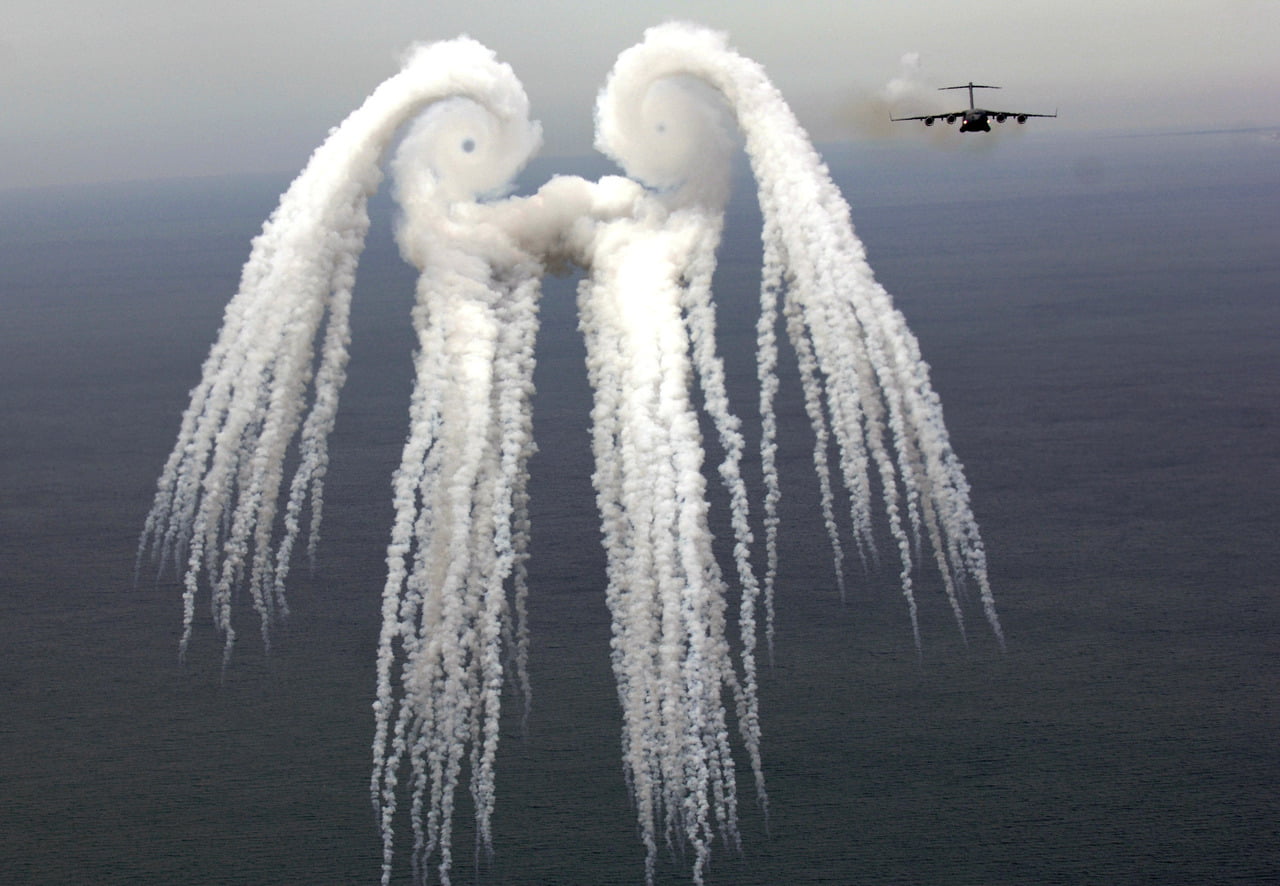
Smoke from flares released by a C-17 Globemaster III gets caught up by the aircraft’s wingtip vortices, creating a distinctive “smoke angel” shape. #