Tag: flow visualization

  • Moving By (Intestinal) Wave

    Moving By (Intestinal) Wave

    A word of warning: today’s post includes visuals of digestion taking place in (non-human) embryonic intestines.

    Our bodies rely on waves driven by muscle contractions to move both fluids and solids, whether through the esophagus, the ureter, the fallopian tubes, or the intestines. In areas where mixing is unnecessary, those waves move in a single direction, transporting the contents one-way. But in the intestines, mixing is critical to enhancing nutrient absorption, so mammal intestines have wave trains that move both forwards and backwards.

    The majority of waves move downstream, carrying waste toward its exit (Images 1 and 2). But occasionally, upstream waves collide with their downstream counterparts to force material together, both mixing and delaying progress in order to allow better nutrient uptake along the intestinal walls (Image 3). (Image credits: top – S. Bughdaryan, others – R. Amedzrovi Agbesi and N. Chavalier; research credit: R. Amedzrovi Agbesi and N. Chavalier; via APS Physics)
  • Tidal Vortices

    Tidal Vortices

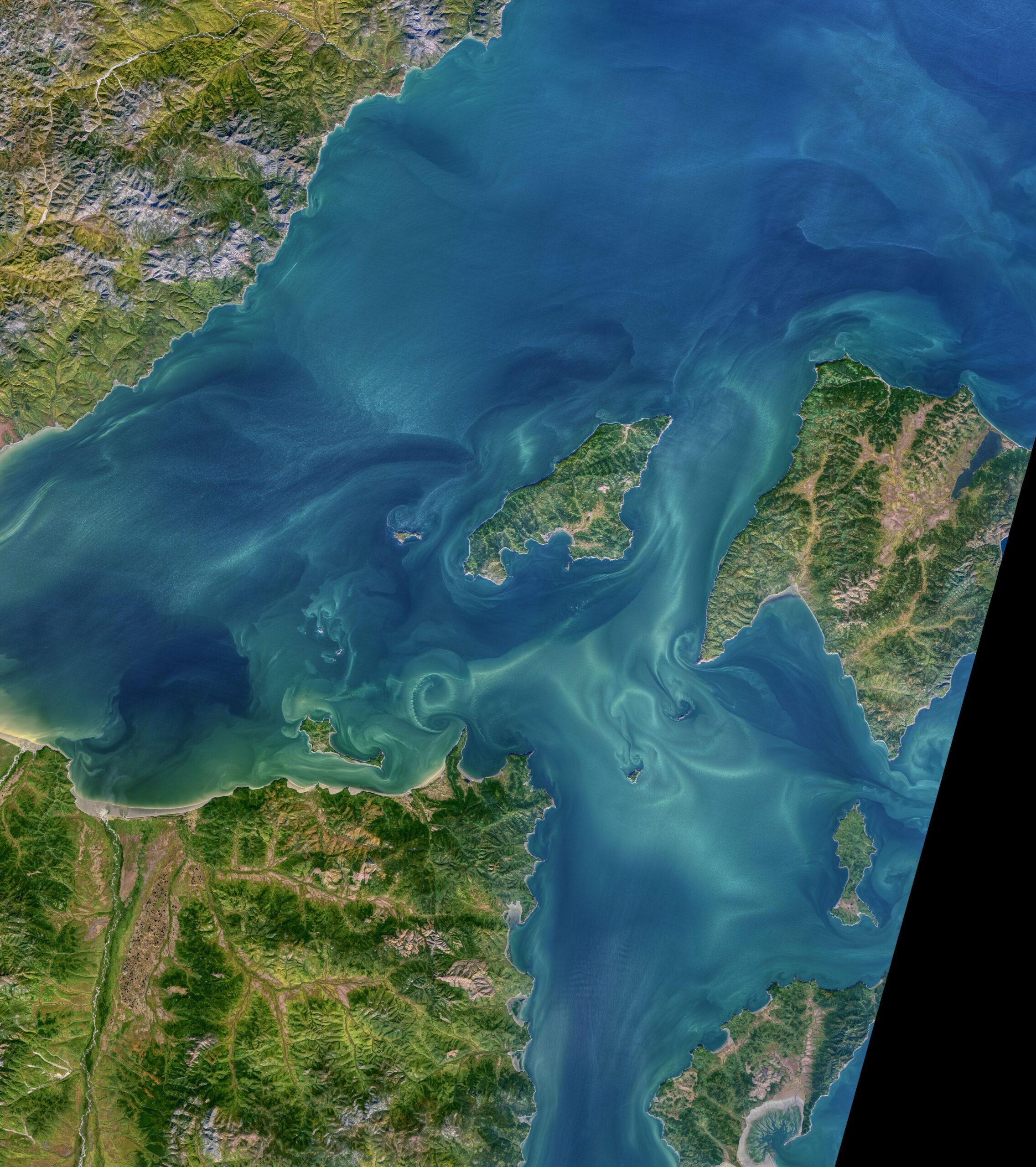
    Local topography in the Sea of Okhotsk funnels water to create some of the largest diurnal tides in the world — nearly 14 meters! The currents rushing past islands and outcrops create swirling vortices like the ones seen in this natural-color satellite image. In some places, you can even see multiple vortices, strung together into a von Karman vortex street. At high tide, the vortex streets stretch westward, but at low tide they point east. (Image credit: N. Kuring/NASA/USGS; via NASA Earth Observatory)

  • Featured Video Play Icon

    Self-Stopping Leaks

    A leak can actually stop itself, as shown in this video. To demonstrate, the team used a tube pierced with a small hole. When filled, water initially shoots out the hole in a jet. The pressure driving the jet comes from the weight of the fluid sitting above the hole. As the water level drops, the pressure drops, causing the jet to sag and eventually form a rivulet that wets the side of the tube. As the water level and driving pressure continue to fall, the rivulet breaks up into discrete droplets, whose exact behavior depends on how hydrophobic the tube is. Eventually, a final droplet forms a cap over the hole and the leak stops. At this point, the flow’s driving pressure is smaller than the pressure formed by the curvature of the capping droplet. (Image and video credit: C. Tally et al.)

  • Featured Video Play Icon

    Inside Viscous Fingers

    Sandwich a viscous fluid between two transparent plates and then inject a second, less viscous fluid. This is the classic set-up for the Saffman-Taylor instability, a well-studied flow in which the interface between the two fluids forms a wavy edge that develops into fingers. Despite its long history, though, there is still more to learn, as shown in this video. Here, researchers alternately injected a dyed and undyed version of the less viscous fluid. The result (Image 3) is a set of concentric dye rings that show how the fluid moves far from the fingers along the edge. Notice that the waviness of the fingers appears in the flowing fluid well before it approaches the interface. (Image and video credit: S. Gowan et al.)

  • Turquoise Eddies

    Turquoise Eddies

    During the summer months, the Barents Sea between Norway and Russia is streaked with blue and teal swirls. These beautiful patterns are the result of a phytoplankton bloom, as viewed by earth-observing satellites (with a little color enhancement). Although each cell in the bloom is only nanometers across, their collective presence is visible from space! They also act as tracers in the water, revealing the swirling flow patterns present there. (Image credit: J. Stevens/NASA Earth Observatory)

  • Featured Video Play Icon

    Double Diffusive Flow

    Diffusion is the tendency for differences in a fluid — in density, temperature, or concentration — to even out over time. Think about a drop of food coloring in a glass of water. Even without stirring, that dye will eventually disperse throughout the glass through diffusion. But when there is more than one factor controlling diffusion — like temperature and salinity — things get more complicated. In the ocean, for example, this double-diffusion causes salt fingers like those shown in the first image.

    But what happens when the two diffusing fluid layers are flowing? That’s the question at the heart of this video, which explores the intricate mixing that takes place between doubly-diffusing liquids in a channel. (Video and image credit: A. Mizev et al.)

  • Re-Entry For X-Wings

    Re-Entry For X-Wings

    Fans of sci-fi and fantasy have a long-standing tradition of exploring the physics and/or practicality of creations in their fandom, and Star Wars fans are no exception. Here engineers ask whether Luke Skywalker’s X-wing fighter could survive the descent through Dagobah’s atmosphere as he searched for Master Yoda. Their results are based on a numerical simulation, with some assumptions about the spacecraft’s descent path and design as well as the planet’s atmosphere. Fans of the Jedi will be glad to hear that the X-wing can survive its supersonic descent intact, delivering the last Jedi safely to his mentor. (Image credit: Y. Ling et al.)

  • Watery Salt Flats

    Watery Salt Flats

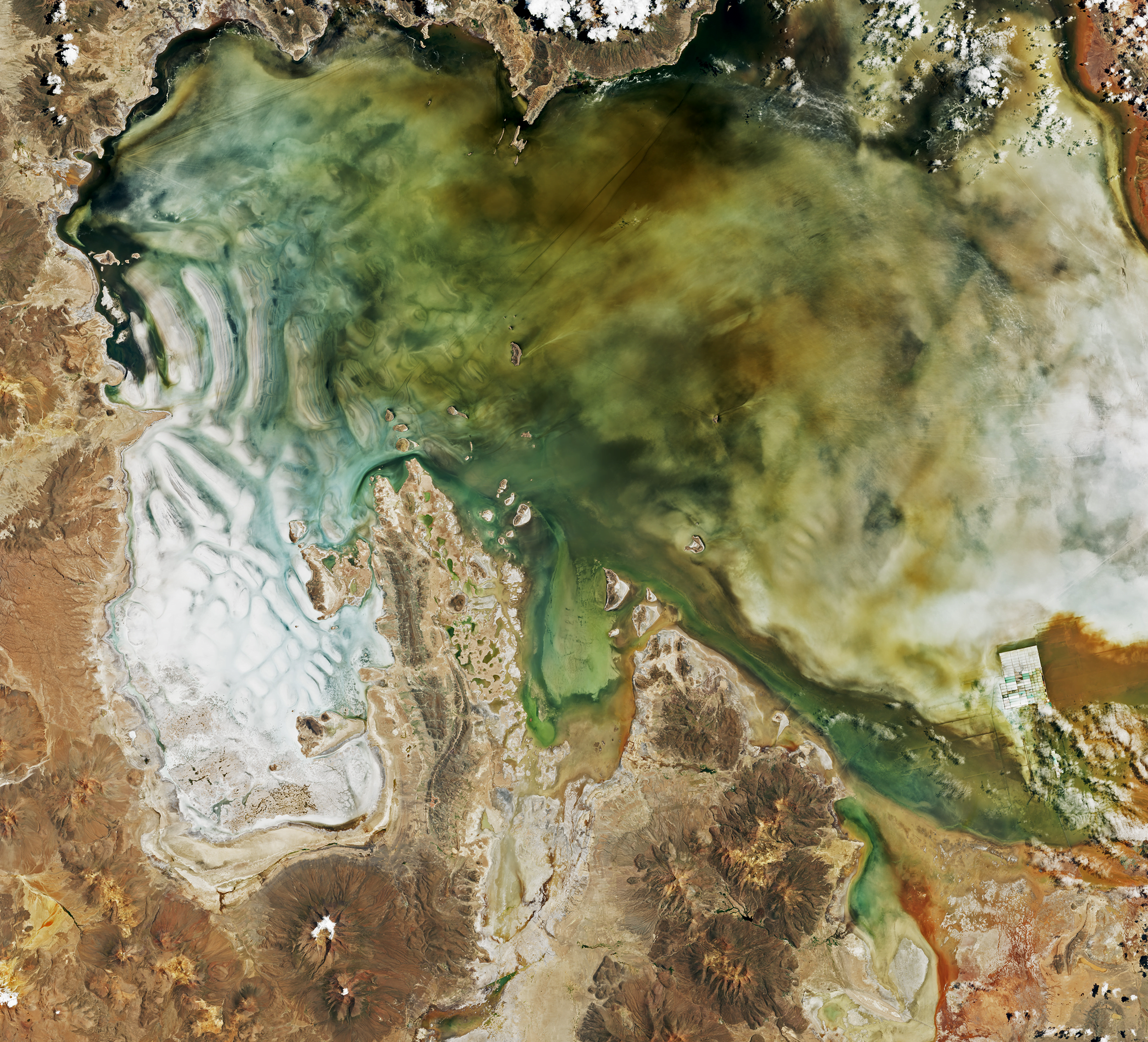
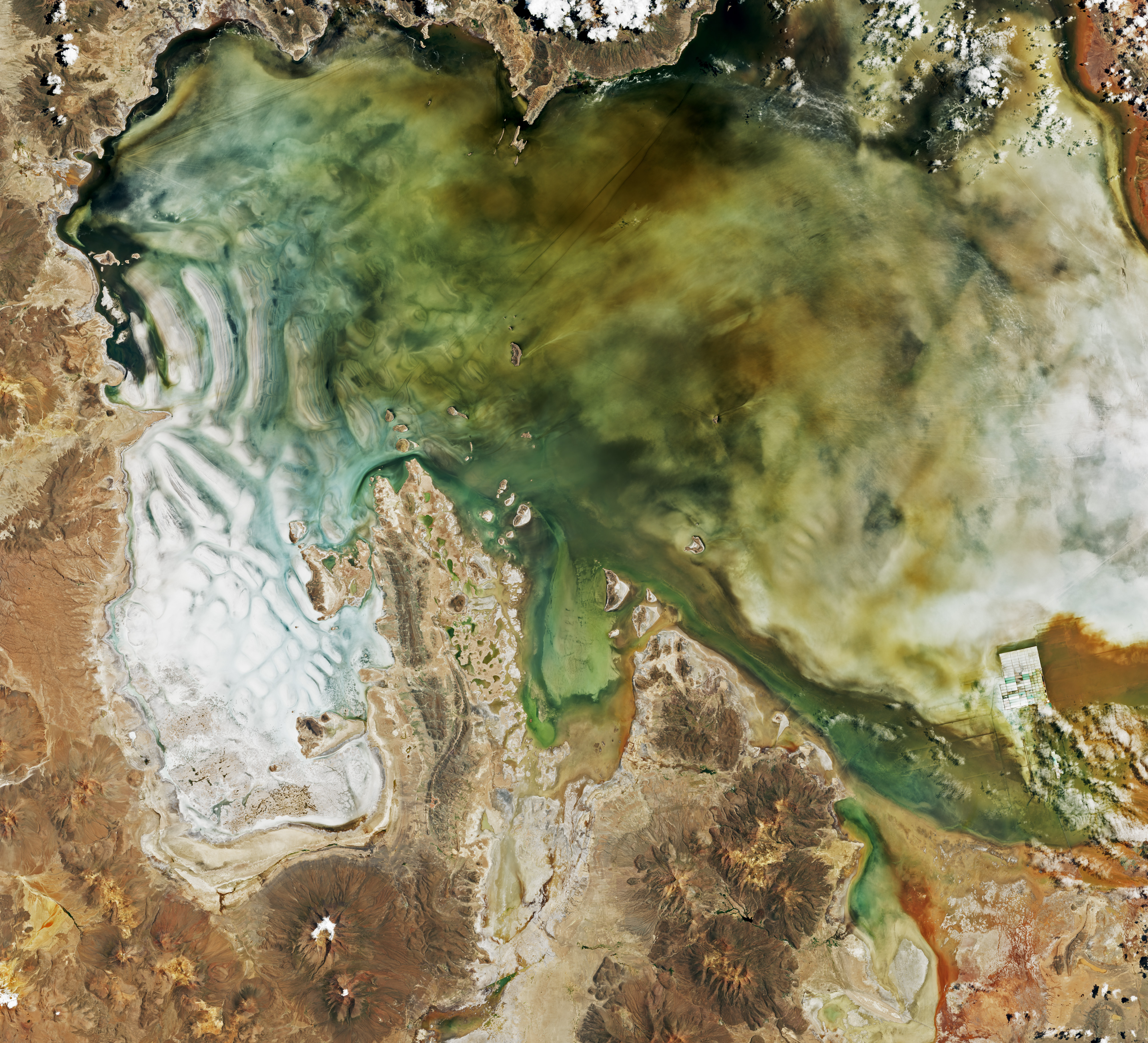
    Unusually high rainfall in Bolivia’s Salar de Uyuni turned the world’s largest salt flat into a shallow salt lake. These natural-color satellite images show the area in late January 2022. If you zoom in on the full resolution image, there are incredible detailed swirls in the water. It’s like peering at an abstract or Impressionist painting. The many colors are attributable to several sources, including volcanic sediments, runoff, and a variety of microbes and algae thriving in the mineral-filled waters. (Image credit: L. Dauphin; via NASA Earth Observatory)

  • Spinning Tops

    Spinning Tops

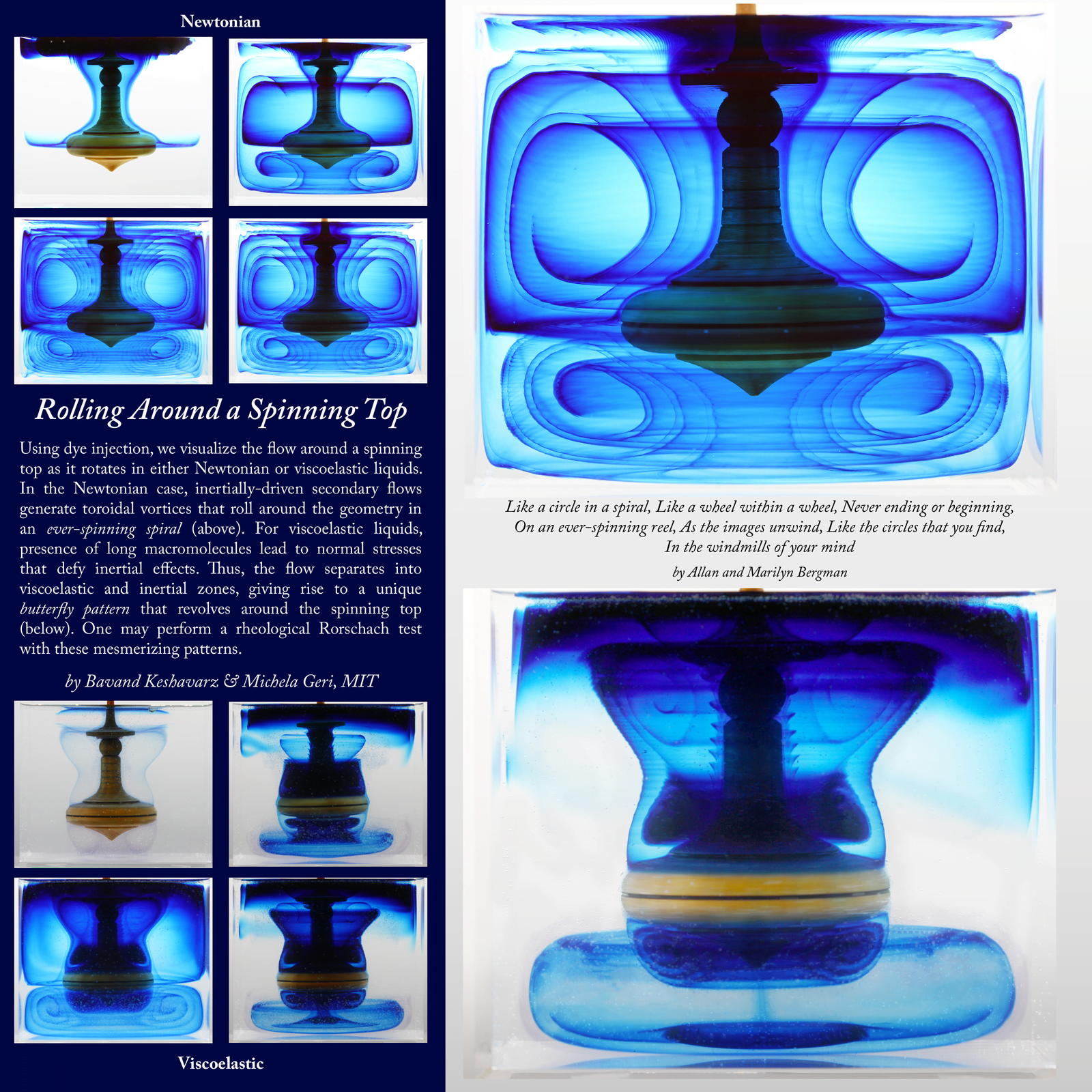
    What does the flow look like around a spinning top? Here, researchers used dye to visualize what happens in a Newtonian fluid (like air or water) as well as a viscoelastic fluid. The Newtonian fluid (upper images) divides into two circulating zones, one below the top and one above. They both take the shape of a toroidal, or donut-shaped, vortex, visible here in cross-section.

    The long molecules of the viscoelastic fluid lend it elasticity to resist stretching. The result is a very different flow field. Beneath the top, there’s still a toroidal vortex, though it appears tighter. But around the upper part of the top, there’s a butterfly-like region of recirculation! (Image credit: B. Keshavarz and M. Geri)

  • Featured Video Play Icon

    Eruption in a Box

    In layers of viscous fluids, lighter and less viscous fluids can displace heavier, more viscous liquids. Here, researchers demonstrate this using four fluids sandwiched between layers of glass and mounted in a rotating frame. (Think of those liquid-air-sand art frames found in museums but bigger!)

    In their first example, each layer of fluid is denser than the one beneath it, so buoyancy forces the lowest layer — air — to rise. The air pushes its way through the more viscous layer of olive oil, then slowly makes its way through the even more viscous glycerin before bursting through the last layer in an eruption. As the team varies the viscosity and miscibility of the layers, the movement of the buoyant fluids through the viscous layers changes dramatically. (Image and video credit: A. Albrahim et. al.)