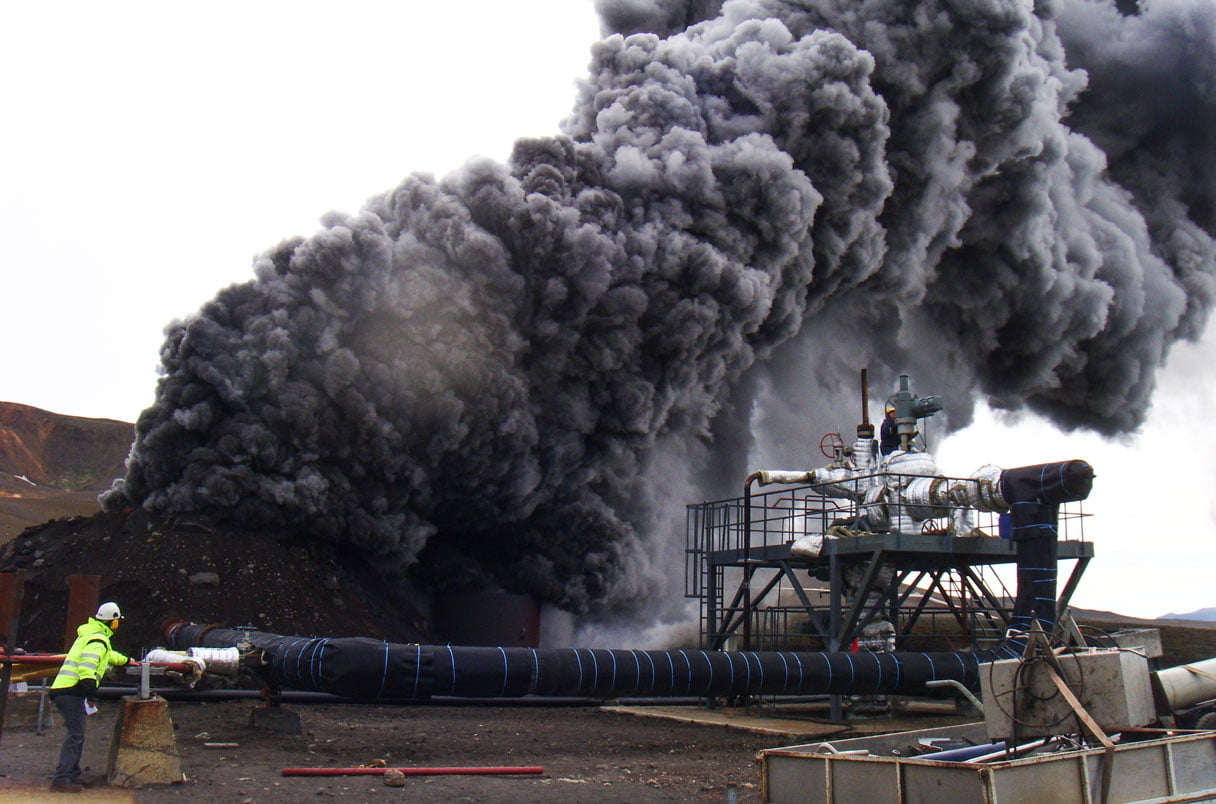
In 2009, drillers seeking geothermal energy in Iceland accidentally pierced a hidden magma chamber. After a billowing pillar of steam and glass shards poured out from the hole, it created the hottest geothermal well ever, until the casing failed. Now drillers are preparing to return to the area, this time with the intention of reaching magma. Capturing a sample of magma before it rises to the surface (thereby losing its trapped gases) is something of a holy grail for geophysicists, who otherwise rely on seismic wave detections and observations of magma that’s reached the surface. Building a long-term magma observatory will be an enormous engineering challenge, but the technologies developed may help us explore other hellish environments like the surface of Venus. (Image credit: G. Fridleifsson/IDDP; via Science)
Tag: engineering

Pressure At The Dam
Hydrostatic pressure in a fluid is based on the fluid’s depth. You’ll rarely see a more dramatic example of that power than with a water release from a dam. Here we see the outlet of the Verbund Hydro Power dam in Austria. With 190 meters of water behind the dam, the outlet jet is massive. It moves 20,000 liters of water per second at a speed of 50 meters per second. Imagine what it would be like to stand next to that! (Image and video credit: Discovery UK; submitted by Olwyn B.)

Zuiderzee Works
Few countries have to contend with water the way the Netherlands does. With 26% of its area and 21% of its population living below sea level, water control is critical. This satellite image shows some of the natural and manmade features that help protect the landscape. The West Frisian Islands, the long spine-like archipelago seen here, form the first barrier. Behind them lies the mudflats of the Wadden Sea, home to countless wetland species. The Wadden Sea is separated from the freshwater Lake Ijssel by the Afsluitdijk, constructed in 1932 to protect the country from rising seas. With the dam in place, the Dutch used wind power to drain the shallow lands behind the dam, reclaiming the polders labeled here. With the islands, mudflats, and lake between urban settlements and the sea, engineers have more options for diverting water and protecting people from disastrous flooding. (Image credit: A. Holmes/NASA’s Ocean Color Web; via NASA Earth Observatory)

How Sinkholes Form
Growing up in the Ozarks, I explored my fair share of caves and sinkholes. These geological features form when flowing groundwater erodes soil, sand, and even rock underground. The Ozark Plateau consists largely of limestone, which is water soluble, making it very prone to this internal erosion. As bedrock dissolves away, it is eventually unable to hold up the weight of ground above it, causing a catastrophic collapse into a sinkhole. Although my childhood sinkholes were naturally occurring, they can also form in spots where leaking pipes and infrastructure help wash underlying soil away. Unfortunately for engineers, this internal erosion can take place for years without any visible sign above ground. (Image and video credit: Practical Engineering)

Breaking Up Is(n’t) Hard to Do
Engineers often need to break a liquid jet up into droplets. To do so quickly, they surround the jet with a ring of fast-moving air in a set-up known as a coaxial jet. Shear between the gas and liquid creates instabilities that quickly distort the jet’s initial cylinder into sheets and ligaments. Those formations then undergo their own instabilities to break up into drops. The method is, as you can see in the high-speed images above, quite effective, though the breakup mechanism itself is tough to quantify. (Image credit: G. Ricard et al.)

Adhering Through Vibration
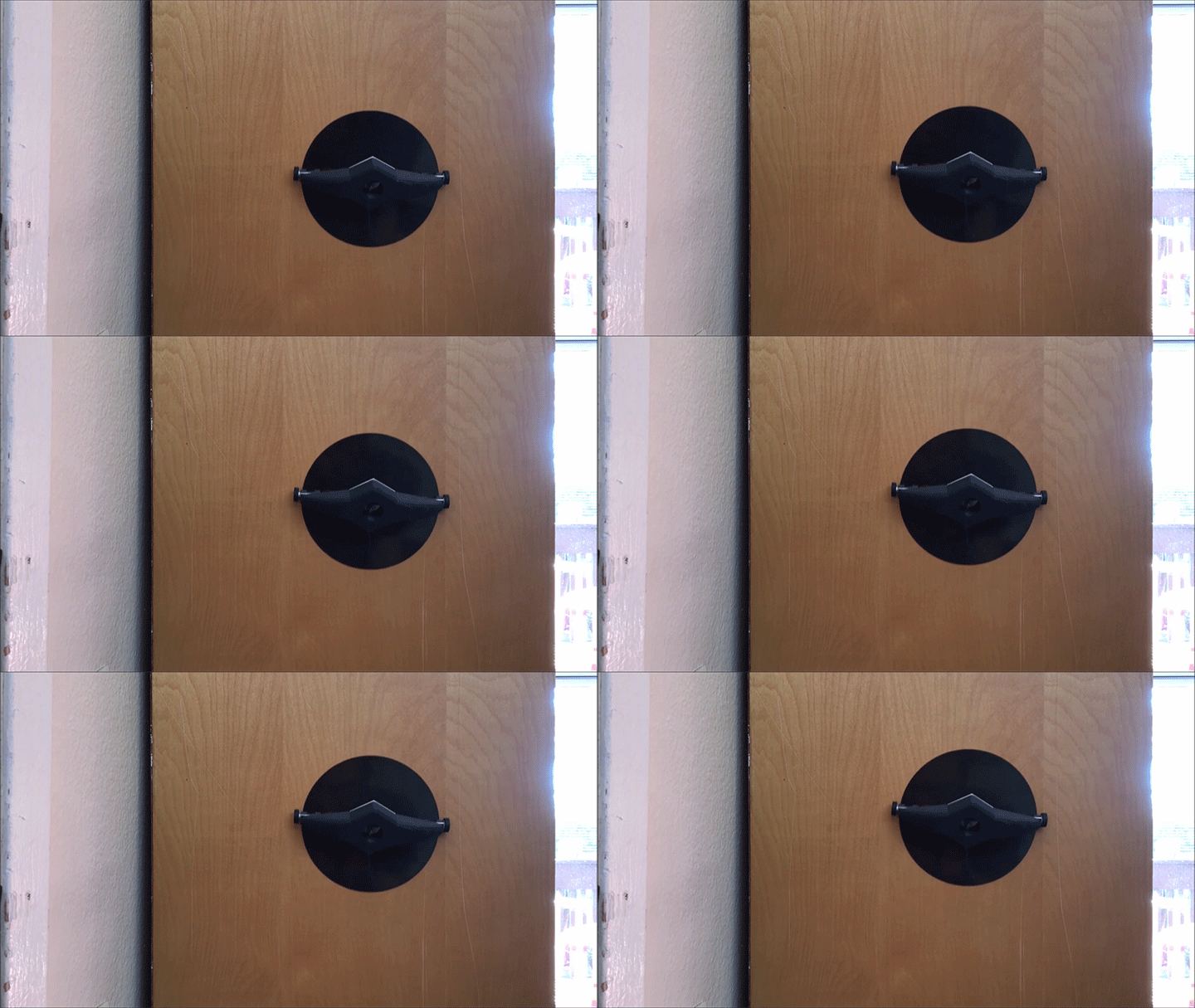
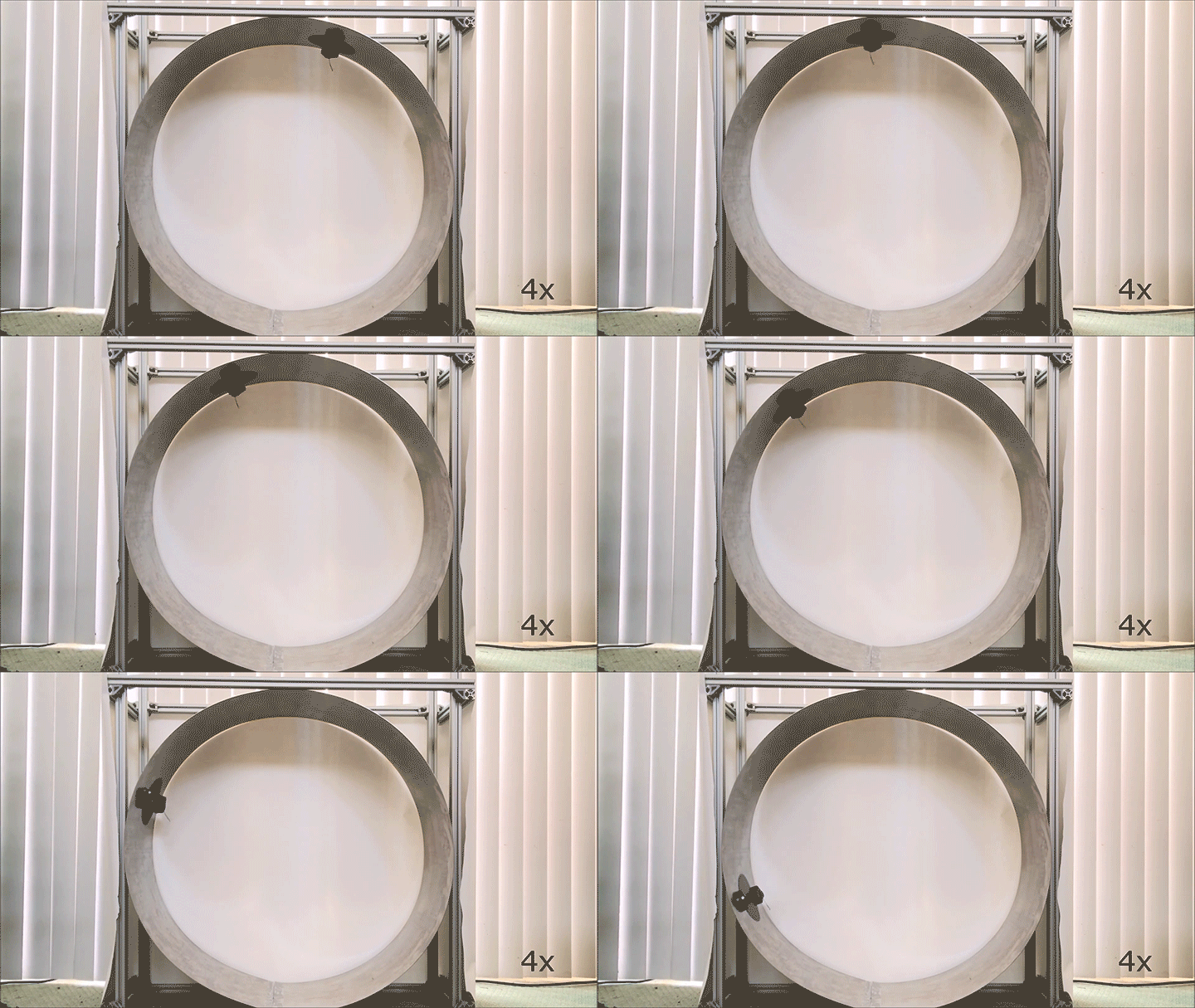
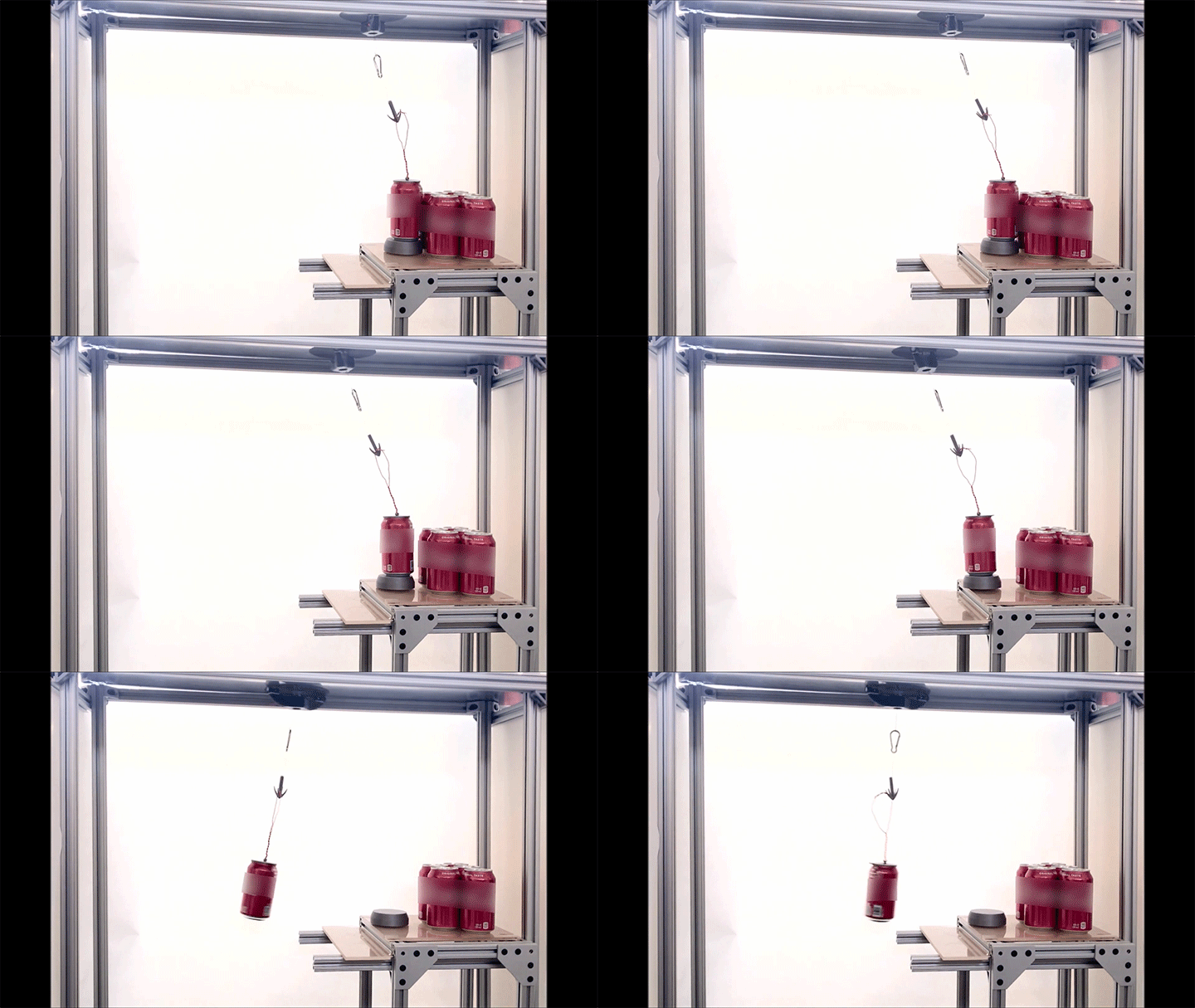
This little robot relies on vibration to generate its adhesion. By vibrating its flexible disk, it generates low pressure in the thin air layer between the disk and the surface. The force created is strong in the normal direction — meaning that the robot won’t come off the surface, even when carrying large weights — but relatively weak in the plane of the surface, allowing the robot to move freely. The system does have some disadvantages, though. It requires a relatively smooth surface to work, and the necessary frequency of vibration is around 200 Hz — well inside of human hearing — which makes the robot very noisy. (Image, video, and research credit: W. Weston-Dawkes et al.; via IEEE Spectrum; submitted by Kam-Yung Soh)

How Sewers Work
One of the most important and underappreciated pieces of urban infrastructure is the sewage system. We rely on them to make our waste vanish, as if by magic. In reality, these systems are carefully engineered and built to be largely self-cleaning and future-proof. Gravity is the primary driver of the system, and engineers design the slope of sewage lines so that flow inside the pipes is fast enough to keep solid waste suspended. There are, of course, plenty of challenges involved; check out the full video for an overview. (Image and video credit: Practical Engineering)

Tokyo 2020: Kasai Canoe Slalom Course
The Kasai Canoe Slalom Course is Japan’s first man-made whitewater venue. To test the design and its multiple configurations, engineers at CTU in Prague built this large-scale hydraulic model. Check out the video below to see it under construction and in action.
The course is adaptable so that it can be used for high-level competitions like the Olympics, then reconfigured for recreational use. You can even see what it’s like to run part of the course in a multi-person raft, thanks to a miniature, GoPro-equipped boat! (Image credit: top – M. Trizuliak, others – CTU Prague; video credit: CTU Prague)
Missed our previous Olympics coverage? Check out how sailboats outrace the wind, the future of swim tech, and how surface roughness affects volleyball aerodynamics.

Pipe Flow and Pressure
Whether you’re a homeowner or an engineer, at some point you’ll have to deal with pipe flow and the challenges inherent to getting water from Point A to Point B. This Practical Engineering video provides a great basic overview of pipe flow and pressure loss, whether you’re looking for an introduction to the topic or a little refresher. It’s also got some small-scale demos in an actual system to help you build intuition for what changing pipe length, diameter, and fittings does to the flow. (Video and image credit: Practical Engineering)

Kinetic Sculptures by Anthony Howe
These mesmerizing kinetic sculptures built by Anthony Howe are entirely wind-driven. It’s not necessarily apparent in these images, but these sculptures are several meters tall and weigh hundreds of kilograms, but they’re engineered so precisely that the slightest breeze sets them silently spinning. See more of Howe’s art in action on his YouTube channel. (Video and image credits: A. Howe; via Colossal)