Tag: engineering

  • Featured Video Play Icon

    Where Does Stormwater Go?

    Stormwater management is one of the biggest municipal challenges towns and cities face. Urban surfaces are largely impermeable, preventing rainwater from soaking into the ground. Instead roads, ditches, and channels collect water and, typically, divert it as quickly as possible into natural waterways.

    In contrast, wild landscapes tend to slow water run-off, filtering it into the water table, soaking it up with vegetation, and distributing it across a larger area. Recently, cities have started using low-impact development strategies, like rooftop gardens and rainwater collection, to mimic natural landscapes in urban ones. (Image and video credit: Practical Engineering)

  • Featured Video Play Icon

    Inside the Blockage of the Suez Canal

    In March 2021, the world watched as the Ever Given container ship got stuck in the Suez Canal, disrupting global shipping for more than a week. In this Practical Engineering video, Grady delves into some of the phenomena that may have played a role in the incident of the ship that launched a thousand memes.

    Heavy container ships displace a lot of water, and in a narrow, shallow canal, there isn’t much space left for that water to go. To squeeze by, the water must speed up, which (per Bernoulli’s law) creates a pressure drop and suction force on the ship. For a ship too close to a canal bank, that suction will pull the ship further to the side, increasing its chances of lodging in the bank. (Video and image credit: Practical Engineering)

  • Loopy Networks and Bird Lungs

    Loopy Networks and Bird Lungs

    When mammals breathe, air flows back and forth inside our lungs. But in birds that inhale and exhale get transformed into one-directional flow inside their lungs. To figure out how, researchers built loopy networks of pipes that turn oscillating flow into unidirectional flow.

    The simplest structure that does this is shown above. The main loop is driven by a pump that oscillates back and forth. A second loop connects through two T-junctions, oriented at 90-degrees to one another. Watch the particles in each loop carefully. Those in the bottom loop move back and forth, driven by the oscillating pump. But the particles in the upper loop only move in one direction! The key to this, the researchers found, are vortices that form at the T-junctions (last image). When the flow in the main loop changes direction, it creates vortices that block flow along one arm of the T-junction, thereby isolating the upper loop. (Image credit: bird – A. Mckie, others – Q. Nguyen et al.; research credit: Q. Nguyen et al.; via APS Physics; submitted by Kam-Yung Soh)

  • Inside Hydroplaning

    Inside Hydroplaning

    When a tire spins over a wet roadway, pressure at the front of the tire generates a lifting force; if that lift exceeds the weight of the car, it will start hydroplaning. To prevent this, the grooves of a tire’s tread are designed to redirect the water. Now researchers have visualized flow inside these grooves for the first time, using a version of particle image velocimetry (PIV). PIV techniques use fluorescent particles to track the flow.

    The results reveal a complicated, two-phase flow inside the tire grooves. As seen in the images above, bubble columns form inside the tire grooves. The team’s results suggest that the bubble columns depended on groove width, spacing, and intersections with other grooves. They also saw evidence of vortices inside some grooves. (Image credit: tires – S. Warid, others – D. Cabut et al.; research credit: D. Cabut et al.; via Physics World; submitted by Kam-Yung Soh)

  • Featured Video Play Icon

    Protecting From Storm Surge

    The most dangerous and destructive part of a tropical cyclone isn’t the wind or rain; it’s the storm surge of water moving inland. This landward shift of ocean takes place because of a cyclone’s strong winds, which drive the water via shear. The depth storm surges reach depends on the wind speed and direction, shape of the shoreline, and many other factors, making exact predictions difficult.

    Fortunately, engineers can — with enough foresight and investment — build structures and networks to help protect developed land from storm surge flooding. (Image and video credit: Practical Engineering)

  • Featured Video Play Icon

    Insect-Inspired Flight

    Insects are incredibly agile and resilient fliers, capable of colliding and recovering without damage. Engineers are only beginning to capture these characteristics in their robots. Here, engineers use a soft actuator — a rubber cylinder coated in carbon nanotubes — to drive their robot’s flight. When voltage is applied across the carbon nanotubes, the rubber squeezes and stretches, causing the robot’s wings to flap. These soft actuators are far less fragile than hard ones, allowing the robots to take hits and keep flapping, much like the real insects. (Image and video credit: MIT News; research credit: K. Chen et al.)

  • Featured Video Play Icon

    Coastal Erosion

    The same dynamic forces that make coastlines fascinating create perennial headaches for engineers trying to maintain coastlines against erosion. This Practical Engineering video discusses some of the challenges of coastal erosion and how engineers counter them.

    In a completely undeveloped coastline, waves and storms erode the shoreline while rivers and currents replenish sand through sedimentation. Manmade structures tend to strengthen erosion processes while disrupting the sedimentation that would normally counter it. Beach nourishment — where sand gets dredged up and deposited on a beach — is an engineered attempt to replace natural sedimentation.

    Dunes, mangrove forests, and wetlands are all nature’s way of protecting and maintaining coastlines. We engineers are still learning how to both utilize and protect shorelines. (Image and video credit: Practical Engineering)

  • Snowflake Velocimetry

    Snowflake Velocimetry

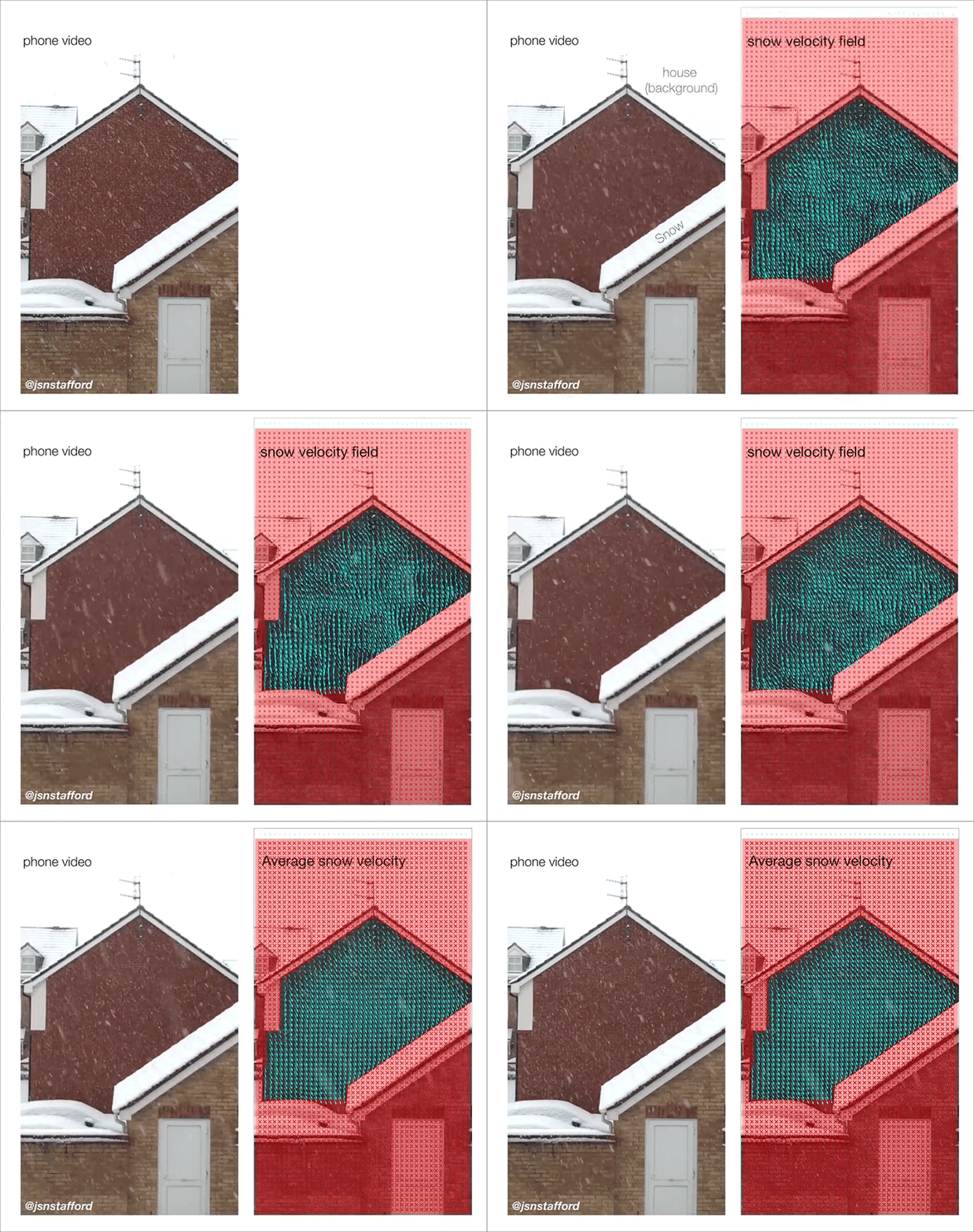
    In our era of remote learning, students don’t always have a chance to do hands-on lab experiments in the usual fashion. But that doesn’t mean they can’t explore important flow diagnostic techniques. Here a simple smartphone video of snow falling gets turned into a lesson on particle image velocimetry, or PIV, a major technique for measuring flow velocities.

    A nearby house acts as a fixed backdrop, and by comparing snowflake positions from one frame to the next, students can measure the instantaneous flow patterns in the snowfall. Of course, that’s a tedious task to do by hand, but luckily there are computer programs that do it automatically. Simply run the smartphone video through the software, and analyze the patterns it reveals!

    As a bonus, students don’t have to get distracted by the complexities of laser sheets and flow seeding that are normally a part of PIV. Instead, the flow and the lighting are already right outside their window, and they can concentrate instead on learning the principles of the technique and how to use the software. (Image and submission credit: J. Stafford)

  • Featured Video Play Icon

    Permeable Pavement

    Controlling storm water is a major challenge in urban environments, where many surfaces are impermeable. In a city, rain cannot simply soak into the ground and filter into the water table. One potential solution is permeable pavement, which uses the same ingredients as its common counterpart minus the sand that usually packs into gaps between the gravel. Without the sand, the final pavement allows water to soak through, as seen above. In practice, the water sinks into a porous reservoir beneath the pavement that helps store and regulate the water’s discharge into the soil.

    Unfortunately, this solution has its limitations. Permeable pavement is not as strong as the regular variety, so it doesn’t work for highly trafficked areas like roadways. It’s also not well-suited to colder areas, where freezing and thawing may disrupt its operation. But it is another tool in engineers’ toolboxes when it comes to keeping urban environments in harmony with nature’s needs. (Image and video credit: Practical Engineering)

  • Oil in Water

    Oil in Water

    In the decade since the Deepwater Horizons oil spill, scientists have been working hard to understand the intricacies of how liquid and gaseous hydrocarbons behave underwater. The high pressures, low temperatures, and varying density of the surrounding ocean water all complicate the situation.

    Released hydrocarbons form a plume made up of oil drops and gas bubbles of many sizes. Large drops and bubbles rise relatively quickly due to their buoyancy, so they remain confined to a relatively small area around the leak. Smaller drops are slower to rise and can instead get picked up by ocean currents, allowing them to spread. The smallest micro-droplets of oil hardly rise at all; instead they remained trapped in the water column, where currents can move them tens to hundreds of kilometers from their point of release. (Image and research credit: M. Boufadel et al.; via AGU Eos; submitted by Kam-Yung Soh)