Tag: bubbles

  • Storing Memory in Bubbles

    Storing Memory in Bubbles

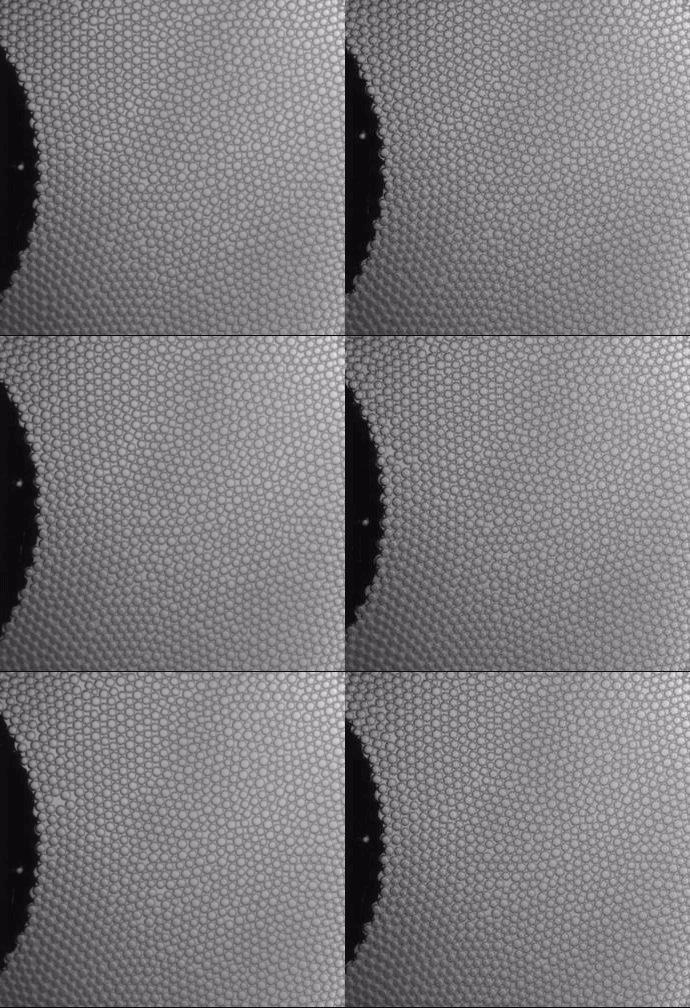
    Soft systems like this bubble raft can retain memory of how they reached their current configuration. Because the bubbles are different sizes, they cannot pack into a crystalline structure, and because they’re too close together to move easily, they cannot reconfigure into their most efficient packing. This leaves the system out of equilibrium, which is key to its memory. 

    By shearing the bubbles between a spinning inner ring (left in image) and a stationary outer one (not shown) several times, researchers found they they could coax the bubbles into a configuration that was unresponsive to further shearing at that amplitude. 

    Once the bubbles were configured, the scientists could sweep through many shear amplitudes and look for the one with the smallest response. This was always the “remembered” shear amplitude. Effectively, the system can record and read out values similar to the way a computer bit does. Bubbles are no replacement for silicon, though. In this case, scientists are more interested in what memory in these systems can teach us about other, similar mechanical systems and how they respond to forces. (Image and research credit: S. Mukherji et al.; via Physics Today; submitted by Kam-Yung Soh)
  • Using Bubbles to Keep Clean

    Using Bubbles to Keep Clean

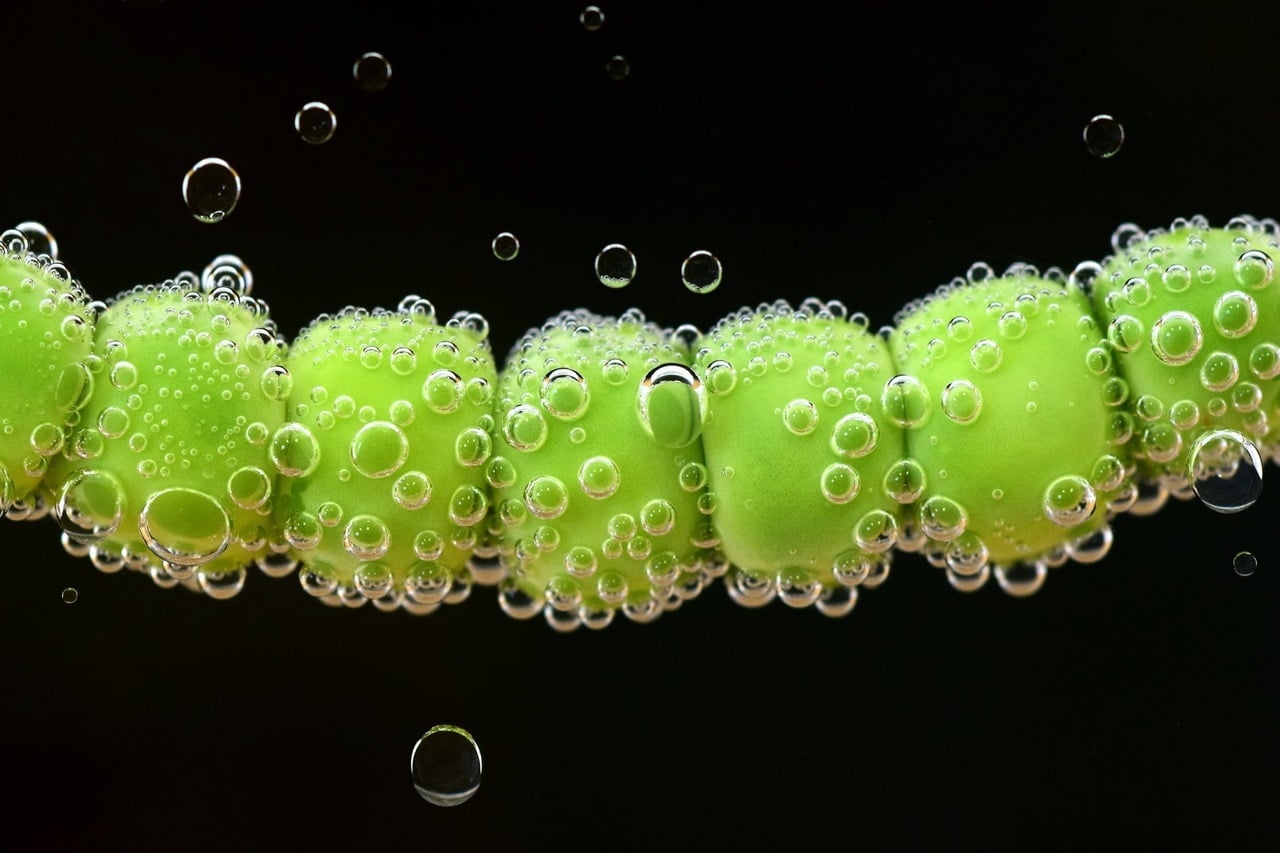
    Keeping produce clean of foodborne pathogens is a serious issue, and delicate fruits and vegetables like tomatoes cannot withstand intense procedures like cavitation-based cleaning. But a new study suggests that simple air bubbles may have the power to keep our produce free of germs.

    In particular, researchers studied air bubbles injected into water as they bounced and slid along an inclined solid surface. They found that as a bubble approaches a tilted surface, it squeezes a thin film of liquid between itself and the surface. That flow creates a shear stress that pushes contaminants like E. coli away from the point of impact. When the bubble bounces away, fluid gets sucked back into the void left behind, creating more shear stress. In their experiments and simulations, the team measured shear stresses greater than 300 Pa, more than double what’s needed to remove foodborne bacteria like Listeria. (Image credit: Pixabay; research credit: E. Esmaili et al.)

  • Bubble Break-Up

    Bubble Break-Up

    When bubbles burst, they spray a myriad of tiny droplets into the air. In general, the older a bubble gets, the thinner it is, thanks to gravity draining its liquid away. When older bubbles burst, they create tinier and more numerous droplets (upper right) compared to a younger bubble (upper left). But there are more forces than just gravity at play.

    Bubbles also undergo evaporation – most effectively at the apex. Evaporation cools the cap of the bubble, increasing its surface tension and triggering a Marangoni flow that helps restore fluid to the bubble film. This stabilizes an aging bubble. 

    Contamination plays a role as well. The bright spots in the bottom image reveal bacteria in the bubble’s cap. Compared to a clean bubble, these contaminated ones can survive far longer and, when burst, produce 10 times as many droplets as a clean bubble of the same age. That has major implications for disease transmission, especially for bacteria that spend a significant portion of their life cycle in liquids. (Image and research credit: S. Poulain and L. Bourouiba; see also Physics Today)

  • Featured Video Play Icon

    Breaking

    As waves fold over and break, they trap air, creating bubbles of many sizes. The smallest of these bubbles can be only a few microns across and persist for long times compared to larger bubbles. When they burst, they create tiny droplets that can carry sea salt up into the atmosphere to seed rain. Understanding how these bubbles form and how many there are of a given size is key to predicting both oceanic and atmospheric behaviors. Numerical simulations like the one featured in the video above reveal the dynamic collisions that create these tiny bubbles and help researchers learn how to model the tiniest bubbles so that future simulations can be faster. (Image and video credit: W. Chan et al.)

  • Foam Collapse

    Foam Collapse

    Introduce the right additive and the bubble arrays in foam will collapse catastrophically. What you see above is high-speed video of a quasi-two-dimensional soap bubble foam collapsing. There are two main mechanisms in the collapse. The first is a propagating mode. When one section of the film breaks, a stream of liquid from the broken film can impact an adjacent section, causing it to break as well. This accounts for much of the breakage you see above.

    The second mode is through penetration by droplets. Watch carefully, and you’ll see that some of the breaking films generate tiny droplets which can fly through the wall of the next cell and impact against the far side. With the right conditions, that impact can trigger a new break along a non-adjacent film. Together, these two mechanisms can destroy foam in the blink of an eye. (Image and research credit: N. Yanagisawa and R. Kurita)

  • Keeping Bubbles Around

    Keeping Bubbles Around

    Bubbles don’t stick around in pure water. Surfactants are needed to stabilize the thin liquid film for longer than the blink of an eye. But that’s not necessarily the case for other liquids. As the video below shows, a bubble in isopropyl alcohol is quite stable. This is because of the alcohol’s volatility – its ability to evaporate easily.

    As the alcohol in the bubble film evaporates, it cools the film, creating a difference in surface tension that pulls fresh alcohol up into the bubble film. It’s so efficient at pulling alcohol up that the alcohol can’t evaporate fast enough to use it all. Once the excess alcohol is heavy enough, it slides back down the side of the bubble. Overall, though, the process is enough to keep a bubble in pure isopropyl alcohol from rupturing for minutes to hours at a time. (Image and video credit: M. Menesses et al.)

  • Finding New Shapes in Foam

    Finding New Shapes in Foam

    In the summer of 2018, a group of researchers announced they’d discovered a new geometrical shape, the scutoid. They found the scutoid, a sort of twisted prism, in the shape of epithelial cells packed between curved surfaces. Having heard of this new geometry, a different group of physicists wondered if they could find scutoids elsewhere, specifically, in the cells of a foam. As shown in the picture above, they did.

    To visualize a scutoid, first image a prism. Take two polygons with an equal number of sides and connect them. But if you imagine packing such prisms between two curved surfaces, you’ll quickly see that it won’t work. They just don’t fit together. Instead, one face may adopt, say, six sides, while the other takes on five. To join those two end faces, one of the sides will have to have a Y-shaped junction and a triangular face. This is a scutoid.

    You can see two such shapes in the image above. In the left bubble, the far side forms a pentagon, while the near face is a hexagon. On the right, the bubble has six faces in the background and eight in the foreground. And between them, you can just see the triangular face that connects the two scutoids.

    It’s not only exciting to find scutoids in a new, non-biological medium; it suggests a physical mechanism behind their formation. Foams are a well-known example of energy minimization. The fact that scutoids are found in a curved foam suggests that the shape itself is connected to energy minimization, something that could help us understand how biological scutoids grow and form. (Image and research credit: A. Mughal et al.; via Physics World; submitted by Kam-Yung Soh)

  • Sniffing Underwater

    Sniffing Underwater

    Star-nosed moles – tiny mammals native to the northeastern United States – have an underwater superpower: sniffing. To seek prey underwater, the moles blow bubbles and suck them back into their nostrils in about a tenth of a second. Their eponymous noses seem to be key to this, as seen in newly published research. Researchers built model star noses from plastic (lower right) to explore how well different shapes could hold the bubble in place, a necessary ingredient for the mole to sniff them back up. 

    With a perfectly flat plate, any small tilt makes the bubble slide toward the edge and float away. Star-shaped ones, on the other hand, can hold a bubble even up to a 7-degree tilt angle, a 40% improvement. The spacing of the gaps is also important. If they’re too wide, buoyancy can pull the bubble up through them. But if they’re too narrow for the bubble to deform upward through them, they make poor anchors. 

    Understanding the mechanics of underwater sniffing is good for more than just appreciating this funny-looking mammal, though. The researchers hope their findings will help develop underwater chemical sensors that use bubble sniffing instead of exposing their components directly to sea water, which would significantly extend their usable life. For more, check out the paper and my interview with the lead author in the video below. (Image credits: top and lower left – K. Catania; lower right – A. Lee; research credit: A. Lee and D. Hu; video credit: N. Sharp and T. Crawford)

  • Waves

    Waves

    Photographer Ray Collins is known for his striking portraits of waves, some of which I’ve featured on previous occasions. Collins is colorblind, so he focuses heavily on shape and texture in the wave, which produces some stunningly dramatic views of moving water frozen in time. There’s great power and beauty in breaking waves, and researchers are still actively learning just how significant they are to our planet’s cycles. 

    Note the spray blurring the edges of every wave here; these are some of the largest droplets the wave will make. As it crashes forward, the wave traps pockets of air, and, as those bubbles burst, they will create a spray of tinier droplets that carry moisture and salt into the atmosphere to seed clouds and, eventually, rain.

    Collins’ work reminds us both of the ocean’s power and its fragility as it undergoes rapid changes due to humanity’s influence. For more photos as well as a great interview with Collins, check out My Modern Met. (Image credit: R. Collins; via My Modern Met and James H.)

  • “Ice Formations”

    “Ice Formations”

    As perfect as ice can appear, it always starts with a defect. Without a speck of dust or soot to act as a seed, supercooled water simply will not freeze. But these imperfections can lead to beauty. In “Ice Formations,” photographer Ryota Kajita captures some of the oddities of ice in Alaska’s interior swamps and ponds. In Kajita’s images bubbles are frozen in suspension, plates of ice form strange shapes, and star-shaped cracks peek through the snow. Whether the ice formed too quickly or too slowly, there are interesting signatures left behind. See the full set of images, spanning the last eight years, here. (Image credit: R. Kajita; via Colossal)