Tag: bubbles

  • Impressionist Foams

    Impressionist Foams

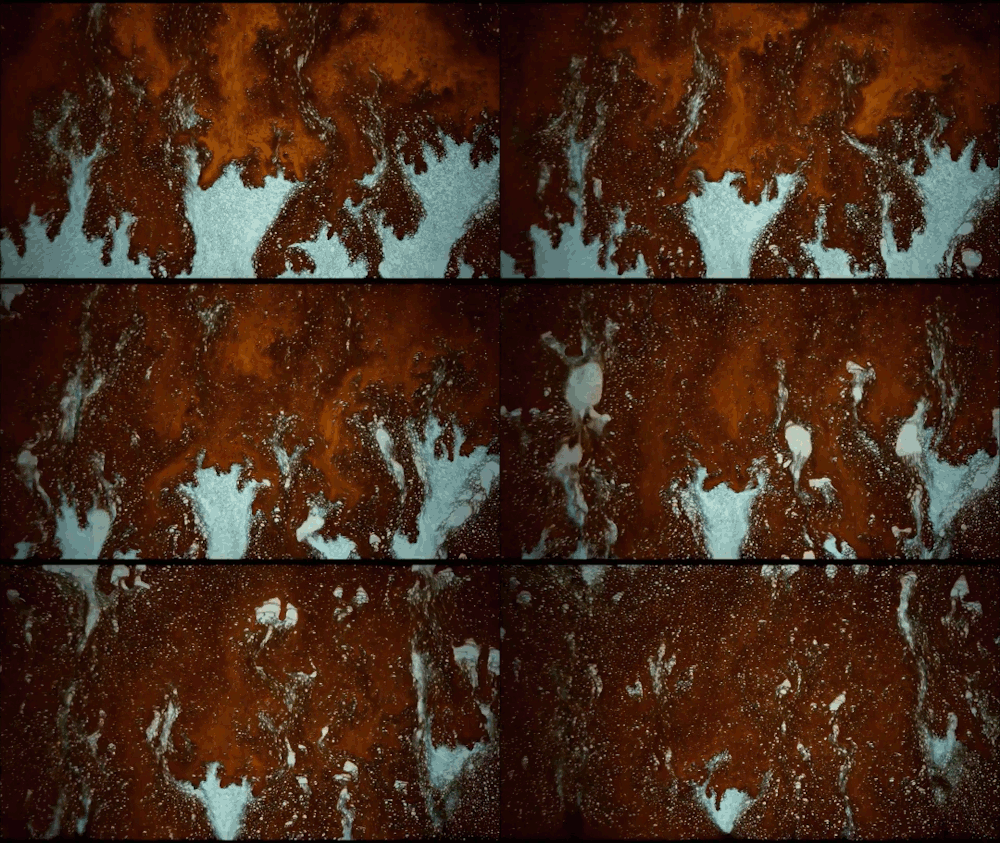
    Imagine taking two panes of glass and setting them in a frame with a small gap between them. Then partially fill the gap with a mixture of dye, glycerol, water, and soap. After turning the frame over several times, the half of the frame will be filled with foamy bubbles. When you flip it again, the dyed glycerol-water will sink and penetrate the bubble layer, creating complex and beautiful patterns as it mixes. Some of the bubbles may get squeezed together until they coalesce into larger bubbles that shoot upward thanks to their increased buoyancy. Other smaller bubbles will wend their way upward as neighboring fluid shifts. If you examine the tracks left by individual bubbles, you can find patterns reminiscent of Impressionist paintings, as seen at the end of this Gallery of Fluid Motion video. (Image credit: A. Al Brahim et al., source)

  • Bubble Trains in a Microchannel

    Bubble Trains in a Microchannel

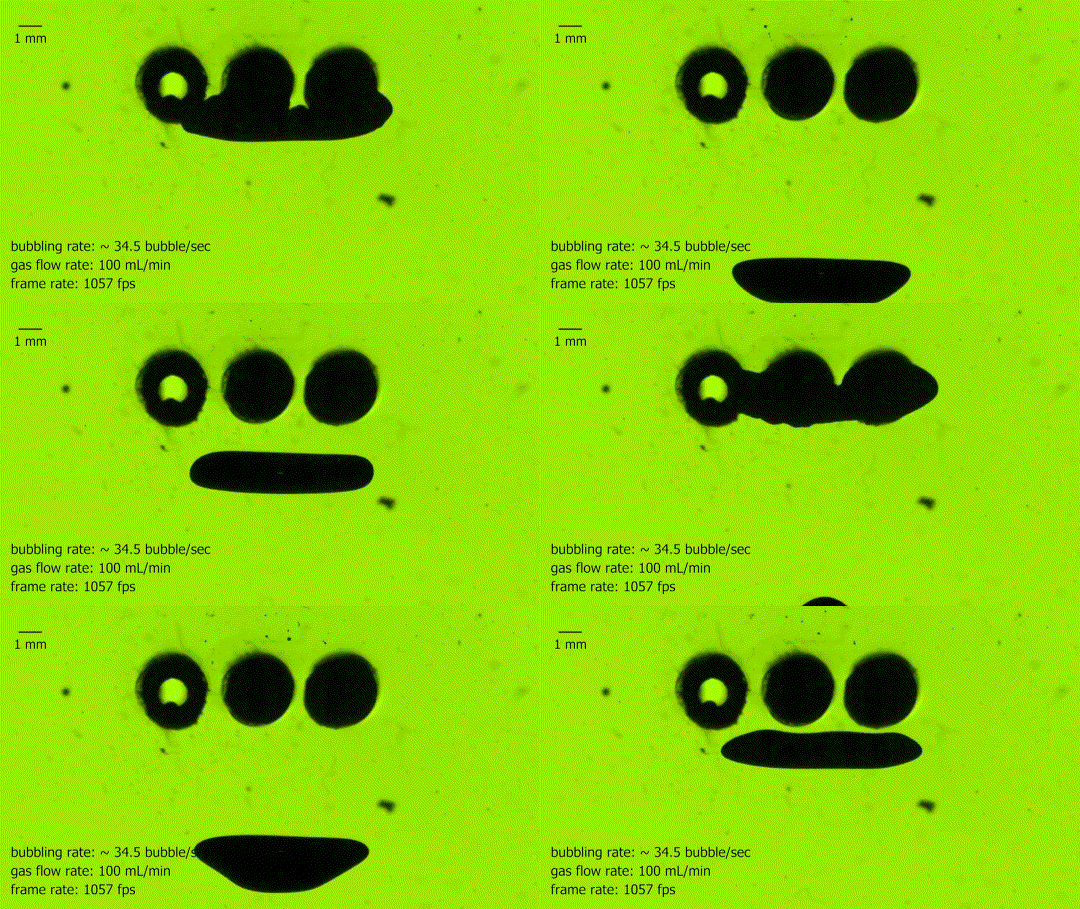
    Trains of bubbles flowing through a microchannel get distorted by periodic expansions and constrictions. In these images, flow is from left to right, and the narrow point of the channel is about 250 microns across. In narrow regions, the front of the bubble tends to move faster, while in wider areas, the back of the bubble speeds up. This causes the distinctive shape changes we see. Microfluidic channels with these exaggerated shifts in geometry allow researchers to study the physics behind liquids and gases seeping through the interstitial gaps of a porous media, like when water and gases move through rock and soil. (Image and research credit: M. Sauzade and T. Cubaud)

  • What Makes Joints Pop?

    What Makes Joints Pop?

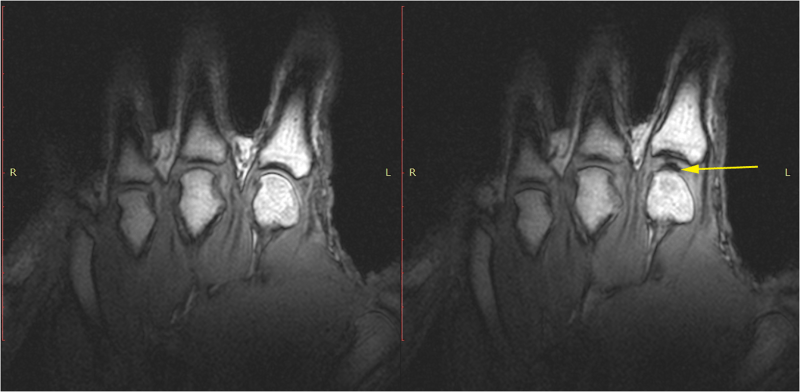
    Cracking one’s knuckles produces an unmistakable popping noise that satisfies some and disconcerts others. The question of what exactly causes the popping noise has persisted for more than fifty years. It’s generally agreed that separating the two sides of a joint causes low enough pressures to form a cavitation bubble in the sinovial fluid of the joint. But researchers have been divided on whether it’s the formation or the collapse of this bubble that’s responsible for the sound. Studying the phenomenon firsthand is difficult with today’s imaging technologies – none of them are fast enough to capture a behavior that takes only 300 milliseconds. As a result, scientists are turning to mathematical modeling and numerical simulation.

    A recent study tackled the problem by modeling a joint that already contains a bubble and examining the bubble’s response to changes in pressure inside the joint. The pressure changes alter the bubble’s size and cause it to generate sound. When compared to experiments of people cracking their knuckles, the simulated sounds are remarkably similar in both amplitude and frequency. It’s not even necessary for the bubble to collapse completely to make the noise. Just a partial collapse is enough to sound just like that old, familiar pop. (Image credit: G. Kawchuk et al.; research credit: V. Chandran Suja and A. Barakat; via Gizmodo)

  • Absorbing Bubbles

    Absorbing Bubbles

    This is a bubble absorber. It’s formed from an array of three springs, seen end-on in the upper center, each of which is coated to make it superhydrophobic. The hollow interior of the springs is filled with air and ventilated to the atmosphere. As bubbles rise through the water, they contact the springs and readily coalesce with the interior gas. In the blink of an eye, the large bubble is almost completely absorbed into the thin air film that clings to the springs. Superhydrophobic arrays like these may be useful in power and life support systems that need to separate liquid and gas phases under low-gravity conditions. (Image credit: N. Pour and D. Thiessen, source)

  • Featured Video Play Icon

    Skiing, Avalanches, and Freezing Bubbles

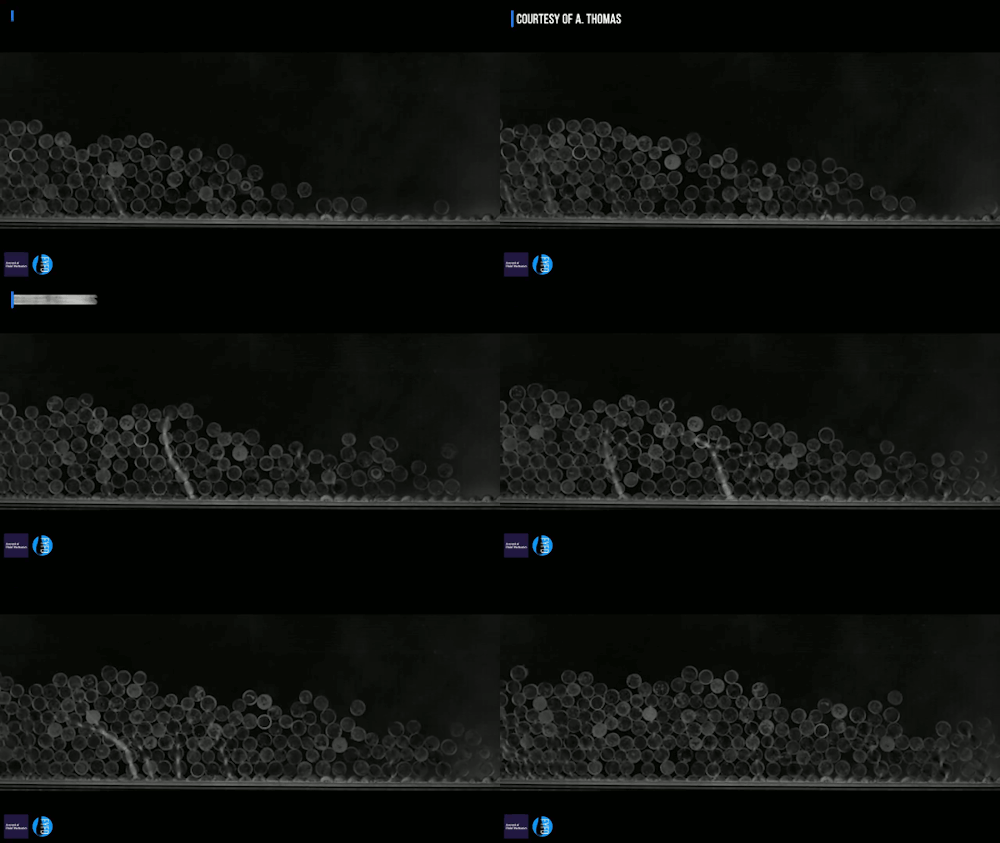
    To wrap up our look at Olympic physics, we bring you a wintry mix of interviews with researchers, courtesy of JFM and FYFD. Learn about the research that helped French biathlete Martin Fourcade leave PyeongChang with 3 gold medals, the physics of avalanches, and how bubbles freeze. 

    If you missed any of our previous Olympic coverage, you can find our previous entries on the themed series page, and for more great interviews with fluids researchers, check out our previous collab video. (Video credit: T. Crawford and N. Sharp; image credits: GettyImages, T. Crawford and N. Sharp)

  • Bubbles Sliding

    Bubbles Sliding

    Two-phase flows involve more than one state of matter – in this case, both gas and liquid phases. Flows like this are common, especially in applications involving heat transfer. In some heat exchangers, bubbles will rise and then slide along an inclined surface, as shown above. The motion of these bubbles is a complicated interplay between the surface, the bubble, and the surrounding fluid. The bubble’s wake, visualized here using schlieren imaging, is unsteady and turbulent. Although the bubble oscillates in its path, the wake spreads even wider, and its turbulence stirs up the liquid nearby, increasing the heat transfer. (Image and research credit: R. O’Reilly Meehan et al., source)

  • Cavitating Inside a Tube

    Cavitating Inside a Tube

    Cavitation – the formation and collapse of low-pressure bubbles in a liquid – can be highly destructive, shattering containers, stunning prey, and damaging machinery. Inside an enclosure, cavitation can happen repeatedly. Above, a spark is used to generate an initial cavitation bubble, which expands on the right side of the screen. After its maximum expansion, the bubble collapses, forming jets on either end that collide as the bubble shrinks. Shock waves form during the collapse, too, although in this case, they are not visible.

    Those shock waves travel to either end of the tube, where they reflect. The reflected waves behave differently; they are now expansion waves rather than shock waves. Their passage causes lower pressure. The two expansion waves meet one another toward the left end of the tube, in the area where a cloud of secondary cavitation bubbles form after the first bubble collapses. Pressure waves continue to reflect back and forth in the tube, causing the leftover clouds of tiny bubbles to expand and contract. (Image credit: C. Ji et al., source)

  • Galapagos Week: Pistol Shrimp

    Galapagos Week: Pistol Shrimp

    One of the most striking things about snorkeling in the Galapagos was how loud it was underwater. There were hardly any boats nearby, but every time my ears dipped below the surface, I could hear a constant cacophony of sound. Some it came from waves against the sand, some of it was the sound of parrotfish nibbling on coral, but a lot of it was likely the work of a culprit I couldn’t see hidden in the sand: the pistol shrimp.

    These small crustaceans hunt with an oversized claw capable of snapping shut at around 100 kph. When the two halves of the claw come together, they push out a high-speed jet of water. High velocity means low pressure – a low enough pressure, in fact, to drop nearby water below its vapor pressure, causing bubbles to form and expand. These cavitation bubbles collapse quickly under the hydrostatic pressure of the surrounding water, creating a distinctive pop that makes the pistol shrimp one of the loudest sea creatures around. (Image credit: BBC Earth Unplugged, source; research credit: M. Versluis et al.)

    All week we’re celebrating the Galapagos Islands here on FYFD. Check out previous posts in the series here.

  • Tightrope Walkair

    Tightrope Walkair

    A bubble rising through water can get caught on an aerophilic (air-attracting) fiber. The bubble will then adhere to the fiber and be guided to the surface by it. In the poster above, the image is a composite photo of such a bubble every 40 milliseconds. Once captured by the fiber, the bubble first accelerates and then reaches a terminal velocity, indicated by the equal spacing of the bubble photos toward the right end of the picture. The terminal velocity strikes a balance between buoyancy, which pulls the bubble upward, and skin friction between the bubble and the water, which acts like drag on the bubble. At the terminal velocity, these forces are equal; neither is able to speed up or slow down the bubble. (Image credit: H. de Maleprade et al.)

  • Sorting by Bubble

    Sorting by Bubble

    Microfluidic devices, also known as labs-on-a-chip, require clever techniques for processes like sorting particles by size. One such technique uses an oscillating bubble to sort particles. When the bubble vibrates back and forth (left) it creates what’s known as a streaming flow – large regions of recirculation (shown as gray ellipses in the right image). If the bubble is placed inside a channel, we say that two flows have been superposed; the device combines both the left-to-right flow of the channel and the recirculating streaming flow.

    Introduce a micron-sized particle into this combined flow, and it will get carried to the bubble and then bounced around by its effects (left). In fact, the larger the particle is, the more the bubble deflects it relative to the flow. You can see this in the image on the right as well. Here the frame rate has been matched to the bubble’s vibration, so the bubble appears stationary, and the particle paths look smooth. The gray lines show the fluid’s path, and individual solid particles are introduced at the left. The largest particle gets strongly deflected as it passes the bubble and exits at the top-right. A fainter, smaller particle follows after it. Being smaller, the bubble’s deflection on it is weaker, and this second particle exits along a path to the center-right. The result is a fast and simple method for particle sorting. (Image and research credit: R. Thameem et al., source)