Tag: bubbles

  • To Beat Surface Tension, Tadpoles Make Bubbles

    To Beat Surface Tension, Tadpoles Make Bubbles

    For tiny creatures, surface tension is a formidable barrier. Newborn tadpoles are much too small and weak to breach the air-water surface in order to breathe. Researchers found that, instead, the 3 millimeter creatures place their mouths against the surface, expand their mouth to generate suction, and swallow a bubble consisting largely of fresh air.

    When they’re especially small, some of these species are essentially transparent (Image 1), allowing researchers to see the bubble directly. But even as the tadpoles aged (Images 2 and 3) and grew strong enough to breach the surface, they observed many instances in which the tadpoles continued this bubble-sucking method to breathe. (Image and research credit: K. Schwenk and J. Phillips; via Cosmos; submitted by Kam-Yung Soh)

  • Featured Video Play Icon

    A Dance of Hydrogen Bubbles

    Hydrogen bubbles rise off zinc submerged in hydrocholoric acid in this short film from the Beauty of Science team. In high-speed video, the rise of the bubbles is stately and mesmerizing. Notice how the smallest bubbles appear as perfect spheres; for them, surface tension is strong enough to maintain that spherical shape even against the viscous drag of their buoyant rise. Larger bubbles, formed from mergers both seen and unseen, have a harder time staying round. In them, surface tension must battle gravitational forces and drag from the surrounding fluid. (Image and video credit: Beauty of Science; via Laughing Squid)

  • The Best of FYFD 2019

    The Best of FYFD 2019

    2019 was an even busier year than last year! I spent nearly two whole months traveling for business, gave 13 invited talks and workshops, and produced three FYFD videos. I also published more than 250 blog posts and migrated all 2400+ of them to a new site. And, according to you, here are the top 10 FYFD posts of the year:

    1. The perfect conditions make birdsong visible
    2. Pigeons are impressive fliers
    3. The water anole’s clever method of breathing underwater
    4. 100 years ago, Boston was flooded with molasses
    5. The BZ reaction is some of nature’s most beautiful chemistry
    6. The labyrinthine dance of ferrofluid
    7. 360-degree splashes
    8. The extraordinary flight of dandelion seeds
    9. Dye shows what happens beneath a wave
    10. Bees do the wave to frighten off predators

    Nature makes a strong showing in this year’s top posts with five biophysics topics. FYFD videos also had a good year: both my Boston Molasses Flood video and dandelion flight video made the top 10!

    If you’d like to see more great posts like these, please remember that FYFD is primarily supported by readers like you. You can help support the site by becoming a patronmaking a one-time donation, or buying some merch. Happy New Year!

    (Image credits: birdsong – K. Swoboda; pigeon take-off – BBC Earth; water anole – L. Swierk; Boston molasses flood – Boston Public Library; BZ reaction – Beauty of Science; ferrofluid – M. Zahn and C. Lorenz; splashes – Macro Room; dandelion – N. Sharp; dyed wave – S. Morris; bees – Beekeeping International)

  • Behind the Bubbly

    Behind the Bubbly

    Carbonation and the fizzy bubbles that come with it are surprisingly popular among humans. Through fermentation or artificial introduction, carbon dioxide gas gets dissolved into a liquid under high pressure. Then, when the pressure is released to atmospheric levels, that gas comes out of solution, forming tiny bubbles that eventually grow large enough to rise buoyantly to the surface. There they will either pop – releasing carbon dioxide gas and aromatics – or form a layer of foam – like in beer – that insulates the liquid and makes it harder to spill. (Image credit: D. Cook; see also R. Zenit and J. RodríguezRodríguez; via Jennifer O.)

  • Featured Video Play Icon

    Blowing Vortex Rings from Bubbles

    When bubbles burst, we often pay attention to the retracting film and forming droplets, but what happens to the air that was inside? By placing a little smoke inside them, we can see. The air inside these bubbles is slightly pressurized compared to the ambient, and as such a bubble ruptures, its air gets pushed out the expanding hole. That momentum makes the air curl as it forces its way into the surrounding air, creating a stack of vortex rings. The researchers observed as many as six stacked vortices from bubbles just under 4 cm in diameter. (Image and research credit: A. Dasouqi and D. Murphy; video credit: Science; see also A. Dasouqi and D. Murphy)

  • Whale Feeding

    Whale Feeding

    Whether in groups or as individuals, humpback whales are canny hunters. They herd prey together by encircling them and releasing bubbles that form a “net” that bars escape. Then, the whales lunge through the center with open mouths, gathering prey. Scientists have long wondered whether humpbacks’ unusually long pectoral fins played any role in their hunting. New drone observations of whales feeding (see video below) are beginning to provide some hints.

    The scientific teams observed multiple individual whales feeding under the same circumstances and found that the whales used their fins quite differently. Both used them as additional barriers to prevent prey from escaping, but one whale favored a horizontal fin position that created currents that helped sweep prey into its mouth. The other whale used a more vertical fin position that, while hydrodynamically unfavorable, exposed its bright underside, which seemed to startle prey into fleeing into its darker, more inviting mouth. (Image credit: K. Kosma; video credit: M. Kosma; research credit: M. Kosma et al.; via Science)

  • Boiling in Microgravity

    Boiling in Microgravity

    In the playground of microgravity, every day processes can behave much differently. This photo comes from the RUBI experiment, the Reference mUltiscale Boiling Investigation, aboard the International Space Station. Freshly installed and switched on, the apparatus is now generating bubbles like this one. On the left, you see temperature sensors used to measure bubble temperatures. High-speed and infrared cameras are also part of the experiment.

    The advantage of studying boiling in space is a lack of gravity that can mask or overwhelm subtler effects. It effectively slows down the process, making it easier to observe. And since boiling is such an important part of heat transfer in many manmade devices, it shows us how we have to adapt when operating in an environment where heat – and bubbles – don’t automatically rise. (Image credit: ESA; submitted by Kam-Yung Soh)

  • Superheating

    Superheating

    Being hot isn’t always enough to make water boil. To form vapor bubbles, water and other liquids need imperfections that serve as seeds. In the absence of these, the liquid can become superheated, reaching temperatures higher than its boiling point without forming bubbles. Superheated water can be quite dangerous because it appears to be cooler, but once it’s disturbed – thereby breaking its surface tension – vapor bubbles form rapidly and explosively. You can see in the animation above just how quickly and unsteadily a sudden vapor bubble expands as it rises to the surface. (Image credit: C. Kalelkar and K. Raj, source)

  • Cavitation Collapse

    Cavitation Collapse

    The collapse of a bubble underwater doesn’t seem like a very important matter, but when it happens near a solid surface, like part of a ship, it can be incredibly destructive. This video, featuring numerical simulations of the bubble’s collapse, shows why. 

    When near a surface, the bubble’s collapse is asymmetric, and this asymmetry creates a powerful jet that pushes through the bubble and impacts the opposite side. That impact generates a shock wave that travels out toward the wall. As the bubble hits its minimum volume, a second shock front is generated. Both shock waves travel toward the wall and reflect off it, generating high pressure all along the surface. (Image and video credit: S. Beig and E. Johnson)

  • Jets from Lasers

    Jets from Lasers

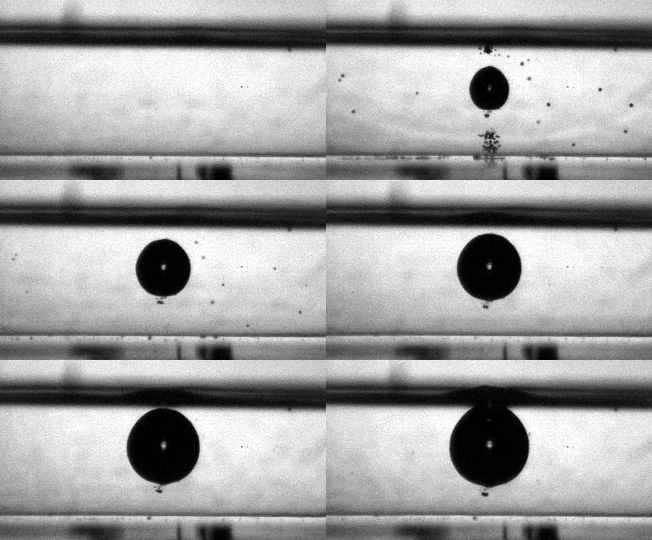
    Laser-induced forward transfer (LIFT) is an industrial printing technique where a laser pulse aimed at a thin layer of ink creates a tiny jet that deposits the ink on a surface. In practice, the technique is plagued with reproducibility issues, in part because it’s difficult to produce only a single cavitation bubble when aiming a laser at the liquid layer. This is what we see above. 

    The laser pulse creates its initial bubble just above the middle of the liquid layer. Shock waves expand from that first bubble and quickly reflect off the liquid surface (top) and wall (bottom). When reflected, the shock waves become rarefaction waves, which reduce the pressure rather than increasing it. This helps trigger the clouds of tiny bubbles we see above and below the main bubble. 

    The effect is worst along the path of the laser pulse because that part of the liquid has been weakened by pre-heating, but impurities and dissolved gases in the liquid layer are also prone to bubble formation, as seen far from the bubble. The trouble with all these unintended bubbles is that they can easily rise to the surface, burst, and cause additional jets of ink that splatter where users don’t intend. (Image and research credit: M. Jalaal et al.; submitted by Maziyar J.)