Sand dunes form with a gentle incline facing the wind and a steeper slip face pointing away from the wind. Most slip faces are angled at about 30 to 34 degrees–called the angle of repose. The shape is determined by the dune’s ability to support its own weight; add more sand and it will cascade down the slip face in a miniature avalanche. Similarly, if you disturb sand on the slip face by digging a hole at the base, you get the cascading collapse seen in this video. By removing sand, the dune’s equilibrium is broken and it can no longer support its weight. This makes sand flow down the slip face until enough is shifted that the dune can support itself. Being a granular material, the sand itself appears to flow much like a fluid, with waves, ripples and all. (Video credit: M. Meier; submitted by Boris M.)
Search results for: “waves”
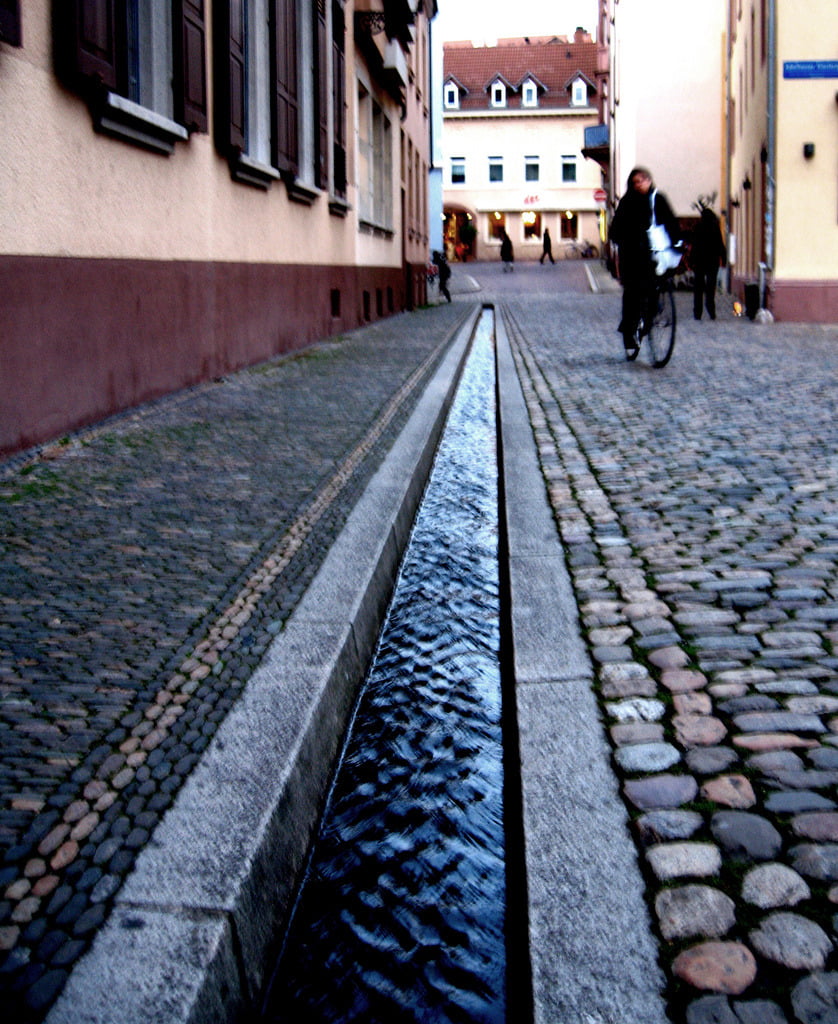
Reader Question: Rippling Runoff

Reader junolivi asks:
When shallow water (like runoff from melting snow) flows across pavement, it creates small repeated wave-like ripples. What creates that texture and why isn’t it just a steady flow?
This is a great question that’s probably crossed the mind of anyone who’s seen water running down the gutter of a street after a storm. The short answer is that this gravity-driven flow is becoming unstable.
Fluid dynamicists often like to characterize flows into two main types: laminar and turbulent. Most flows in nature are turbulent, like the wild swirls you see behind cars driving in the rain. But there are laminar flows in nature as well. Often flows that begin as laminar will become turbulent. This happens because those laminar flows are unstable to disturbances.
The classic example of stability is a ball on a hill. If the ball is at the top of the hill and you disturb it, it will roll down the hill because its original position was unstable. If, on the other hand, the ball is in a depression, then you can prod the ball and it will eventually settle back down into its original place because that position was stable. Another way of looking at it is that, in the unstable case, the disturbance–how far the ball is from its original position–grows uncontrollably. In the stable case, on the other hand, the disturbance can be initially large but eventually decays away to nothing.
There are many ways to disturb a laminar flow–surface roughness, vibrations, curvature, noise, etc., etc. These disturbances enter the flow and they can either grow (and become unstable) or decay (because the flow is stable to the disturbance). Just as one can look at the stability of a pendulum, one can mathematically examine the stability of a fluid flow. When one does this for water flowing down an incline, one finds that the flow is quite unstable, even in the ideal case of a pure, inviscid fluid flowing down a smooth wall.
The reason that one sees distinctive waves with a particular wavelength (assuming that they aren’t caused by local obstructions) is directly related to this idea of instability. Essentially, the waves are the disturbance, having grown large enough to see. One could imagine that any wavelength disturbance is possible in a flow, but mathematically, what one finds, is that different wavelengths have different growth rates associated with them. The wavelength we observe is the most unstable wavelength in the flow. This is the wavelength that grows so much quicker than the others that it just overwhelms them and trips the flow to turbulence. This is very common. For example, you can see distinctive waves showing up before the flow goes turbulent in both this mixing layer simulation and this boundary layer flow.
(Image credits: anataman, mo_cosmo; also special thanks to Garth G. who originally asked a similar question via email)

Below a Surfer’s Wave
From below a plunging breaking wave–the classic surfer’s wave–looks like a giant vortex tube. Smaller rib vortices, the rings around the main vortex in the photo above, can form where there are variations along the breaking wave. As the wave rolls on, it stretches the vorticity variations along the wave’s span. When stretched, vortices spin up and intensify; this is a result of conservation of angular momentum. Check out more amazing photos of waves in Ray Collins’ portfolio. (Photo credit: R. Collins; via The Inertia)

Swimming Through Sand
Shovel-nosed snakes and sandfish lizards both swim through granular materials like sand. Researchers at Georgia Tech used x-rays to observe their subsurface motions. Despite their different shapes, the long, slender snake and the shorter, wider lizard both move under the sand by projecting traveling waves along their bodies. The snake’s long, skinny body allows it to have more bends along its length, which increases its transport efficiency because it allows the snake to move mostly through the tunnel created by its head’s passage. In contrast, the sandfish’s motions fluidize the sand around it, enabling it to swim. Although the snake is faster, both animals have optimized their motions for fast, low-energy transit according to their body type. (Video credit: Georgia Tech; research credit: S. Sharpe et al.; via io9)
Simplified Schlieren Set-up
Schlieren photography offers a glimpse into flows that are usually invisible to the human eye. With a relatively simple set-up–a light source, collimating mirror(s), and a razor blade–it becomes possible to see differences in density. The technique lets one visualize temperature-driven flows like the buoyant convection from a flame or other heat source, and it can also be used to visualize shock waves and sound. The video above has several neat schlieren demos, including some non-air examples using hydrogen (lighter than air) and sulfur hexafluoride (denser than air), both of which are transparent to the naked eye. (Video credit: Harvard University, via Jennifer Ouellette)

Sound Interactions


Sound waves often interact with many objects before we hear them. Understanding and controlling those interactions is a major part of acoustic engineering. The animations above show shock waves–sound–from a trumpet interacting with different objects. The sound is made visible using the schlieren optical technique, allowing us to observe the reflection, absorption, and transmission of sound as it hits different surfaces. Fiberboard, for example, is highly reflective, redirecting the sound waves along a new path without a lot of damping. In contrast, the metal grid is only weakly reflective and a small portion of the incoming sound wave is transmitted through the grid. To see more examples, check out the full video, and, if you want to learn more about acoustics, check out Listen To This Noise. (Image credits: C. Echeverria et al., source video)

Wave Clouds

Coming home from APS DFD, I looked out the window as we flew east over the last of the Rockies and caught these wave clouds. Air flowing west to east gets disturbed by the mountains, which creates internal waves in the atmosphere. Generally, these are invisible–though they can cause some of the turbulence you feel when flying. In this case, water vapor has condensed at the crests of the internal waves, creating a pattern of cloudy and clear stripes to mark the waves. The internal waves damped out by the time we flew a couple hundred miles east of Denver, but for awhile conditions were just right. (Photo credit: N. Sharp)
“Cymatics”
Nigel Stanford’s new “Cymatics” music video is full of stunning science-inspired visuals. The entire video is set up around various science demos–many of which will be familiar to readers–that translate sound or vibration into visual elements. The video uses ferrofluids, vibrates vodka on a speaker to create Faraday waves, and visualizes resonant sound waves with a Rubens’ tube. I don’t want to give away all the awesome effects, so watch it for yourself, and then check out their behind-the-scenes page where they talk about how they created each effect. (Video credit: N. Stanford; submitted by buckitdrop)
Also, today is the final day of voting for the Vizzies, an NSF-sponsored contest for the best science and engineering visuals. Head over to their website to check out the finalists and choose your favorites!
The Hidden Complexities of the Simple Match
Striking a match and blowing it out seems rather simple to the naked eye. But with high-speed video and schlieren photography, the act takes on new complexity. Schlieren photography is an optical technique that is incredibly sensitive to changes in density, which makes it a prime choice for visualizing flows with temperatures variations or shock waves. Here it shows the hot gases generated as the match is lit. Once the match ignites, the flow calms somewhat into a gently rising plume of exhaust and hot air. When someone enters the frame to blow out the match, the frame rate increases to capture what happens next. The flow field around the match becomes very complex as the air and flame interact. The range of length scales in the flow increases, from scales of several centimeters down to those less than a millimeter. This complexity and range of sizes is a hallmark of turbulence. (Video credit: V. Miller et al.)

Kelvin-Helmholtz Clouds
When differing layers of fluid move past one another, friction between them causes shear. This shear quickly transforms a simple flat interface between fluid layers into a wavy unstable boundary that resembles a series of breaking ocean waves. This effect is known as the Kelvin-Helmholtz (KH) instability. In the atmosphere, this instability causes air layers with differing temperatures and moisture content to form wave-like clouds where the two layers meet. Other examples of the effect are widespread. On earth, many ocean waves are generated by wind shearing the water; elsewhere in our solar system, the cloud bands of Jupiter are lined with spinning eddies from the KH instability. (Photo credit: H. Bondo)