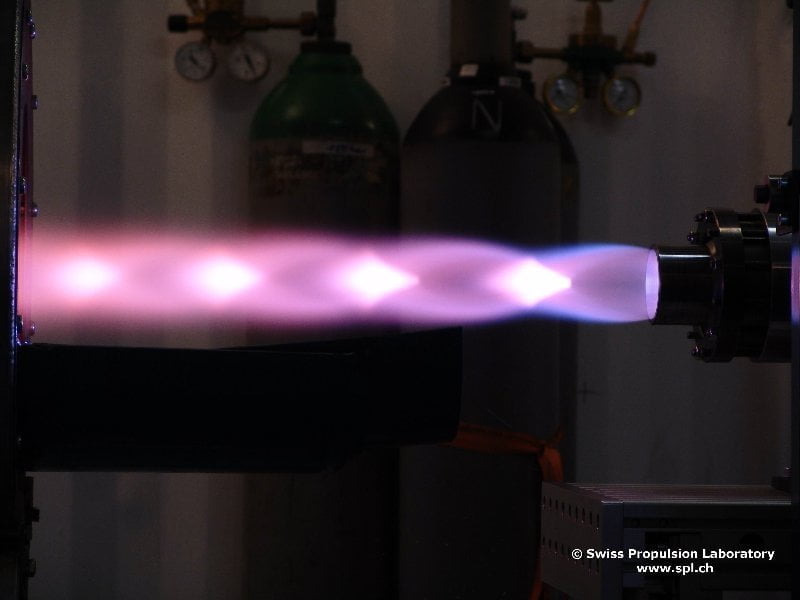
Rocket engines often feature a distinctive pattern of diamonds in their exhaust. These shock diamonds, also known as Mach diamonds, are formed as result of a pressure imbalance between the exhaust and the surrounding air. Because the exhaust gases are moving at supersonic speeds, changing their pressure requires a shock wave (to increase pressure) or an expansion fan (to decrease the pressure). The diamonds are a series of both shock waves and expansion fans that gradually change the exhaust’s pressure until it matches that of the surrounding air. This effect is not always visible to the naked eye, though. We see the glowing diamonds as a result of ignition of excess fuel in the exhaust. As neat as they are to see, visible shock diamonds are actually an indication of inefficiencies in the rocket: first because the exhaust is over- or under-pressurized, and, second, because combustion inside the engine is incomplete. (Photo credit: Swiss Propulsion Laboratory)
Search results for: “waves”

Wave Tank
A new wave tank facility opening at the University of Edinburgh promises new capabilities to simulate ocean wave behavior. The circular 25m diameter wave tank is lined with 168 wave makers and is equipped with 28 submerged flow-drive units. Together, these allow the tank to simultaneously simulate nearly any wave type as well as tidal currents up to 1.6 m/s. The facility is intended for 1/20th scale modeling; projected to full-size, this means that the tank is capable of making waves representative of 28 m high ocean waves and tidal currents in excess of 12 knots. It’s expected to be particularly valuable in the development and testing of wave and tidal motion generators for clean energy. For more, see BBC News and FloWave’s own website. (Image credit: Brightspace/BBC News; submitted by srikard)

Kelvin-Helmholtz in the Lab
The Kelvin-Helmholtz instability looks like a series of overturning ocean waves and occurs between layers of fluids undergoing shear. This video has a great lab demo of the phenomenon, including the set-up prior to execution. When the tank is tilted, the denser dyed salt water flows left while the fresh water flows to the right. These opposing flow directions shear the interface between the two fluids, which, once a certain velocity is surpassed, generates an instability in the interface. Initially, this disturbance is much too small to be seen, but it grows at an exponential rate. This is why nothing appears to happen for many seconds after the tilt before the interface suddenly deforms, overturns, and mixes. In actuality, the unstable perturbation is present almost immediately after the tilt, but it takes time for the tiny disturbance to grow. The Kelvin-Helmholtz instability is often seen in clouds, both on Earth and on other planets, and it is also responsible for the shape of ocean waves. (Video credit: M. Hallworth and G. Worster)

Space Balls (of Water!)
The microgravity environment of space is an excellent place to investigate fluid properties. In particular, surface tension and capillary action appear more dramatic in space because gravitational effects are not around to overwhelm them. In this animation, astronaut Don Petit injects a jet of air into a large sphere of water. Some of the water’s reaction is similar to what occurs on Earth when a drop falls into a pool; the jet of air creates a cavity in the water, which quickly inverts into an outward-moving jet of water. In this case, the jet is energetic enough to eject a large droplet. Meanwhile, the momentum, or inertia, from the air jet and subsequent ejection causes a series of waves to jostle the water sphere back and forth. Surface tension is strong enough to keep the water sphere intact, and eventually surface tension and viscosity inside the sphere will damp out the oscillations. You can see the video in full here. (Image credit: Don Petit/Science off the Sphere)
Rubens’ Table
Veritasium’s new video has an awesome demonstration featuring acoustics, standing waves, and combustion. It’s a two-dimensional take on the classic Rubens’ tube concept in which flammable gas is introduced into a chamber with a series of holes drilled across the top. Igniting the gas produces an array of flames, which is not especially interesting in itself, until a sound is added. When a note is played in the tube, the gas inside vibrates and, with the right geometry and frequency, can resonate, forming standing waves. The motion of the gas and the shape of the acoustic waves is visible in the flames. Extended into two-dimensions, this creates some very cool effects. (Video credit: Veritasium; via Ryan A.; submitted by jshoer)
Rebounding
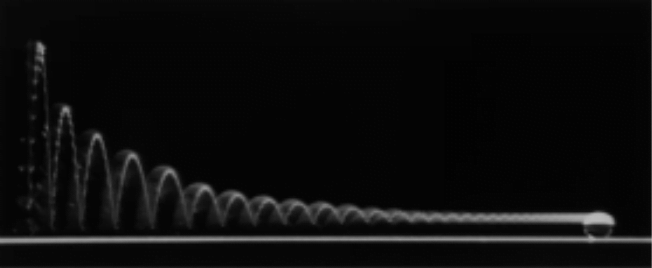
A water droplet can rebound completely without spreading from a superhydrophobic surface. The photo above is a long exposure image showing the trajectory of such a droplet as it bounces. In the initial bounces, the droplet leaves the surface fully, following a parabolic path with each rebound. The droplet’s kinetic energy is sapped with each rebound by surface deformation and vibration, making each bounce smaller than the last. Viscosity damps the drop’s vibrations, and the droplet eventually comes to rest after twenty or so rebounds. (Image credit: D. Richard and D. Quere)
“Becoming Harmonious”
Much as I try to keep from getting repetitious, this was just too neat to pass up. This new music video for The Glitch Mob’s “Becoming Harmonious” is built around the standing Faraday waves that form on a water-filled subwoofer. The vibration patterns, along with judicious use of strobe lighting, produce some fantastic and kaleidoscopic effects. (Video credit: The Glitch Mob/Susi Sie; submitted by @krekr)
What Sound Looks Like
NPR’s Skunk Bear Tumblr has a great new video on the schlieren visualization technique. The schlieren optical set-up is relatively simple but very powerful, as shown in the video. The technique is sensitive to variations in the refractive index of air; this bends light passing through the test area so that changes in fluid density appear as light and dark regions in the final image. Since air’s density changes with temperature and with compressibility, the technique gets used extensively to visualize buoyancy-driven flows and supersonic flows. Since sound waves are compression waves which change the air’s density as they travel, schlieren can capture them, too. (Video credit: A. Cole/NPR’s Skunk Bear)
“High Ball Stepper”
The recently released music video for Jack White’s “High Ball Stepper” is a fantastic marriage of science and art. The audio is paired with visuals based around vibration effects using both granular materials and fluids. There are many examples of Faraday waves, the rippling patterns formed when a fluid interface becomes unstable under vibration. There are also cymatic patterns and even finger-like protrusions formed by when shear-thickening non-Newtonian fluids get agitated. (Video credit: J. White, B. Swank and J. Cathcart; submitted by Mike and Marius)

Kelvin Wakes
Ducks, boats, and other objects moving along water create a distinctive V-shaped pattern known as a Kelvin wake. As the boat moves, it creates disturbance waves of many different wavelengths. The constructive interference of the slower waves compresses them into the shock wave that forms either arm of the V. Sometimes evenly spaced wavelets occur along the arms as well. Between the arms are curved waves that result from other excited wave components. The pattern was first derived by Lord Kelvin as universally true at all speeds – at least for an ideal fluid – but practically speaking, water depth and propeller effects can make a difference. Recently, some physicists have even suggested that above a certain point, an object’s speed can affect the wake shape, but this remains contentious. (Image credit: K. Leidorf; via Colossal; submitted by Peter)
