Search results for: “waves”

  • Featured Video Play Icon

    “Cymatics”

    Nigel Stanford’s new “Cymatics” music video is full of stunning science-inspired visuals. The entire video is set up around various science demos–many of which will be familiar to readers–that translate sound or vibration into visual elements. The video uses ferrofluids, vibrates vodka on a speaker to create Faraday waves, and visualizes resonant sound waves with a Rubens’ tube. I don’t want to give away all the awesome effects, so watch it for yourself, and then check out their behind-the-scenes page where they talk about how they created each effect. (Video credit: N. Stanford; submitted by buckitdrop)

    Also, today is the final day of voting for the Vizzies, an NSF-sponsored contest for the best science and engineering visuals. Head over to their website to check out the finalists and choose your favorites!

  • Featured Video Play Icon

    The Hidden Complexities of the Simple Match

    Striking a match and blowing it out seems rather simple to the naked eye. But with high-speed video and schlieren photography, the act takes on new complexity. Schlieren photography is an optical technique that is incredibly sensitive to changes in density, which makes it a prime choice for visualizing flows with temperatures variations or shock waves. Here it shows the hot gases generated as the match is lit. Once the match ignites, the flow calms somewhat into a gently rising plume of exhaust and hot air. When someone enters the frame to blow out the match, the frame rate increases to capture what happens next. The flow field around the match becomes very complex as the air and flame interact. The range of length scales in the flow increases, from scales of several centimeters down to those less than a millimeter. This complexity and range of sizes  is a hallmark of turbulence. (Video credit: V. Miller et al.)

  • Kelvin-Helmholtz Clouds

    Kelvin-Helmholtz Clouds

    When differing layers of fluid move past one another, friction between them causes shear. This shear quickly transforms a simple flat interface between fluid layers into a wavy unstable boundary that resembles a series of breaking ocean waves. This effect is known as the Kelvin-Helmholtz (KH) instability. In the atmosphere, this instability causes air layers with differing temperatures and moisture content to form wave-like clouds where the two layers meet. Other examples of the effect are widespread. On earth, many ocean waves are generated by wind shearing the water; elsewhere in our solar system, the cloud bands of Jupiter are lined with spinning eddies from the KH instability. (Photo credit: H. Bondo)

  • “Courants et Couleurs”

    Although flow visualization is a scientific technique, there is very much an art to it. Flow structures are, by their nature, ephemeral. To capture them, one must design an experiment that introduces dye into regions of interest without altering the flow significantly and without either ignoring or obscuring important physics. One of the great masters of this scientific art was Henri Werlé, whose extensive flow visualization work at France’s national aerospace lab is documented in the short film above. The film includes examples of simple geometries, full aircraft models, subsonic flow, shock waves, and more. eFluids has a whole gallery of Werlé images, too. Take a few minutes to enjoy the mesmerizing beauty of these experiments and appreciate the talents of those who made them possible. If you have questions about specific clips, feel free to ask! (Video credit: H. Werlé/ONERA; via J. Hertzberg)

  • Featured Video Play Icon

    Inside the Strait of Gibraltar

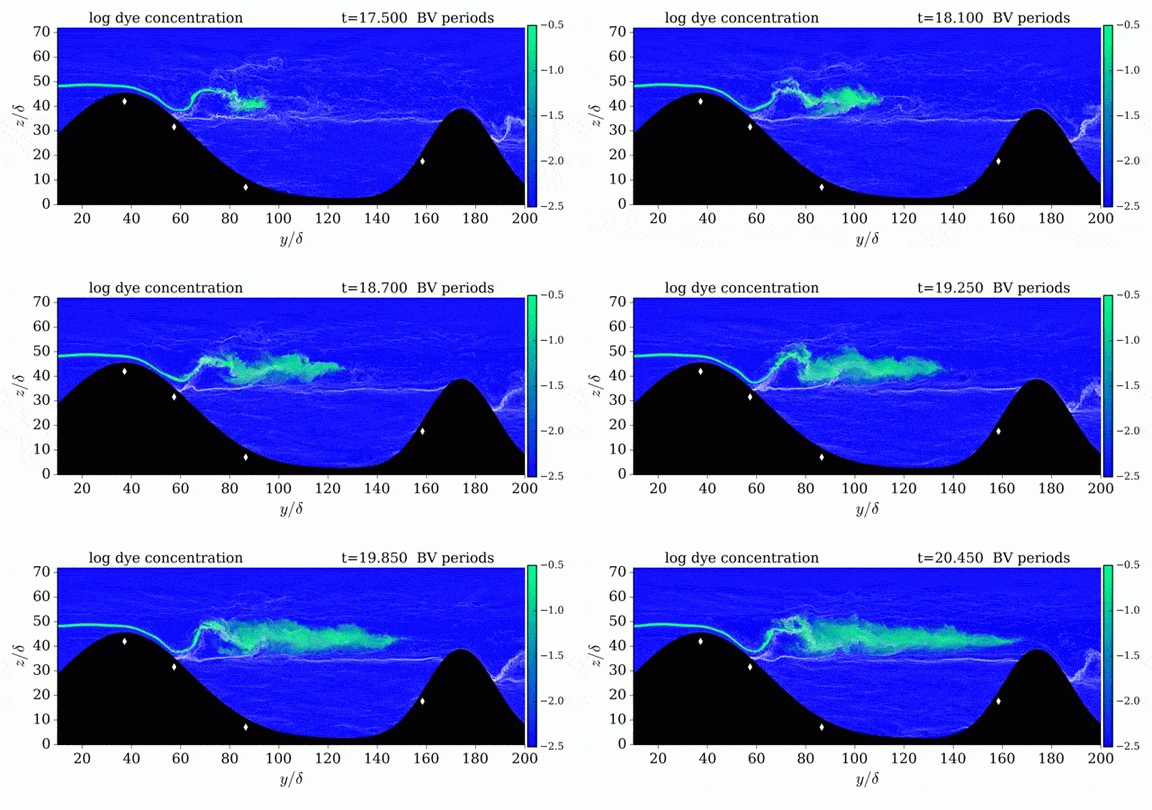
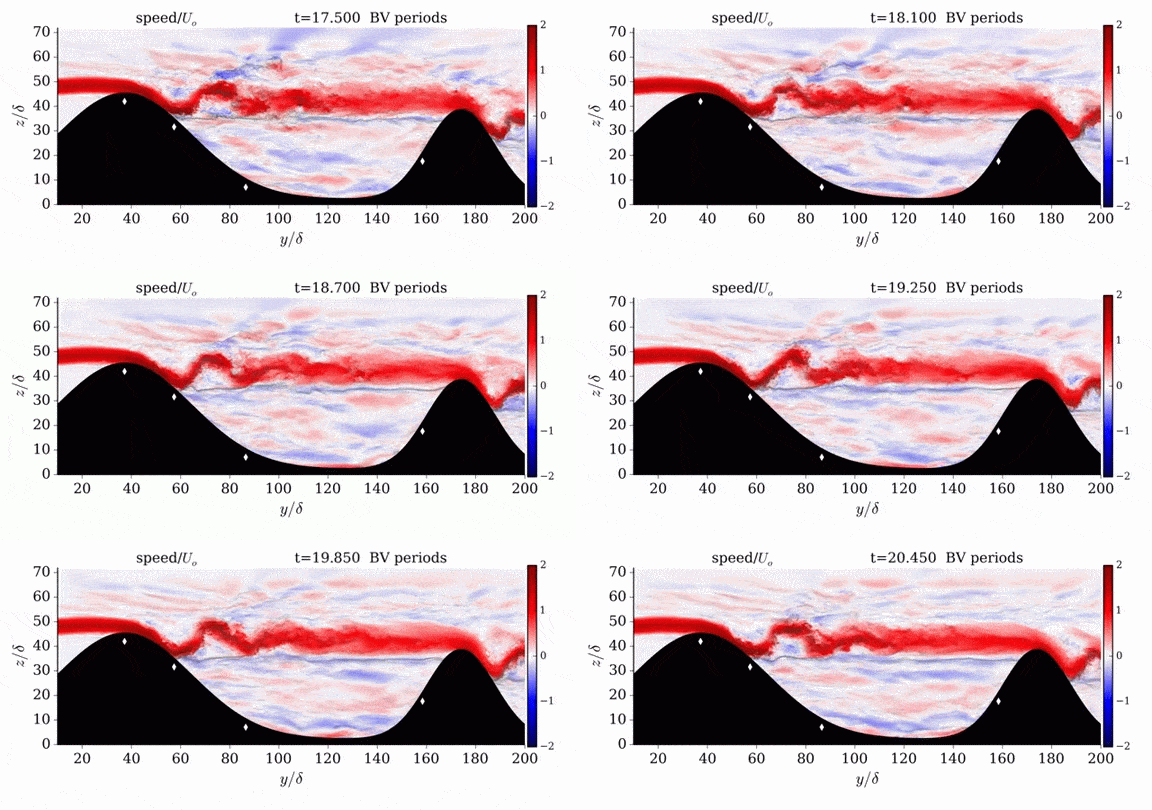
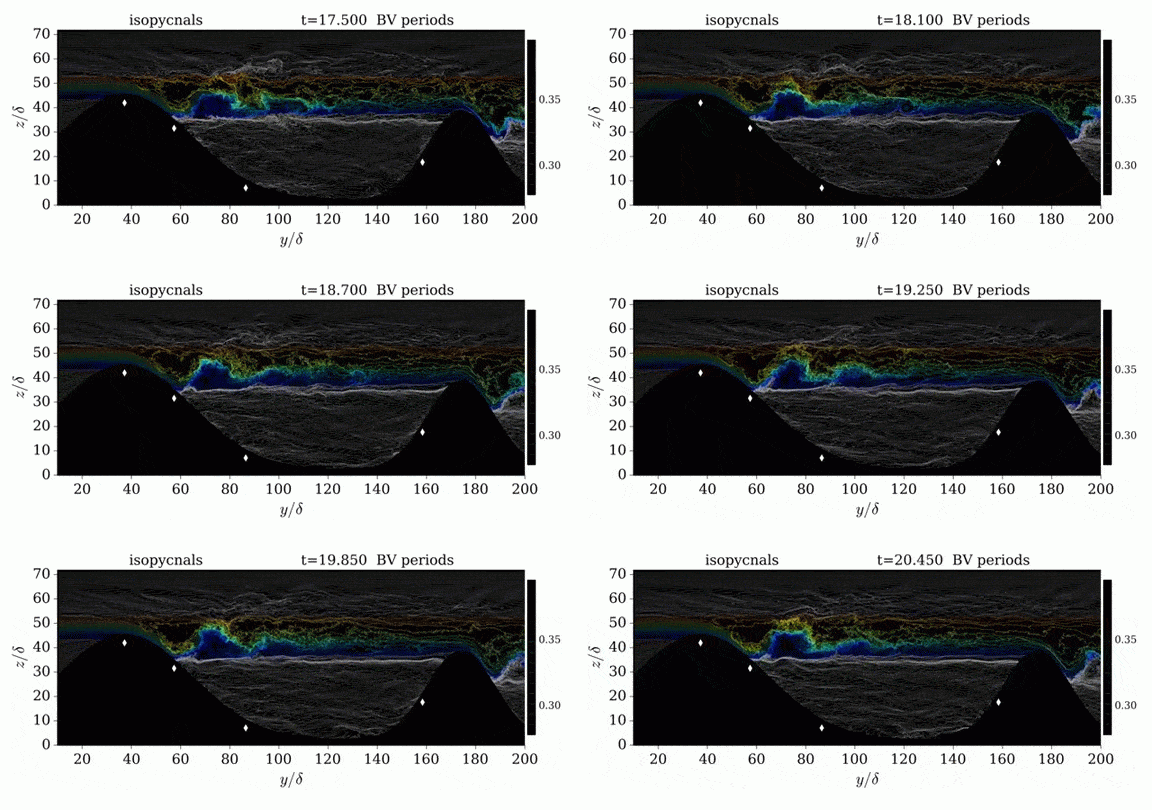
    When a fluid is stratified into layers, it’s possible to have waves generated and transmitted along the interface between layers. Because these waves remain inside the bulk fluid, they are called internal waves. They often occur in the atmosphere or the ocean as fluids with different properties move past changing terrain. The Strait of Gibraltar is an excellent source of internal waves. The tidal exchange of waters between the Mediterranean Sea and Atlantic Ocean takes place through a narrow corridor interrupted by the peak of Camarinal Sill. The internal waves generated by the constriction are large enough that their effect on the surface flow is visible to satellites. The video above visualizations data from a numerical simulation of flow through the Strait, showing the obstacles, flow, and wave structures generated. (Video credit: J.C. Sanchez Garrido et al.)

  • Featured Video Play Icon

    “Cymatic Sun”

    “Cymatic Sun” from artist Lachlan Turczan uses vibrating fluids to generate mesmerizing and surreal visuals. At some points distinct Faraday waves are visible on the surface. At other times, there is simply a blur of motion and refracted light. Check out my “fluids as art” tag for many more great examples of fluid dynamics and art merging. (Video credit and submission: L. Turczan)

  • Transonic Flow

    Transonic Flow

    In the transonic speed regime the overall speed of an airplane is less than Mach 1 but some parts of the flow around the aircraft break the speed of sound. The photo above shows a schlieren photograph of flow over an airfoil at transonic speeds. The nearly vertical lines are shock waves on the upper and lower surfaces of the airfoil. Although the freestream speed in the tunnel is less than Mach 1 upstream of the airfoil, air accelerates over the curved surface of airfoil and locally exceeds the speed of sound. When that supersonic flow cannot be sustained, a shock wave occurs; flow to the right of the shock wave is once again subsonic. It’s also worth noting the bright white turbulent flow along the upper surface of the airfoil after the shock. This is the boundary layer, which can often separate from the wing in transonic flows, causing a marked increase in drag and decrease in lift. Most commercial airliners operate at transonic Mach numbers and their geometry is specifically designed to mitigate some of the challenges of this speed regime.  (Image credit: NASA; via D. Baals and W. Corliss)

  • Breaking Drops with Vibration

    Breaking Drops with Vibration

    Atomization is the process of breaking a liquid into a spray of fine droplets. There are many methods to accomplish this, including jet impingement, pressure-driven nozzles, and ultrasonic excitement. In the images above, a drop has been atomized through vibration of the surface on which it rests. Check out the full video. As the amplitude of the surface’s vibration increases, the droplet shifts from rippling capillary waves to ejecting tiny droplets. With the right vibrational forcing, the entire droplet bursts into a fine spray, as seen in the photo above. The process is extremely quick, taking less than 0.4 seconds to atomize a 0.1 ml drop of water. (Photo and video credit: B. Vukasinovic et al.; source video)

  • Featured Video Play Icon

    Water-Based Tractor Beam

    Researchers in Australia have demonstrated a “tractor beam” capable of manipulating floating objects from a distance using surface waves on water. And, unlike some research, you can try to replicate this result right in the comfort of your own bathtub! When a wave generator oscillates up and down, it creates surface waves that move objects and particles on the water’s surface. When the wave amplitudes are small, the outgoing wave fronts tend to be planar, as in part (a) of the figure above. These planar waves push surface flow away from the wave generator in a central outward jet, and new fluid is entrained from the sides to replace it. This creates the kind of flowfield shown in the streaklines of part (b).

    Increasing the amplitude of the surface waves drastically changes the surface flow’s behavior. Larger wave amplitudes are more susceptible to instabilities due to the nonlinear nature of the surface waves. This means that the planar wave fronts seen in part (a) break down into a three-dimensional wavefield, like the one shown in part (c). Near the wave-maker, the surface waves now behave chaotically. This pulsating motion ejects surface flow parallel to the wave-maker, which in turn draws fluid and any floating object toward the wave-maker. The corresponding surface flowfield is shown in part (d). The researchers are refining the process, but they hope the physics will one day be useful in applications oil spill clean-up. (Video credit: Australia National University; image and research credit: H. Punzmann et al. 1, 2; via phys.org; submitted by Tracy M)

  • Featured Video Play Icon

    4th Birthday: Mantis Shrimp

    Undoubtedly one of the most mind-boggling instances of fluid dynamics I’ve learned about in writing FYFD is that of sonoluminescence – an effect in which light is produced from imploding cavitation bubbles. In a laboratory, the effect is usually initiated with acoustic waves. A bubble can be forced to oscillate and collapse periodically when forced by the sound. During the collapse, the vapor inside the bubble reaches temperatures of the order of thousands of Kelvin, and light is produced. What is far more wild, though, is that the effect occurs in nature as well. Both the pistol shrimp and the mantis shrimp produce the effect. As shown in the video above, the mantis shrimp swings its club-like arm with such speed that the local pressure drops below the vapor pressure, causing a cavitation bubble to form and sonoluminescence to occur. Some real Mortal Kombat finishing move s&#% there, indeed.  (Video credit: Z. Frank)