Search results for: “water droplet”

  • Granular Instabilities

    Granular Instabilities

    Granular mixtures show surprising similarities to fluids, even though their underlying physics differ. The latest example of this is a Rayleigh-Taylor-like instability that occurs when heavy particles sit atop lighter ones. By combining vertical vibration and an upward gas flow, researchers found that the lighter particles form fingers and bubbles that seep up between the heavier grains (upper left). Visually, it looks remarkably similar to a lava lamp or other Rayleigh-Taylor-driven instability (upper right).

    But the physics behind the two are distinctly different. In the fluid, buoyancy drives the instability while surface tension acts as a stabilizing force. There’s no surface tension in a granular material, though. Instead, the drag force from gas flowing upward provides the vertical impetus while friction between the grains – essentially an effective viscosity – replaces surface tension as a stabilizing influence.

    The similarities don’t stop there, though. When the researchers tested a “bubble” of heavy grains suspended in lighter ones (lower left), they found that, instead of sinking, the granular bubble split in two and drifted downward on a diagonal. Eventually, those daughter bubbles also split. Again, visually, this looks a lot like what happens to a drop of ink or food coloring falling through water (lower right), but the physics aren’t the same at all. 

    In the fluid, the breakup happens when a falling vortex ring splits. In the granular example, gas moving upward tends to channel around the heavy grains because they’re harder to move through. Eventually, this builds up a solidified region under the bubble. When the heavy grains can’t move directly down, they split and sink through the surrounding suspended particles until they build up another jammed area and have to split again. (Image credits: granular RTI – C. McLaren et al.; RTI simulation – M. Stock; bag instability – D. Zillis; research credit: C. McLaren et al.; submitted by Kam-Yung Soh)

  • The Bouncing Drop

    The Bouncing Drop

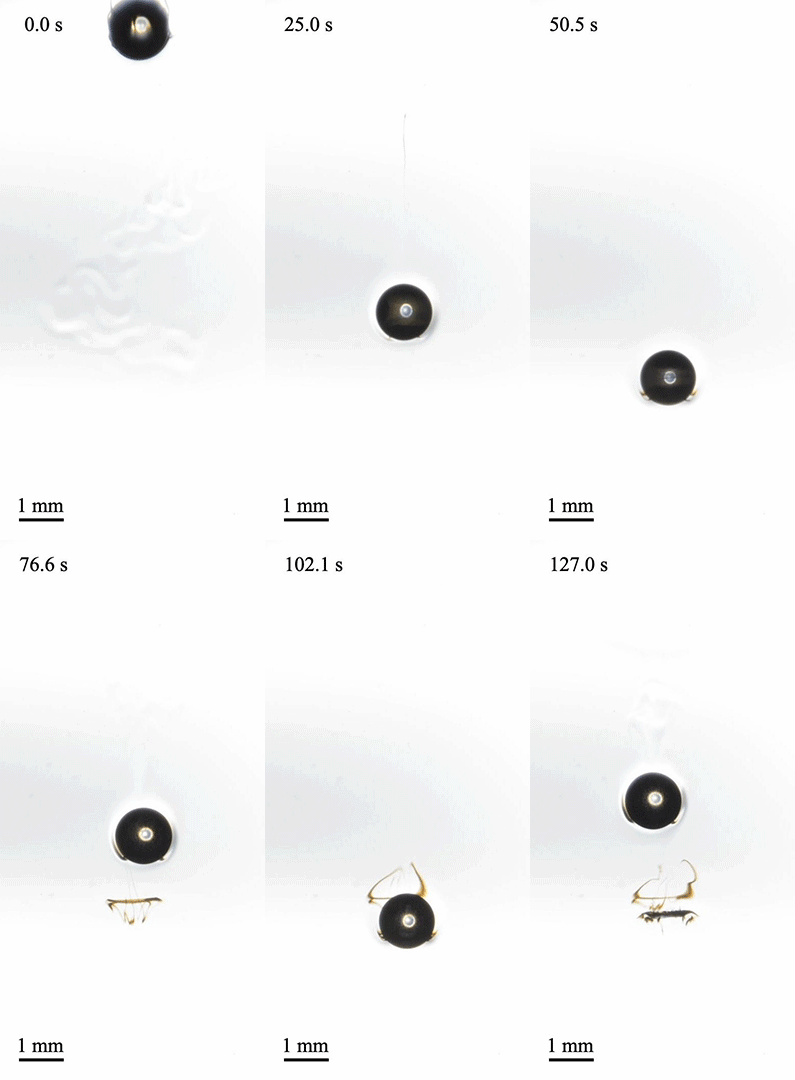
    For a droplet to bounce, we expect it to hit a wall or a sharp interface of some kind. But in a new study, researchers demonstrate a droplet that bounces with neither. Shown above is an oil droplet sinking through a stratified mixture of ethanol (toward the top) and water (toward the bottom). Because the oil is heavier than ethanol, it initially sinks, dragging some of the ethanol with it as it falls. Over time, some of that ethanol rises again, forming what’s known as a buoyant jet.

    Simultaneously, the gradient of ethanol to water between the top and bottom of the drop creates an imbalance in surface tension. The ethanol near the top of the drop has a lower surface tension than the water at the bottom. This creates a downward Marangoni flow along the drop interface.

    The bounce itself happens quickly after a long, slow sinking period. As the drop’s sinking slows, the buoyant jet weakens until it disappears completely. At the same time, the downward Marangoni flow pulls fresh ethanol-rich fluid toward the top of the drop. That increases the surface tension difference and strengthens the Marangoni flow, creating a positive feedback loop. In less than a second, the Marangoni flow increases by two orders of magnitude, pulling so hard that the drop shoots upward.

    That resets the cycle by weakening the Marangoni flow and strengthening the buoyant jet. The droplet can continue bouncing for about 30 minutes until the concentration gradient is so well-mixed that the cycle can’t continue. (Image and research credit: Y. Li et al.; via APS Physics; submitted by Kam-Yung Soh)

  • Freezing Stains

    Freezing Stains

    When they evaporate, drops of liquids like coffee and red wine leave behind stains with a darker ring along the edges, thanks to capillary action and surface tension pulling particles to that outer edge. In contrast, sublimating a frozen droplet leaves a stain pattern that concentrates at the center (top). When droplets freeze from the surface upward, particles within the droplet are driven toward the center as the freeze front pushes toward the drop apex. The final shape of the stain depends on the initial geometry of the droplet, and the concentration of particles toward the center occurs because of the way that the particle freezes, not how it sublimates (bottom). 

    Since many industrial processes rely on droplet evaporation to spread coatings, this work offers a new way to control the final outcome. (Image and research credit: E. Jambon-Puillet, source)

  • Featured Video Play Icon

    Freezing Drop Impact

    At the altitudes where aircraft fly, it’s often cold enough for water drops to freeze in seconds or less. Once attached to a wing, such frozen drops disrupt the flow, reducing lift and increasing drag. To help understand how such droplets freeze, scientists study droplet impact on cold surfaces. Starting at room temperature (counter-clockwise from upper left), a drop will spread on the surface, then retract. When the temperature is colder, parts of the droplet freeze before retraction completes, leaving a thin sheet with a thicker center. At even colder temperatures, the droplet’s rim destabilizes and freezing occurs before the droplet has time to retract fully. And at the coldest temperatures, the droplet breaks apart into a frozen splash. (Image and video credits: V. Thievenaz et al.)

  • Putting a Spin on Splashes

    Putting a Spin on Splashes

    Researchers put a spin on splashing droplets with selective wetting. When a drop impacts on a water-repellent, superhydrophobic surface, it will spread circularly, then pull back together and rebound off the surface. That’s because the surface coating resists actually touching – or being wetted by – the water. But just as there are surface coatings that resist water, there are those that attract it.

    Above, researchers have coated a surface so that it’s mostly superhydrophobic, but it also has narrow pinwheel-like arms that are hydrophilic. As the drop impacts, it spreads across the surface and then retracts. But where the hydrophilic arms are, the drop lingers. This creates the four lobes we see on the droplet, and the asymmetric retraction gives the drop angular momentum. As it leaves the surface, the spin continues. In some configurations, the researchers could make the drop spin at more than 7300 rpm. (Image and research credit: H. Li et al; via Science; submitted by Kam-Yung Soh)

  • Featured Video Play Icon

    Massive Worthington Jet

    The FloWave facility in Scotland is one of the coolest ocean simulators out there. Equipped with 168 individual wave makers and 28 submerged flow-drive units, it’s capable of recreating almost any ocean conditions imaginable. So naturally the Slow Mo Guys used it to create a giant spike wave.

    Essentially, this is an oversized Worthington jet, the same as the ones you see after a droplet hits the surface. But with several thousand tonnes of crystalline clear water, the effect of that wave focusing is pretty spectacular. When you’re watching the high-speed footage, be sure to pay attention to the details, like the glassy surface of the collapsing jet, or the way holes open and expand as the splash curtain comes down around Dan’s head (above). Longtime readers will recognize many familiar features. (Image and video credit: The Slow Mo Guys)

  • Exploding a Drop

    Exploding a Drop

    Leidenfrost drops levitate over a hot substrate on a thin layer of their own vapor, constantly replenished as the drop evaporates. For the most part, previous studies have focused on pure droplets, but a new one looks at what happens when you add surfactants – and the results are, well, explosive.

    Surfactants are a type of chemical that like to gather at the surface of a drop, and, unlike water, they’re nonvolatile – they don’t evaporate easily. So as the Leidenfrost drop evaporates and shrinks, the surface of the drop becomes more and more crowded with surfactant molecules. Eventually, they form an elastic shell around the remaining water, making evaporation more difficult.

    Inside the droplet, the temperature continues to rise, eventually reaching a point where bubbles of vapor can nucleate inside. When that happens, the bubbles expand almost instantaneously and the internal pressure spike bursts the shell, causing the entire droplet to explode. (Image and research credit: F. Moreau et al.)

  • Avoiding Ice

    Avoiding Ice

    Keeping ice from forming on a surface is a major engineering challenge. Typically, there’s no controlling certain factors – like the size and impact speed of droplets – so engineers try to tame ice by changing the surface. This can be through chemicals – as with deicing fluids used on aircraft – or by tuning the surface itself.

    One way to do this is by making the surface superhydrophobic – or extremely water repellent. These surfaces are rough on a nanoscale level, but they’re delicate, and once ice gets a grip on them, it’s even harder to remove. In a recent study, however, researchers used particles with both hydrophobic and hydrophilic – water-attracting – properties to create a superior ice-resistant surface. The combination of hydrophobic and hydrophilic aspects to the particles made supercooled droplets break up on contact with the surface. This made the drops smaller and decreased their contact time, making it harder for them to stick and freeze. (Image credit: Pixabay; research credit: M. Schwarzer et al.; via Chembites; submitted by Kam-Yung Soh)
  • Featured Video Play Icon

    Sonic Tractor Beam

    Acoustic levitation uses the radiation forces generated by sound waves to trap small, lightweight particles at the nodes of standing waves. We’ve seen this a number of times previously, both with solid objects and liquid droplets. What makes this example particularly impressive, though, is that these researchers use an array of speakers to manipulate multiple objects at once. Check out the video above for a whole series of clips from the research. (Video credit: Science; research credit: A. Marzo and B. Drinkwater)

  • Waves

    Waves

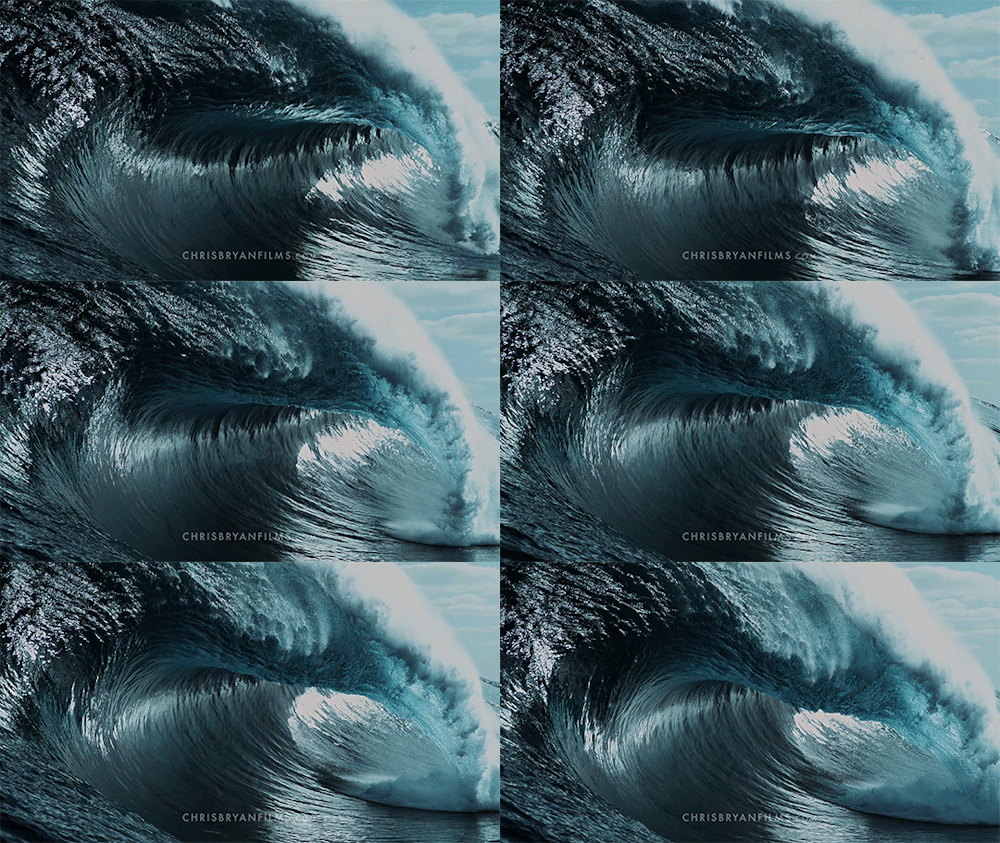
    Photographer Ray Collins is known for his striking portraits of waves, some of which I’ve featured on previous occasions. Collins is colorblind, so he focuses heavily on shape and texture in the wave, which produces some stunningly dramatic views of moving water frozen in time. There’s great power and beauty in breaking waves, and researchers are still actively learning just how significant they are to our planet’s cycles. 

    Note the spray blurring the edges of every wave here; these are some of the largest droplets the wave will make. As it crashes forward, the wave traps pockets of air, and, as those bubbles burst, they will create a spray of tinier droplets that carry moisture and salt into the atmosphere to seed clouds and, eventually, rain.

    Collins’ work reminds us both of the ocean’s power and its fragility as it undergoes rapid changes due to humanity’s influence. For more photos as well as a great interview with Collins, check out My Modern Met. (Image credit: R. Collins; via My Modern Met and James H.)