Search results for: “water droplet”

  • Measuring Contaminants in Drops and Bubbles

    Measuring Contaminants in Drops and Bubbles

    Rising bubbles and droplets are common in many chemical and industrial applications. But just a tiny concentration of contaminants on their surface can completely alter their behavior, disrupting coalescence and slowing down chemical reactions.

    Historically, it’s been hard to measure the level of contamination in these some drops and bubbles, but a new study outlines a way to measure these small concentrations by perturbing the drops and watching how they deform. By analyzing how the drop shimmies and shakes, they’re able to measure its surface tension and, ultimately, the concentration of contaminants. (Image credit: S. Sørensen; research credit: B. Lalanne et al.; via APS Physics)

  • Marangoni Bursting

    Marangoni Bursting

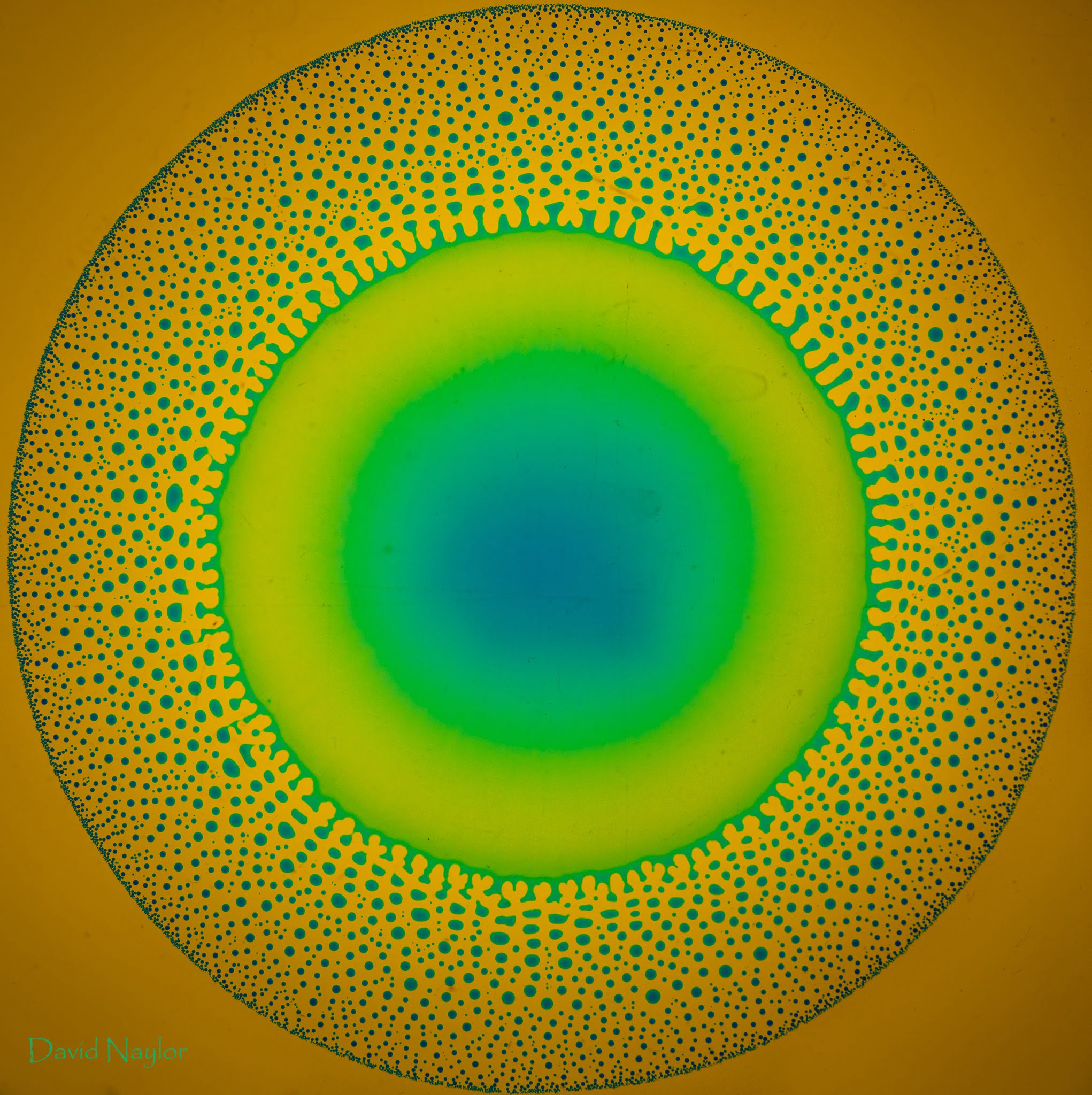
    Placing a mixture of alcohol and water atop a pool of oil creates a stunning effect that pulls droplets apart. The action is driven by the Marangoni effect, where variations in surface tension (caused in this case by the relative evaporation rates of alcohol and water) create flow. David Naylor captures some great stills of the flow, including the only example of a double burst I’ve seen so far. For more on the science behind the effect, check out this previous post or the original research paper. (Image credit: D. Naylor; see also this previous post)

  • Capsule Impact and Bursting

    Capsule Impact and Bursting

    Nature and industry are full of elastic membranes filled with a fluid, from red blood cells to water balloons. A new study looks at how these capsules deform — and sometimes burst — on impact. The researchers created custom elastic shells that they filled with various fluids like water, glycerol, and honey, then used the impacts to build a model of capsule deformation.

    They found that there’s significant overlap between droplet impacts and capsule impacts, with a few key differences; instead of surface tension, capsules resist deformation through their elastic shell’s surface modulus — a combination of its elasticity and thickness. Capsules, unlike droplets, can also burst. To study this, the researchers used water balloons, which they were able to pre-stretch more easily than their custom shells. They found that their model could accurately predict the conditions under which the balloons burst.

    The authors hope the model will be helpful both in designing capsules intended to burst — like a fire-fighting projectile — and in creating safety measures to prevent capsule burst — like car-crash standards that protect from organ damage. (Image and research credit: E. Jambon-Puillet et al.; via Physics World; submitted by Kam-Yung Soh)

  • Bouncing Off Hydrophilic Surfaces

    Bouncing Off Hydrophilic Surfaces

    Droplets typically bounce off hydrophobic surfaces due to air trapped beneath the liquid that prevents contact between the drop and surface. But even extremely smooth, hydrophilic surfaces can elicit a bounce under the right circumstances, as shown in a new study.

    The key is that the droplet must bounce at exactly the right speed. If the bounce has too much momentum, it will squeeze the nanometer-sized air cushion too thin, allowing contact. Too slow and the Van der Waals attraction between the droplet molecules and wall molecules will have time to act. But between those lies a sweet spot where the dimple and cushion of air beneath the drop keep it from impacting. (Image credit: droplets – klickblick, drop bounce – J. Kolinski, bounce sim – J. Sprittles et al.; research credit: M. Chubynsky et al.; submitted by James S.)

  • Pearls On a Puddle

    Pearls On a Puddle

    Leave a drop of coffee sitting on a surface and it will leave behind a ring of particulates once the water evaporates. But what happens to a droplet made up of multiple liquids that evaporate differently? That’s the subject of this new study. Researchers mixed a volatile drop (isopropyl alcohol) with a smaller amount of a non-volatile liquid and observed how this changed the droplet’s splash rim and evaporation pattern.

    When the surface tension difference between the two liquids was large, the researchers found that the splash formed fingers along its rim (Image 1). The fingers consist almost entirely of the non-volatile component, driven to the outskirts of the drop by Marangoni forces. The dark and light bands you see in the image are interference fringes, which the researchers used to track the film’s thickness.

    When the researchers used liquids with similar surface tensions, the droplet rim instead formed pearl-like satellite droplets. Once the volatile liquid evaporated away, the remaining liquid merged into a thick film. (Image and research credit: A. Mouat et al.; via APS Physics; submitted by Kam-Yung Soh)

  • Featured Video Play Icon

    Waltzing Defects

    Liquid crystals are a peculiar state of matter with both liquid and crystalline properties. In this video, a microfluidic device breaks water into droplets surrounded by a shell of liquid crystal. Because the molecular structure of the liquid crystals is helical and cannot pack neatly in a spherical shell, there are visible defects in the liquid crystal shells. Given time, those defects can merge as the liquid crystal shell thickens. (Image and video credit: The Lutetium Project)

  • Featured Video Play Icon

    Blooming Deposits

    Evaporate a droplet full of silica nanoparticles, and you’ll get beautiful, flower-like films. As the water evaporates, dry nanoparticles build up in a solid deposit. The evaporation creates a pressure gradient that pulls toward the center of the drop, forcing the deposit to bend. As stress builds in the deposit, cracks form petal-like segments. The number of cracks is indicative of how much of the drop was solid material; the higher the volume fraction of particles is, the fewer cracks form and the less the deposit bends. (Image, video, and research credit: P. Lilin et al.)

  • Falling Drops and Forming Stalagmites

    Falling Drops and Forming Stalagmites

    The vast stalactites and stalagmites found in caves take millennia to form. Mineral-rich water seeps down the icicle-like stalactites and then drips onto stalagmites below, each drop depositing a little more calcite onto the growing rock. By observing this dripping action first-hand, researchers found that most falling drops create a splash that’s much smaller than the width of the stalagmite they fall onto. So how do stalagmites end up so wide?

    It turns out that there’s a large variance in where drops hit the stalagmite. There’s no wind in these caves to push the droplets, so researchers concluded the drop’s trajectory depends on the vortices it sheds as it falls. A drop that falls from a short height will have a vertical trajectory. But once the drop is falling tens of meters, it can end up as many as several centimeters to the side of where it would fall in a vacuum. This scatter-shot variation in drop impacts is what enables stalagmites to grow so wide. (Image and research credit: J. Parmentier et al., source; via NYTimes; submitted by Kam-Yung Soh)

  • Whiskey Stains

    Whiskey Stains

    Complex fluids leave behind fascinating stains after they evaporate. We’ve seen previously how coffee forms rings and whisky forms more complicated stains as surface tension changes during evaporation drive particles throughout the droplet. Now researchers are considering the differences between traditional Scottish whisky, which ages in re-used, uncharred barrels, and American whiskeys like bourbon, which are required to age in new, charred white oak barrels.

    When diluted, the American whiskeys form web-like patterns – seen above – that vary from brand to brand, like a fingerprint. The charring of the barrels allows American whiskeys to pick up more water-insoluble molecules compared to whisky aged in uncharred barrels. Since the webbed patterns form in American whiskey but not Scotch whisky, it’s likely those molecules play an important role in the evaporation dynamics and subsequent staining. (Image credit: S. Williams et al.; research credit: S. Williams et al.; via APS Physics; submitted by Kam-Yung Soh)

  • Featured Video Play Icon

    “Mocean”

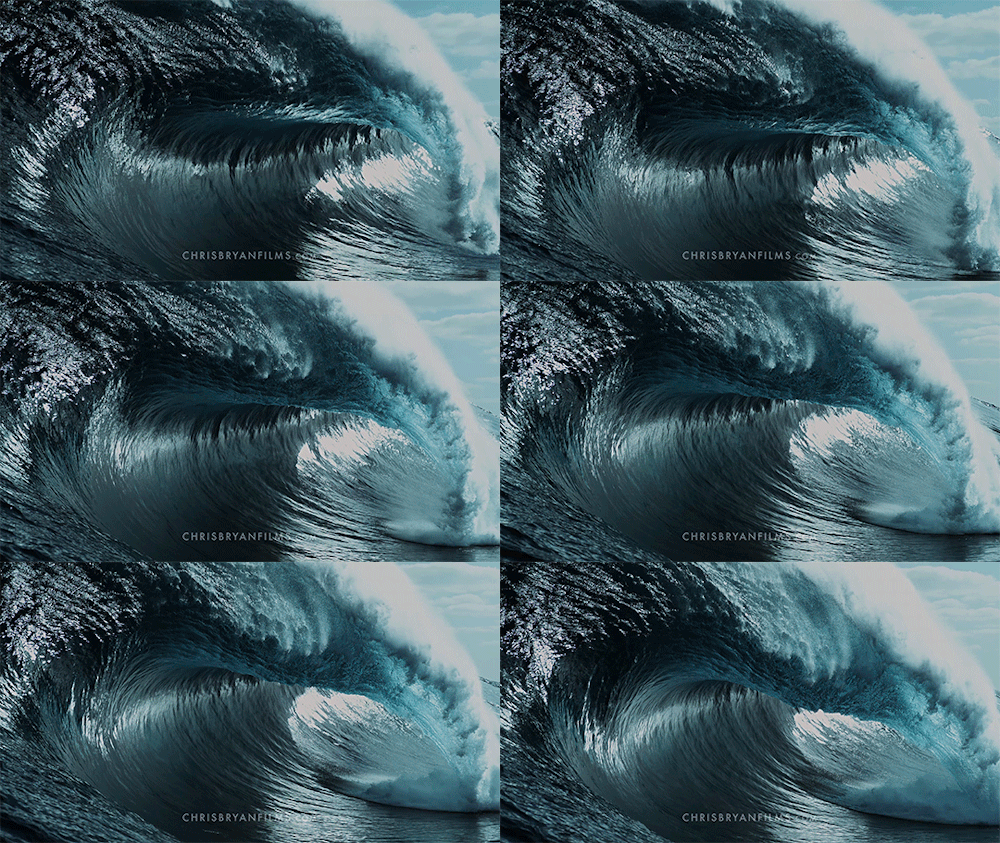
    Ocean waves are endlessly fascinating to watch. In “Mocean,” cinematographer Chris Bryan captures them in ways few ever see, thanks to his high-speed camera. Honestly, this film is so gorgeous that I don’t want to distract you with the science, so just go watch!

    All done? Pretty wonderful, right? There’s nothing quite like seeing those holes break and expand through sheets of water, tearing what looked solid into a spray of droplets that bleed salt into the atmosphere. Or how about those rib vortices underneath the waves? Or the cloud-like turbulence of the waves breaking overhead? How fortunate we are to see and capture and share such beauty! (Video and image credit: C. Bryan; via RedShark; submitted by Michael F.)